
Key Takeaways
-
Provide exact specifications for all materials and equipment including brand names, model numbers, manufacturer locations, and reagent concentrations to enable other researchers to replicate your study precisely.
-
Follow your target journal's specific guidelines for section headings, word limits, and reporting standards (CONSORT, PRISMA, STROBE) before writing to avoid desk rejection.
-
Justify your methodological choices by explaining why you selected specific designs, statistical tests, and approaches with supporting citations to demonstrate scientific rigor.
-
Organize your methods section with clear subheadings such as Study Design, Participants, Data Collection, Materials, and Data Analysis to improve readability and help reviewers locate information quickly.
-
Write entirely in past tense with consistent voice choice, and include complete participant descriptions with recruitment details, inclusion/exclusion criteria, and ethical approval information to prevent peer review rejection.
-
Avoid common pitfalls such as including results in the methods section, using undefined jargon, omitting ethical approvals, and describing irrelevant procedures that distract from your research questions.
The methods section is one of the most important parts of any research paper. It tells readers exactly how you conducted your study. Without a clear, detailed methods section, other researchers cannot replicate your work. Journal reviewers may also reject your manuscript if this section is vague or incomplete.
Learning how to write the methods section of a research paper can feel overwhelming, especially for early-career researchers or non-native English speakers. The good news is that this section follows a predictable structure. Once you understand the key components, writing it becomes much easier.
This guide provides 11 practical, expert-backed tips. Whether you are preparing your first journal submission or refining a manuscript for resubmission, these tips will help you build a methods section that earns reviewer confidence. You can also explore the knowledge center at San Francisco Edit for additional writing and editing guidance.

Why the Methods Section Matters So Much
The methods section serves a critical purpose. It allows other scientists to reproduce your study. Reproducibility is the foundation of scientific credibility. If a reader cannot follow your methodology step by step, your findings lose authority.
Journals also use this section to evaluate the scientific rigor of your work. Weak or ambiguous methods can lead to outright rejection, even if your results are compelling. A well-written methods section strengthens your entire manuscript. If you need expert support, consider professional scientific editing to ensure your methods meet journal standards.

11 Expert Tips for Writing Your Methods Section
1. Follow the Journal’s Specific Guidelines First
Before writing a single sentence, read the target journal’s author guidelines carefully. Different journals use different section headings. Some use “Methods,” others use “Materials and Methods,” and some have specific subheadings like “Participants,” “Procedures,” and “Data Analysis.”
Journals also have word limits. Exceeding these limits can result in desk rejection. Many journals in clinical research also require you to follow reporting standards such as CONSORT for randomized controlled trials or PRISMA for systematic reviews. Referencing published guidelines from PubMed-indexed journals can also help you identify what reviewers expect.
2. Write in the Past Tense
The methods section describes what you already did. This means you should write in the past tense throughout. For example, write “Participants were recruited from three hospitals” rather than “Participants are recruited from three hospitals.”
Tense consistency matters to journal reviewers and manuscript editors alike. Mixing tenses creates confusion and signals a lack of attention to detail. If English is not your first language, this is an area where language editing services can make a significant difference.
3. Choose Active or Passive Voice Deliberately
Both active and passive voice are acceptable in the methods section. However, you should choose deliberately based on what your journal prefers. Some journals prefer passive voice because it keeps the focus on the process rather than the researcher. Others encourage active voice for clarity.
The key is consistency. Do not switch between active and passive voice within the same paragraph without purpose. Many editors recommend passive voice when describing procedures (“Samples were centrifuged”) and active voice when attributing specific decisions (“We selected this design because…”).
4. Organize with Clear Subheadings
A well-organized methods section uses subheadings to guide the reader. Common subheadings include:
- Study Design or Research Design
- Participants or Study Population
- Data Collection Procedures
- Materials or Instruments
- Data Analysis or Statistical Analysis
- Ethical Considerations
Subheadings improve readability and make it easier for reviewers to locate specific information. They also demonstrate that you have thought carefully about each component of your methodology.
5. Provide Exact Specifications for All Materials and Equipment
Vague descriptions make it impossible for others to replicate your study. Always provide exact details for every material and piece of equipment you used. This includes:
- Brand names and model numbers
- Manufacturer names and locations
- Reagent concentrations and sources
- Software versions and developers
- Measurement units and quantities
For example, instead of writing “a centrifuge was used,” write “samples were centrifuged at 3,000 rpm for 10 minutes using a Beckman Coulter Allegra X-30R centrifuge (Brea, CA, USA).” This level of detail is what separates publishable manuscripts from rejected ones.
6. Justify Your Methodological Choices
Do not just describe what you did. Explain why you made those choices. Reviewers want to know that your design decisions were deliberate and appropriate for your research questions.
For example, if you chose a qualitative approach, briefly explain why it was more suitable than a quantitative design. If you used a specific statistical test, cite a reference that supports that choice. Linking your methods to your research objectives shows scientific maturity and strengthens reviewer confidence.
7. Describe Participants in Detail
If your study involves human participants, describe them thoroughly. This is especially important in clinical and social science research. Include the following details:
- How participants were recruited
- Inclusion and exclusion criteria
- Sample size and how it was determined
- Relevant demographic characteristics
- Consent procedures
Missing participant details are a common reason for peer review rejection. Reviewers need to assess whether your sample is appropriate for your conclusions. Visit the San Francisco Edit FAQ page to learn how professional editors address these common gaps.
8. Include Ethical Approvals and Compliance Statements
Most journals require a statement of ethical approval for studies involving human or animal subjects. Include the name of the approving ethics board or institutional review board (IRB), the approval number, and the date of approval.
For clinical trials, you may also need to include trial registration details. Omitting this information can lead to immediate rejection. Check the guidelines from the WHO International Clinical Trials Registry Platform to ensure your study meets international registration requirements.
9. Avoid Common Writing Mistakes
The methods section has several pitfalls that even experienced researchers fall into. Here are the most common mistakes to avoid:
- Including results in the methods section — Save all findings for the results section.
- Using undefined jargon or abbreviations — Define every technical term the first time you use it.
- Describing irrelevant procedures — Only include steps that directly relate to your research questions.
- Omitting limitations of the method — Briefly acknowledge any known limitations where appropriate.
- Providing unjustified statistical choices — Always cite support for your analytical decisions.
Reviewing your draft with a critical eye for these issues will significantly improve your manuscript’s quality before submission.
10. Structure Chronologically or Thematically
There are two main ways to organize your methods section. You can present procedures in the order they occurred (chronological), or you can group related procedures together (thematic). The best choice depends on your study design.
For laboratory experiments, a chronological structure usually works best because the sequence of steps matters. For complex studies with multiple components, a thematic structure may be clearer. Either way, the reader should be able to follow your process without confusion. For scientific manuscript editing, experienced editors often help restructure this section to improve logical flow.
11. Move Excessive Detail to Supplementary Materials
Some journals allow supplementary materials or appendices. If your methodology involves highly complex protocols that would make the main text too long, consider moving detailed steps to a supplement. Include a clear reference in the main text so readers know where to find the additional information.
This approach keeps your methods section concise while maintaining full transparency. Always check the target journal’s policy on supplementary materials before using this strategy.
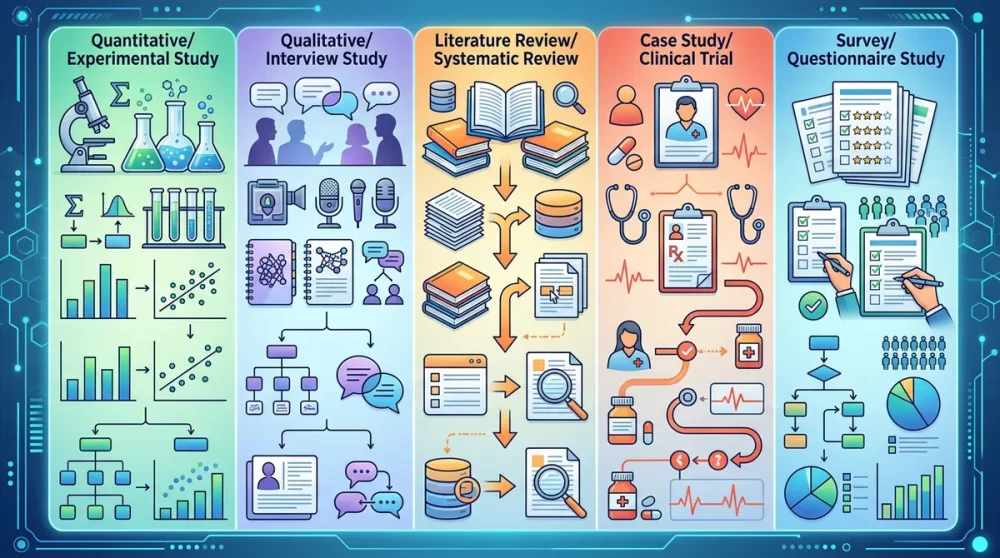
Quick Comparison: Methods Section for Different Study Types
| Study Type | Key Methods Elements | Common Reporting Standard |
|---|---|---|
| Randomized Controlled Trial | Randomization, blinding, interventions, outcome measures | CONSORT |
| Systematic Review / Meta-Analysis | Search strategy, inclusion criteria, data extraction, quality assessment | PRISMA |
| Observational Study | Study design, setting, participants, exposure, outcome measurement | STROBE |
| Qualitative Research | Sampling approach, data collection method, analysis framework | COREQ / SRQR |
| Laboratory / Bench Research | Materials, reagents, equipment, step-by-step procedures | Journal-specific |

Checklist Before Submitting Your Methods Section
Before you submit your manuscript, use this checklist to review your methods section one final time:
- Does your section follow the journal’s required headings and word limit?
- Is the entire section written in consistent past tense?
- Have you provided exact specifications for all materials and equipment?
- Have you justified your research design and analytical choices?
- Is your participant description complete, including recruitment and ethics?
- Have you included your ethical approval details and consent procedures?
- Is the section free of results, irrelevant background, or undefined jargon?
- Are all statistical methods cited and appropriate for your data?
Running through this checklist can catch errors that might otherwise lead to peer review rejection. You can also submit your manuscript to San Francisco Edit for expert review by PhD-qualified scientific editors.
How Professional Editing Strengthens Your Methods Section
Even experienced researchers benefit from a second pair of expert eyes. Professional manuscript editors are trained to identify ambiguous language, missing details, and structural weaknesses that authors often overlook. This is especially valuable for non-native English speakers, where small linguistic errors can obscure important scientific details.
San Francisco Edit is a specialist editing service trusted by researchers across the globe. Our editors are native English-speaking PhD scientists with deep subject expertise. With a 98% acceptance rate for edited manuscripts, we help authors across life sciences, medicine, engineering, and social sciences publish with confidence. Learn more about our work on our clients page or read what researchers say on our testimonials page.
Conclusion
Writing a strong methods section is a skill that improves with practice and expert guidance. By following journal guidelines, using precise language, justifying your choices, and organizing your content clearly, you give your manuscript the best possible chance of acceptance. Each of the 11 tips in this guide addresses a real challenge that researchers face when preparing their work for peer review.
If you want to be confident that your methods section meets the highest editorial standards, professional editing is one of the most effective investments you can make. Submit your manuscript to San Francisco Edit today and let our expert scientific editors help you move one step closer to publication.
FAQs
Q: What are the essential subheadings for a methods section?
A: The most common subheadings include Study Design, Participants, Data Collection Procedures, Materials or Instruments, Data Analysis, and Ethical Considerations. Always check your target journal’s author guidelines, as some journals specify exact subheading names and structure.
Q: What tense and voice should be used in the methods section?
A: The methods section should be written in the past tense throughout, since you are describing procedures that have already been completed. Either active or passive voice is acceptable, but your choice should be consistent and aligned with the target journal’s preferred style.
Q: How do you ensure reproducibility in the methods section?
A: Reproducibility requires providing exact specifications for all materials, equipment, reagents, and software used in your study. Include manufacturer names, model numbers, concentrations, software versions, and step-by-step procedural details so that another researcher can replicate your work precisely.
Q: What are common mistakes to avoid in the methods section?
A: Common mistakes include including results in the methods section, using undefined jargon, omitting ethical approval details, providing unjustified statistical choices, and describing irrelevant procedures. Professional manuscript editing can help identify and correct these issues before submission.
Q: How is the methods section different for quantitative vs. qualitative research?
A: Quantitative methods sections focus on sample size calculations, statistical tests, measurement instruments, and controlled procedures. Qualitative methods sections emphasize sampling approaches, data collection methods such as interviews or focus groups, and the analytical framework used to interpret findings. Both require clear justification of design choices.