Key Takeaways
-
Start with the Methods section to build momentum, then write Introduction and Discussion; always write the Abstract last after the manuscript is complete to ensure accuracy.
-
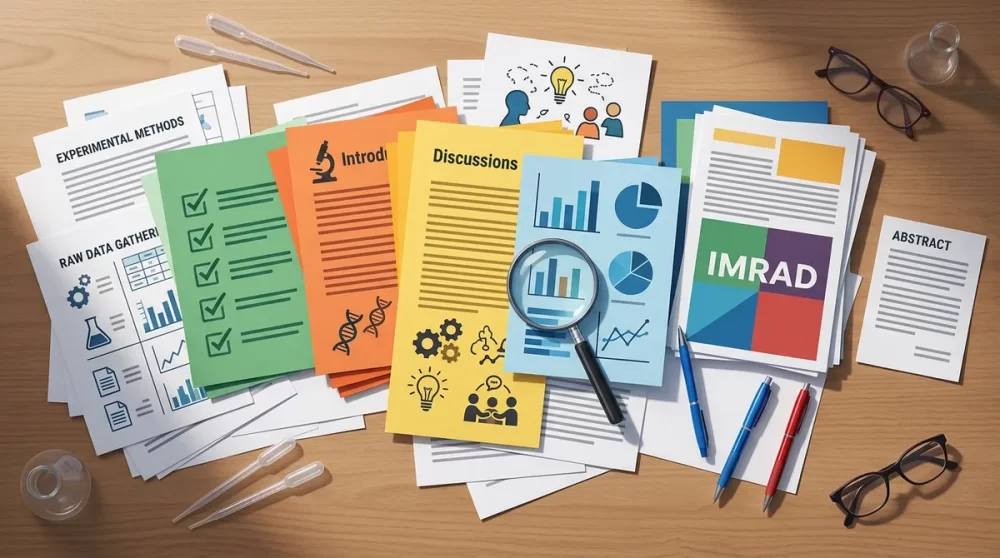
Follow the IMRAD structure (Introduction, Methods, Results, Discussion) strictly—each section has a specific role, and editors expect clear logical flow from start to finish.
-
Make Results section purely factual and objective using past tense; ensure tables and figures stand alone with clear legends, and never interpret findings in this section.
-
Include all mandatory declarations before submission: ethics approval, data availability statements, conflict of interest disclosures, and reproducibility statements, as missing these causes immediate rejection.
-
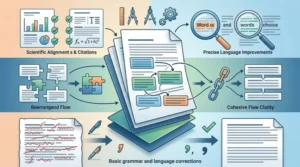
Revise in two separate passes: first for structural logic and IMRAD compliance, then for language clarity, brevity, and precision—attempting both simultaneously causes critical problems.
-
Choose your target journal before drafting and read its author guidelines carefully; selecting the right journal early saves significant revision time and aligns your manuscript with specific formatting requirements.
Publishing a scientific paper is one of the most important milestones in a researcher’s career. Yet many authors — from PhD candidates to experienced clinicians — struggle with where to begin, how to structure their work, and how to meet the exacting standards of peer-reviewed journals. The process of learning how to write a scientific paper involves far more than putting data into words. It requires a clear structure, precise language, and rigorous attention to journal guidelines. In 2026, journals are more competitive than ever, and editors are looking for manuscripts that are not only scientifically sound but also clearly written and professionally presented. This step-by-step guide breaks the process into 11 manageable steps. Whether you are submitting your first manuscript or refining your publication workflow, these steps will help you produce a paper that stands the best possible chance of acceptance. For authors who want expert support, scientific editing services can make a critical difference.

1. Choose Your Research Question and Target Journal
Before writing a single word, define your research question clearly. A focused question guides your entire manuscript. Ask yourself: What problem does this study address? What gap does it fill? Once your question is clear, identify your target journal. Every journal has specific aims, scope, and formatting rules. Read the author guidelines carefully before you start drafting. Choosing the right journal early saves significant revision time later.
2. Understand the IMRAD Structure
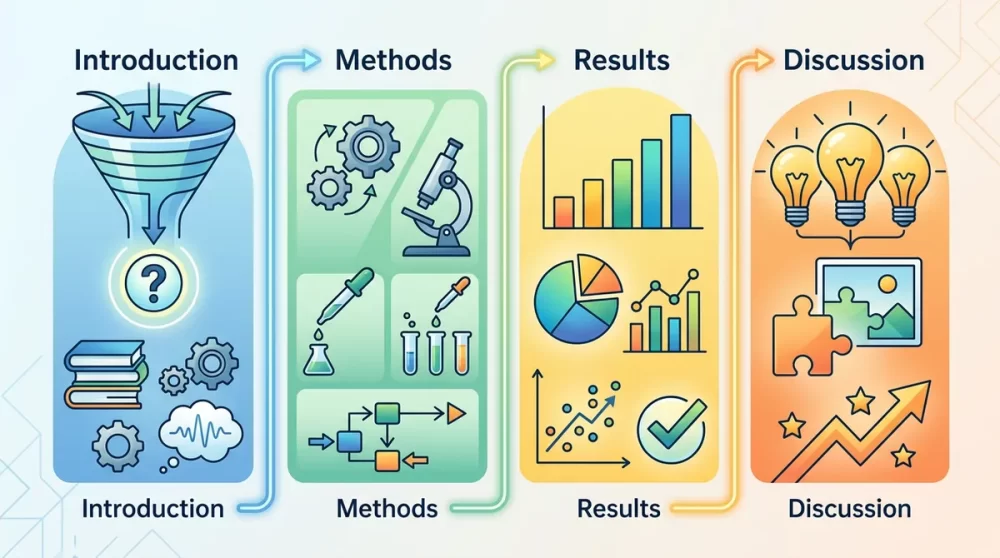
Most scientific papers follow the IMRAD structure: Introduction, Methods, Results, and Discussion. This format is the global standard for scientific communication. Each section has a specific purpose, and editors — both journal editors and professional manuscript editors — expect each section to stay within its defined role. Understanding IMRAD before you draft ensures your paper flows logically from start to finish.
| Section | Purpose | Common Mistakes |
|---|---|---|
| Introduction | Establish context and research gap | Too broad, lacks clear research question |
| Methods | Describe how the study was conducted | Insufficient detail for reproducibility |
| Results | Present findings without interpretation | Mixing results with discussion |
| Discussion | Interpret findings and address limitations | Overstating conclusions |
3. Write the Methods Section First
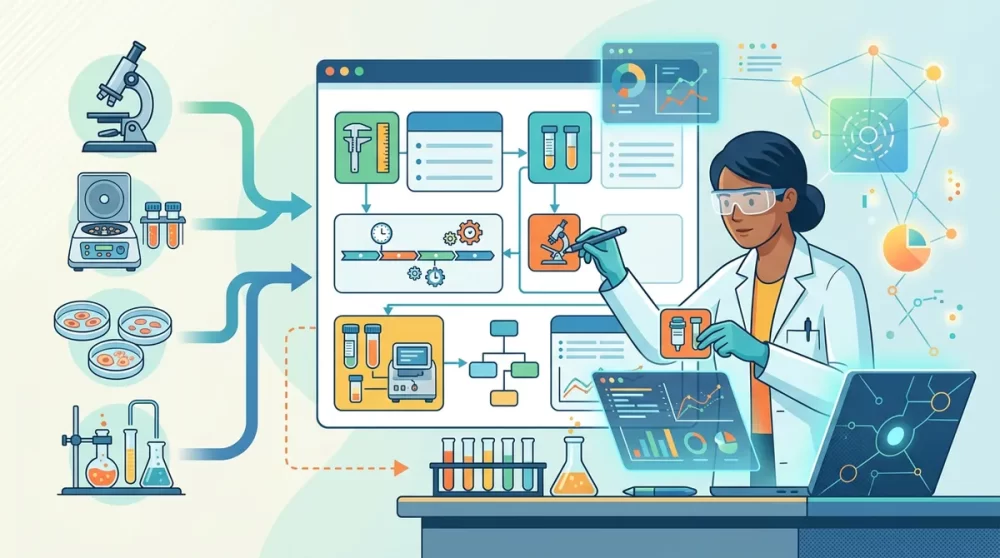
Experienced scientific writers often start with the Methods section. This section is the most factual and concrete part of your paper. Writing it first builds momentum. Describe your study design, participants, instruments, and analysis plan in enough detail that another researcher could replicate your work. In 2026, many journals require explicit reproducibility statements, so thoroughness here is essential. Visit the knowledge center for guidance on methods writing best practices.

4. Present Results Clearly and Objectively
The Results section should present facts only. Use the past tense. Include raw numbers, percentages, and statistical significance where relevant. Do not interpret your findings here — save that for the Discussion. Your tables and figures must stand alone, meaning a reader should understand them without reading the surrounding text. Editors frequently flag results sections that contain opinion or redundant narrative alongside tables.
- Use past tense throughout the Results section
- Include exact values and confidence intervals
- Ensure every table and figure has a clear, descriptive legend
- Arrange data in a logical sequence that tells a coherent story
- Avoid duplicating data in both text and figures
5. Write a Focused and Evidence-Based Introduction
The Introduction should move from broad context to your specific research question. Start with the wider problem, narrow to the gap in current knowledge, and end with your study’s objective or hypothesis. Cite relevant, recent literature from databases such as PubMed to demonstrate awareness of the field. Keep your Introduction concise — typically two to four paragraphs is sufficient for most journal articles.
6. Craft a Strong Discussion Section
The Discussion is where you interpret your results in the context of existing literature. Start by restating your key findings, then compare them to prior studies. Address unexpected results honestly. Every Discussion section must acknowledge limitations — reviewers will notice if you do not. End with a clear conclusion that directly answers your original research question.
- Restate your main findings in plain language
- Compare results to existing literature with citations
- Explain unexpected or contradictory findings
- Acknowledge study limitations clearly and honestly
- State the clinical or scientific implications of your findings
- End with a concise, direct conclusion
7. Write the Abstract Last
Always write your abstract after the full manuscript is complete. The abstract must stand alone — a reader should understand your entire study without reading the main paper. Include your research question, methods summary, key results with statistical data, and main conclusion. Avoid jargon and acronyms unless defined. In 2026, many journals also request structured abstracts with labeled subsections, so follow journal-specific requirements precisely.
- Write the abstract only after all sections are complete
- Include key numerical results and significance values
- Keep language clear and free of unexplained acronyms
- Check word limits — most abstracts are 150 to 300 words
8. Format References Consistently
Inaccurate or inconsistently formatted references are a common reason for desk rejection. Use your target journal’s preferred citation style — whether Vancouver, APA, or another format — from the very beginning. Reference management software can help organize citations, but always verify each entry manually. Errors in author names, volume numbers, or page ranges are more common than most authors expect. For authors submitting to major conferences, formatting is equally strict — for example, CVPR 2026 limits papers to eight pages including figures and tables, excluding references.
9. Revise for Structure, Then for Language
Revision should happen in two distinct passes. First, review the overall structure: Does each section do its job? Is the logical flow from Introduction to Conclusion coherent? Once the structure is solid, revise for language. Simplify long sentences, remove redundant phrases, and replace vague terms with precise ones. Scientific writing rewards brevity and clarity. Authors who try to revise structure and language simultaneously often miss important problems in both. Explore more revision strategies in our newsletter resources.
- Read the full manuscript for structural logic first
- Check that each section fulfills its IMRAD role
- Revise language for clarity, precision, and brevity
- Check figures, tables, and legends for accuracy
- Verify all references are complete and correctly formatted
10. Address Ethical and Reproducibility Requirements
In 2026, journals place increasing emphasis on research ethics and reproducibility. Most peer-reviewed journals now require authors to declare ethical approvals, data availability statements, and conflicts of interest. Many also require a reproducibility statement confirming that methods are described in sufficient detail for replication. Failing to include these elements — even if your research itself is sound — can result in immediate rejection. Check each journal’s specific requirements for these declarations before submission.
| Requirement | Why It Matters | Where to Include |
|---|---|---|
| Ethics approval | Required for human and animal studies | Methods section |
| Data availability statement | Supports open science principles | End of manuscript or supplementary |
| Conflict of interest | Ensures transparency | Author declarations |
| Reproducibility statement | Validates methodological rigor | Methods or supplementary |
11. Seek Professional Manuscript Editing Before Submission
Even experienced researchers benefit enormously from professional editing before submission. A trained scientific editor does far more than correct grammar. They check logical flow, eliminate redundancy, verify that terminology is consistent, and ensure your manuscript aligns with the target journal’s conventions. For non-native English authors in particular, language clarity is directly linked to publication success. San Francisco Edit is a specialist editing service that works with authors globally across life sciences, medicine, engineering, and social sciences. With a 98 percent acceptance rate for edited papers and more than 325 combined years of editorial experience on staff, it is one of the most trusted names in the field. Submitting a professionally edited manuscript significantly improves your chances of acceptance at peer-reviewed journals. You can learn more about what professional editors offer through our FAQ page.
Common Mistakes That Manuscript Editors Fix
Understanding what professional editors look for can help you self-edit more effectively. Here are the most frequently corrected issues in scientific manuscripts:
- Redundancy: Repeating the same information in multiple sections
- Vague language: Using phrases like “approximately” or “some” without data
- Inconsistent terminology: Referring to the same concept with different terms
- Passive voice overuse: Making sentences harder to follow than necessary
- Mismatched tenses: Switching between past and present tense without reason
- Weak transitions: Failing to connect ideas logically between paragraphs
If you want expert guidance on language precision, language editing services can address these issues comprehensively before you submit your work to a journal. For researchers who want to check the quality standards of published work in their field, PubMed and resources from the National Library of Medicine provide extensive access to peer-reviewed literature.
What to Check Before You Submit
A pre-submission checklist is one of the most effective tools for catching errors. Use this list before you upload your manuscript:
- All sections are complete and follow the IMRAD structure
- Abstract meets the journal’s word limit and format requirements
- All figures and tables are labeled and legible
- References are formatted correctly in the required style
- Ethics and reproducibility statements are included
- The manuscript has been reviewed by a professional editor
Authors who want to review pricing options for professional editing can visit the Pricing and Payment page for transparent, straightforward information. Standard turnaround is six to eight days, with rush options available in three to four days for time-sensitive submissions.
Conclusion
Learning how to write a scientific paper is a skill that improves with practice, structure, and expert support. The 11 steps outlined in this guide — from choosing your research question to seeking professional editing — reflect the standards that leading journals expect in 2026. Following this process consistently will strengthen your manuscripts, reduce revision cycles, and improve your publication success rate. The final step — professional editing — is often what separates accepted papers from rejected ones. If you are ready to give your manuscript the attention it deserves, submit your manuscript to San Francisco Edit and let our team of expert scientific editors help you reach your publication goals.
FAQs
Q: What is the IMRAD structure in scientific paper writing?
A: IMRAD stands for Introduction, Methods, Results, and Discussion. It is the globally accepted framework for organizing scientific manuscripts. Each section has a specific role: the Introduction establishes context, the Methods describe the study design, the Results present findings objectively, and the Discussion interprets those findings and addresses limitations.
Q: Why should the abstract be written last when preparing a scientific paper?
A: The abstract must accurately summarize the entire paper, including key findings and conclusions. Writing it last ensures it reflects the final content of every section. A well-written abstract stands alone — readers should understand the study’s purpose, methods, results, and significance without reading the full manuscript.
Q: What common mistakes do professional manuscript editors correct?
A: Professional editors commonly address redundancy, vague language, inconsistent terminology, passive voice overuse, mismatched tenses, and weak transitions between sections. These issues reduce clarity and can negatively affect a manuscript’s chances of acceptance in peer-reviewed journals.
Q: How does professional editing improve a scientific paper’s chances of publication?
A: Professional manuscript editors improve logical flow, eliminate redundancy, ensure consistent terminology, and align the manuscript with journal-specific conventions. For non-native English authors especially, language precision is directly linked to acceptance rates. Services like San Francisco Edit report a 98 percent acceptance rate for professionally edited manuscripts.
Q: What ethical and reproducibility requirements do journals expect in 2026?
A: In 2026, most peer-reviewed journals require authors to include ethics approval declarations, data availability statements, conflict of interest disclosures, and reproducibility statements. These elements must be included correctly before submission, as missing declarations can result in immediate rejection regardless of the study’s scientific merit.