
Key Takeaways
-
Most peer-reviewed journals expect abstracts between 150-250 words, but always check your target journal's specific author guidelines as word limits vary significantly by publication and field.
-
Write your abstract after completing the full manuscript to ensure accuracy, and revise it 3-5 times to eliminate wordiness without sacrificing meaning or essential content.
-
Include four core components in every abstract: motivation/problem, methods/approach, results, and conclusions, allocating roughly equal word space to each element within your limit.
-
Exceeding the journal's word limit often results in desk rejection before peer review, so prioritize strict compliance as it signals whether you've read submission guidelines carefully.
-
Use precise, concise language by eliminating filler phrases, replacing long expressions with shorter alternatives, and using numerals for data reporting to maximize clarity within word constraints.
-
Keep your abstract self-contained and avoid introducing new information not present in the main text; readers often access abstracts through databases without access to the full paper.
Your abstract is the first thing editors, reviewers, and readers see. It may be the only part they read before deciding whether to continue. Yet many authors spend the least amount of time on it. One of the most common mistakes is getting the word count wrong. Too long, and you risk desk rejection. Too short, and you may fail to communicate your research clearly.
So, how many words in abstract sections should you aim for? The short answer is 150 to 250 words for most journals. But the full answer depends on your journal, your field, and whether your abstract is structured or unstructured. This guide covers 13 essential rules to help you write an abstract that fits within the required limits and makes a strong impression. Whether you are a graduate student submitting your first paper or an experienced researcher aiming to improve your publication rate, these rules will help you get it right.

1. Know the Standard Word Count Range
Most peer-reviewed journals expect abstracts between 150 and 250 words. General science journals tend to favor this range. Some journals allow up to 300 words for more detailed studies. Others, like JMIR Publications, permit up to 450 words for unstructured abstracts. Always treat 100 to 400 words as your working range, but aim for the journal’s specific limit first.

2. Always Check the Journal’s Author Guidelines
Every journal has its own rules. Do not assume a standard word count applies across all publications. Some journals count words including section headings; others do not. Visit the author guidelines page for every journal you target. Ignoring this step can result in immediate rejection at the desk level. The knowledge center at San Francisco Edit offers detailed guidance on navigating journal submission requirements.

3. Understand Structured vs. Unstructured Abstracts
There are two main abstract formats. Knowing which applies to your submission will shape how you use your words.
- Structured abstracts use labeled headings such as Background, Methods, Results, and Conclusion
- Unstructured abstracts are written as a single continuous paragraph
- Structured abstracts are common in clinical, medical, and health sciences journals
- Unstructured abstracts appear frequently in humanities, social sciences, and some basic science fields
- Some journals using PRISMA checklists require structured formats for systematic reviews
Knowing which type your journal requires helps you allocate words more effectively across each section.
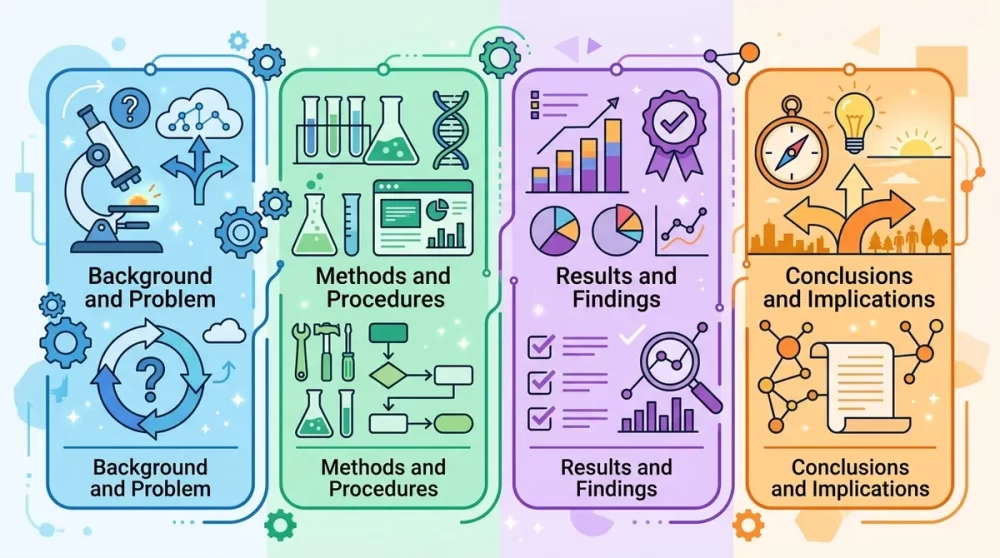
4. Include the Four Core Components
Regardless of format, a strong abstract covers four key elements. Each must be addressed clearly within your word limit.
- Motivation or problem: Why does this research matter?
- Approach or methods: How did you conduct the study?
- Results: What did you find?
- Conclusions: What do your findings mean?
Skipping or condensing any of these sections weakens your abstract. Allocate roughly equal word space to each element when writing within tight limits.
5. Write Your Abstract Last
It sounds counterintuitive, but you should write your abstract after completing the full manuscript. This ensures that every summary statement is accurate and grounded in what your paper actually delivers. Writing it first often leads to vague claims that do not match the final content. After your manuscript is complete, use it as a source document for drafting your abstract.
6. Do Not Introduce New Information
Your abstract should summarize what is in your paper. It should not introduce data, findings, or interpretations that do not appear in the main text. This is a frequent error, especially among early-career researchers. Reviewers will notice the inconsistency, and it can raise questions about the integrity of your manuscript.
7. Use Precise, Concise Language
Every word must earn its place in an abstract. Eliminate filler phrases and redundant language. Replace long expressions with shorter alternatives. This helps you stay within the word limit without sacrificing meaning.
- Replace “in order to” with “to”
- Replace “it is important to note that” with nothing, or restructure the sentence
- Replace “a large number of” with “many”
- Remove introductory phrases like “This paper presents” when possible
- Use active voice wherever appropriate to reduce word count and increase clarity
8. Handle Abbreviations Carefully
Abbreviations save words, but they must be used correctly. Any abbreviation introduced in the abstract must also be defined the first time it appears in the main text. Do not assume the reader knows what every acronym means. If space is tight, weigh whether using a full term is clearer than introducing an abbreviation that only saves one or two words.
9. Use Numerals for Data Reporting
In abstracts, numerals are preferred over spelled-out numbers when reporting data. Writing “47%” takes fewer words than “forty-seven percent” and improves clarity. This applies to most scientific and medical journals. However, always check your target journal’s style guide, as rules can vary between publications.
10. Understand What Happens When You Exceed the Limit
Journals enforce word limits strictly. Exceeding the limit is one of the most common reasons for desk rejection. In some cases, after peer review, editors may allow minor adjustments with justification. But this is the exception, not the rule. Submitting an oversized abstract signals that the author has not read the guidelines carefully, which can create a poor first impression.
| Journal Type | Typical Abstract Word Limit | Abstract Format |
|---|---|---|
| General Science Journals | 150–250 words | Unstructured |
| Clinical / Medical Journals | 200–300 words | Structured |
| Systematic Reviews | 250–350 words | Structured (PRISMA) |
| Humanities / Social Sciences | 150–200 words | Unstructured |
| Large Open-Access Journals (e.g., JMIR) | Up to 450 words | Unstructured |
11. Revise Multiple Times to Reduce Word Count
A first draft of your abstract will almost always be too long. Plan to revise it at least three to five times. Each pass should focus on cutting words without losing meaning. Read each sentence and ask: is this word necessary? Can this idea be stated more directly? This iterative process is what separates a good abstract from a great one.
- Write a full draft without worrying about the word count
- Cut any sentence that repeats an idea already stated elsewhere
- Replace complex phrases with simpler alternatives
- Count the words and identify which section is running long
- Trim until you are within the journal’s stated limit
12. Keep the Abstract Self-Contained
Your abstract must make complete sense on its own. Readers often encounter abstracts through databases like PubMed without immediate access to the full paper. If your abstract relies on context from the introduction or figures, readers will not get what they need. Every essential idea must be present within the abstract itself, using only the words available in your limit.
13. Get Professional Editing Before Submission
Even experienced authors benefit from a second set of eyes. A professional editor helps you identify where your abstract is over-worded, unclear, or inconsistent with journal guidelines. This is especially important for non-native English speakers, where subtle language issues can affect how results are communicated. The abstract is the most-read section of any manuscript, directly influencing whether editors send it out for review and whether readers cite your work. Getting it right is worth the investment.
Scientific editing services like those offered by San Francisco Edit are designed specifically for this purpose. With over 325 years of combined staff experience and a 98% publication acceptance rate, San Francisco Edit helps researchers across every discipline refine their abstracts and full manuscripts before submission. Their editors are native English-speaking PhD scientists who understand both the language requirements and the subject matter.
Tips for Shortening an Overly Long Abstract
If your abstract consistently runs over the word limit, use these practical strategies to reduce it efficiently.
- Remove background information that belongs in the introduction, not the abstract
- Cut hedging language like “it seems” or “it appears that” when findings are clear
- Consolidate methods into one or two sentences focusing on the most critical design choices
- Limit results to your two or three most significant findings
- Remove citations — abstracts rarely require references
- Avoid restating conclusions that are already implied by the results
Does the Abstract Count Toward the Total Manuscript Word Limit?
This is a common question. In most cases, the abstract word count is separate from the total manuscript word count. However, journal policies differ. Some journals count everything, including the abstract, references, and figure captions. Others count only the main body text. Always check your target journal’s instructions for authors to confirm how they calculate total length. If this is unclear, you can also consult the FAQ section at San Francisco Edit for submission-related guidance.
For additional resources on how to structure and write an effective abstract, the National Library of Medicine structured abstract guidelines offer authoritative direction for medical and health science submissions.
Conclusion
Getting the word count right in your abstract is not just about following rules. It reflects the care and precision you have brought to your entire manuscript. A well-crafted abstract within the correct word limit improves your chances of passing the desk review, engaging peer reviewers, and reaching a wider audience. Whether you are writing a 150-word abstract for a general science journal or a 350-word structured abstract for a clinical publication, the principles remain the same: be clear, be concise, and stay within limits.
If you want expert support from experienced editors who understand how many words in abstract sections are appropriate for your specific journal, submit your manuscript to San Francisco Edit and let a team of PhD-qualified editors help you publish with confidence.
FAQs
Q: What is the standard word count for a journal abstract?
A: Most peer-reviewed journals require abstracts between 150 and 250 words. The acceptable range across all journal types is generally 100 to 400 words, but you should always check the specific author guidelines for your target journal before submitting.
Q: Are abstracts included in the total manuscript word count?
A: In most cases, the abstract is counted separately from the main manuscript body. However, journal policies differ, so it is essential to consult your target journal’s instructions for authors to confirm exactly how the total word count is calculated.
Q: What happens if my abstract exceeds the journal’s word limit?
A: Exceeding the abstract word limit can result in desk rejection without peer review. Journals enforce these limits strictly, as they signal whether an author has followed submission guidelines carefully. Always revise your abstract to comply before submitting.
Q: What should be included in a research abstract?
A: A strong abstract should include four core components: the motivation or research problem, the approach or methods used, the key results, and the conclusions or implications. All of these must be addressed clearly within the journal’s stated word limit.
Q: How can I shorten my abstract without losing key information?
A: Focus on removing background detail, hedging language, and repeated ideas. Consolidate methods into one or two sentences, limit results to your most significant findings, and replace complex phrases with simpler alternatives. Multiple revision passes are recommended to achieve the right balance.