Key Takeaways
-
Use the WWHS framework (What, Why, How, So What) to structure your abstract with clear logical flow and ensure all essential elements are present before writing.
-
Write your final abstract only after completing the entire dissertation, but draft an early version after the literature review to clarify research scope and direction.
-
Keep sentences to 15-20 words, use specific vocabulary, avoid jargon and citations, and ensure every claim appears in the main text to maximize clarity and reader comprehension.
-
Follow your journal or university's formatting requirements strictly—check word limits (typically 150-250 words), use past tense for completed actions, and include 4-6 relevant keywords for database searchability.
-
Revise your abstract at least three times: once for structure, once for language clarity, and once for word count compliance to catch common mistakes like vague findings or excessive background.
-
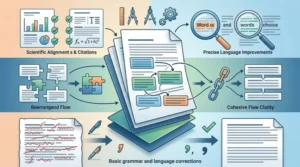
Consider professional editing to assess structural completeness, language precision, and formatting alignment—particularly valuable for non-native English speakers seeking higher journal acceptance rates.
Your dissertation abstract is the first thing readers see. It may be the only thing some readers look at before deciding whether to read further — or cite your work. A poorly written abstract can undermine months or years of rigorous research. That is a significant risk for any PhD candidate, early-career scientist, or medical researcher aiming for publication in a peer-reviewed journal.
Learning how to write abstract in dissertation form — clearly, concisely, and compellingly — is one of the most valuable academic skills you can develop. Done well, a strong abstract boosts discoverability, engages reviewers, and reflects the quality of your entire manuscript. This guide breaks the process into three proven steps, backed by expert editorial guidance and real-world publishing standards.
Whether you are writing your first dissertation or refining a manuscript for journal submission, these steps will help you craft an abstract that represents your research with precision and authority. You can also explore the knowledge center at San Francisco Edit for additional writing and editing resources.

What Is a Dissertation Abstract and Why Does It Matter
A dissertation abstract is a short, self-contained summary of your entire research document. It typically runs between 150 and 250 words — roughly 6 to 7 sentences. Most journals specify abstract word limits between 100 and 300 words, depending on the field and publication format.
The abstract serves a critical function. It appears in academic databases and search engines, allowing other researchers to find your work. Databases like PubMed index abstracts heavily, making keyword placement and clarity essential for discoverability in medical and life sciences research.
Key reasons the abstract matters:
- It is the most-read section of any dissertation or journal article
- It determines whether busy reviewers read the full manuscript
- It influences citation rates and academic impact
- It reflects the quality and clarity of your entire study
- It must stand alone — no citations or references to the full text
Given these stakes, it pays to get the abstract right from the start. Poor English, vague language, or missing structural elements can lead to rejection — even when the underlying research is sound.

Step 1 — Build the Right Structure for Your Abstract
Structure is the foundation of a strong abstract. Without a clear framework, even excellent research can appear disorganized or incomplete. One widely recommended approach follows the WWHS model: What, Why, How, and So What.
The WWHS Framework Explained
This four-part framework gives your abstract logical flow and ensures all essential elements are present. Here is how each component maps to your abstract:
- What (Background/Topic): Briefly introduce the research topic and the problem you are addressing. This sets context for your reader.
- Why (Significance): Explain why this research matters. What gap does it fill? Why should readers care about your findings?
- How (Methods): Describe the research design, methodology, or approach you used. Keep this concise — one to two sentences is usually sufficient.
- So What (Findings and Implications): State your key results and their broader significance. This is the most important part of any abstract.
Structured abstracts, common in medical and clinical research, use labeled sections such as Background, Objective, Methods, Results, and Conclusion. Unstructured abstracts, more common in humanities and social sciences, flow as a single paragraph. Check your university or target journal guidelines to determine which format is appropriate.
Structured vs. Unstructured Abstracts
| Feature | Structured Abstract | Unstructured Abstract |
|---|---|---|
| Format | Labeled sections (e.g., Methods, Results) | Single flowing paragraph |
| Common Fields | Medicine, clinical sciences, life sciences | Humanities, social sciences, arts |
| Word Count | Often 200–300 words | Often 150–250 words |
| Reader Guidance | Easy to scan; clear navigation | Requires careful reading |
| Journal Preference | Most peer-reviewed medical journals | General and interdisciplinary journals |
If you are unsure which format to use, consult your supervisor or refer to your target journal’s author guidelines. You can also get expert guidance through scientific editing services that specialize in manuscript preparation.

Step 2 — Write With Clarity, Precision, and Focus
Once your structure is in place, the next step is writing with clarity. This is where many researchers struggle — especially non-native English speakers or early-career scientists unfamiliar with academic writing conventions.
Core Writing Principles for a Strong Abstract
Follow these principles when writing each sentence of your abstract:
- Be specific, not vague. Avoid phrases like “this study explores several factors.” Name the factors.
- Use precise vocabulary. Choose words that accurately reflect your methods and findings.
- Keep sentences short. Aim for 15 to 20 words per sentence for maximum readability.
- Avoid unnecessary jargon. Write for an intelligent reader outside your immediate specialty.
- Never include citations. Abstracts must be self-contained and reference-free.
- Do not introduce information absent from the main text. Every claim in the abstract must appear in the dissertation itself.
When to Draft and Revise Your Abstract
Many experienced researchers recommend drafting the abstract early — even before the dissertation is complete. An early draft helps clarify the research scope and direction. However, the final abstract should be written or revised only after the dissertation is finished.
A practical revision schedule looks like this:
- Early draft: Write a rough abstract after completing your literature review. This helps anchor your research goals.
- Mid-draft revision: Revise after completing your methods and results chapters. Update the abstract to reflect any methodological changes.
- Final revision: Polish the abstract last — after writing the conclusion. At this stage, you have full clarity on your findings and implications.
Multiple revision cycles are essential. Most professional editors recommend at least three passes: one for structure, one for language, and one for word count compliance. Accessing language editing support can make this process significantly more efficient, particularly for authors writing in a second language.
Choosing the Right Keywords
Keywords placed at the end of your abstract improve database searchability. This is especially important for medical and scientific manuscripts indexed on platforms such as PubMed or institutional repositories.
Tips for selecting abstract keywords:
- Choose 4 to 6 terms most relevant to your research topic
- Use terms that appear in major indexing databases for your field
- Avoid overly broad terms (e.g., “science” or “medicine”)
- Include your study population, methodology, and core findings as keyword themes
- Check subject-specific controlled vocabularies such as MeSH for medical topics

Step 3 — Refine, Format, and Professionally Edit Your Abstract
Writing a solid first draft is an achievement. Transforming that draft into a publication-ready abstract requires careful editing and formatting. This final step is where many researchers can benefit most from professional editorial support.
Formatting Standards to Follow
Abstract formatting varies by institution and journal. However, several universal standards apply:
- No indentations at the start of the abstract paragraph
- No headers or subheadings in unstructured abstracts
- Strict adherence to the specified word limit
- Consistent use of past tense for completed research actions
- Present tense for implications and conclusions
Formatting errors — even minor ones — signal carelessness to reviewers. Journals and dissertation committees expect strict compliance with their guidelines. Refer to your university’s style guide or your target journal’s instructions for authors.
Common Abstract Writing Mistakes to Avoid
Even experienced researchers make these errors. Watch for them during your revision:
- Including too much background: Context is important but must be minimal. Two sentences maximum for most abstracts.
- Omitting key findings: The results section of your abstract is its most critical component. Do not leave it vague.
- Using passive voice excessively: Active voice is clearer, more direct, and more engaging for readers.
- Exceeding the word limit: Over-length abstracts signal poor editing discipline. Count every word carefully.
- Misrepresenting the research: The abstract must accurately reflect what is in the dissertation — no overstating findings.
Why Professional Editing Makes a Measurable Difference
For PhD candidates, medical professionals, and non-native English authors, professional editing transforms a competent abstract into a compelling one. San Francisco Edit is a specialist editing service that works with scientific, medical, and general manuscript authors globally. With more than 325 years of combined staff experience and a 98% publication success rate, the team provides expert human editing — no AI — that strengthens every element of your manuscript, including the abstract.
Professional editors evaluate your abstract against the following criteria:
- Structural completeness (does it address all WWHS elements?)
- Language accuracy and idiomatic English
- Vocabulary precision and appropriate technical terminology
- Word count compliance and formatting alignment
- Keyword relevance and placement
For non-native English-speaking researchers in particular, having a native English-speaking PhD scientist review the abstract can significantly increase the probability of journal acceptance. You can review testimonials from authors across disciplines who have benefited from this level of expert support.
Abstract Quality Checklist Before Submission
Before submitting your dissertation or manuscript, run through this final checklist to confirm your abstract is ready:
| Checklist Item | Status |
|---|---|
| Word count falls within required limits (150–250 words typical) | ✓ Verify |
| All WWHS elements are present and clearly expressed | ✓ Verify |
| No citations or references included | ✓ Verify |
| No information absent from the main dissertation body | ✓ Verify |
| Keywords listed at the end (if required) | ✓ Verify |
| Language is clear, precise, and jargon-free | ✓ Verify |
| Formatting matches university or journal guidelines | ✓ Verify |
| Abstract reviewed by a professional editor or supervisor | ✓ Verify |
This checklist applies whether you are submitting to a university committee or preparing your dissertation for publication as a journal article. You can also browse the FAQ section for additional guidance on manuscript preparation and submission standards.
Conclusion
Knowing how to write abstract in dissertation form is a skill that pays dividends throughout your academic and research career. A well-structured, clearly written abstract increases your manuscript’s visibility, engages peer reviewers, and gives your research the professional presentation it deserves. By following these three proven steps — building the right structure, writing with clarity and focus, and refining through professional editing — you give your work the best possible chance of acceptance and impact.
If you want expert support at any stage of this process, San Francisco Edit’s team of PhD-level, native English-speaking editors is ready to help. With decades of experience editing scientific and medical manuscripts for global publication, the team delivers precise, high-quality editing with a fast turnaround. Explore the pricing and payment options to find a plan that suits your needs.
Ready to strengthen your dissertation abstract and maximize your chances of publication? Submit your manuscript today and work with editors who understand your field.
FAQs
Q: What are the key elements to include in a dissertation abstract?
A: A dissertation abstract should include four core elements: the research background, the problem or gap being addressed, the methods used, and the key findings along with their implications. These elements are often summarized using the WWHS framework — What, Why, How, and So What. The abstract should be self-contained, free of citations, and limited to information that appears in the dissertation itself.
Q: How long should a dissertation abstract be?
A: Most dissertation abstracts range from 150 to 250 words, which typically equals 6 to 7 well-crafted sentences. Journal-specific requirements vary, with most peer-reviewed publications setting limits between 100 and 300 words. Always verify the word count requirement in your university’s style guide or the target journal’s author instructions before finalizing your abstract.
Q: What common mistakes should I avoid when writing a dissertation abstract?
A: The most common mistakes include exceeding the word limit, omitting key findings, including too much background information, and introducing details not present in the main dissertation. Many authors also use overly complex jargon, passive voice, or vague language that weakens the abstract’s impact. Professional editing can identify and correct these issues before submission.
Q: When is the best time to write the dissertation abstract?
A: Experts recommend drafting an early version of the abstract after completing the literature review, then revising it at each major milestone of the writing process. The final version should be written or thoroughly revised only after the entire dissertation is complete, ensuring the abstract accurately reflects the final findings, methodology, and conclusions.
Q: How can professional editing improve my dissertation abstract?
A: Professional manuscript editors assess your abstract for structural completeness, language precision, idiomatic English, and adherence to formatting guidelines. For non-native English speakers, expert editing by a native English-speaking PhD scientist can correct subtle language errors that may otherwise trigger reviewer concerns. Services like San Francisco Edit offer specialized support that consistently helps authors achieve higher journal acceptance rates.