Key Takeaways
-
A well-written cover letter directly influences whether an editor sends your manuscript for peer review or rejects it at desk triage, making it a strategic document rather than an afterthought.
-
Always include six core elements: manuscript title and article type, a fresh plain-language summary of purpose and findings, specific novelty and significance claims, clear journal scope alignment, originality declaration, and required ethical compliance statements.
-
Keep your cover letter to one page or less and tailor every letter to the specific journal by reading recent issues to understand methodologies, topics, and study types the journal actually publishes.
-
Address the letter to a named editor using ‘Dear Dr. [Name]’ rather than generic greetings, and omit unnecessary elements like funding details, full abstract rewrites, suggested reviewers, and personal author background.
-
Non-native English speakers should prioritize language quality in the cover letter, as grammatical errors signal to editors that the manuscript may have similar problems, directly affecting perceived submission quality.
-
Avoid common mistakes including copying your abstract word-for-word, using generic templates, failing to declare exclusive submission, and making vague novelty claims—all significantly reduce acceptance chances during triage screening.
You have finished your manuscript. The data is solid. The writing is clear. Now you face one more task before submission: the cover letter. Many researchers treat this document as an afterthought. That is a costly mistake. A well-written cover letter for journal submission can influence whether an editor sends your paper out for peer review or rejects it at the desk. It is your first direct communication with the editor, and it needs to count.
This guide explains exactly what to include, how to structure the letter, and what to leave out. Whether you are submitting your first manuscript or your fiftieth, a strong cover letter strengthens your submission package. Pair it with a polished manuscript, and you give your research the best possible chance of publication.

Why the Cover Letter Matters in Journal Submission
Editors receive hundreds of submissions each month. During initial triage, many journals screen manuscripts before they ever reach a peer reviewer. The cover letter is part of that screening. It tells the editor what the paper is about, why it fits the journal, and why readers would care.
According to guidance from both Elsevier and Springer Nature, the cover letter should give editors a concise explanation of the study’s aim, main findings, and significance. This is not the place to repeat your abstract word for word. It is the place to make a direct, compelling case to the editor.
If you want to understand the full manuscript submission process, the Getting Published knowledge center at San Francisco Edit offers detailed guidance for researchers at every stage.

Core Elements Every Cover Letter Must Include
Most journals expect specific information in the cover letter. Below is what should always appear, regardless of the journal’s specific instructions.
1. Basic Manuscript Information
Start with the essentials. State the manuscript title, the article type (original research, review, case report, etc.), and the names of all authors. This gives the editor immediate context. Make this section brief and factual.
2. A Clear Statement of the Study’s Purpose and Findings
In two to four sentences, explain what your study aimed to do and what it found. Do not copy your abstract. Instead, write a fresh, plain-language summary that highlights the most important result. Focus on what is new and why it matters.
3. Novelty and Significance
Editors want to know why this paper advances the field. Explain what gap your study fills or what question it answers for the first time. This is one of the most important elements in your cover letter for journal submission. Be specific. Vague claims about “important contributions” rarely persuade an editor.
4. Relevance to the Journal’s Aims and Scope
This element is critical. Publisher guidance consistently identifies alignment with journal scope as one of the most common screening criteria used during triage. Explain specifically why your paper fits this journal’s readership and mission. Reference the journal’s stated aims if possible.
5. Originality and Exclusive Submission Declaration
Springer Nature guidance requires all cover letters to confirm that the manuscript has not been published elsewhere and is not under consideration by another journal. Elsevier and most other publishers require this as well. Include a clear statement to this effect.
6. Ethical Compliance Statements (When Required)
If the journal requests it, confirm that the study received ethics approval, that participants provided informed consent, and that relevant reporting guidelines were followed. Check the journal’s Instructions for Authors to know whether this is required.
Recommended Structure of a Journal Submission Cover Letter
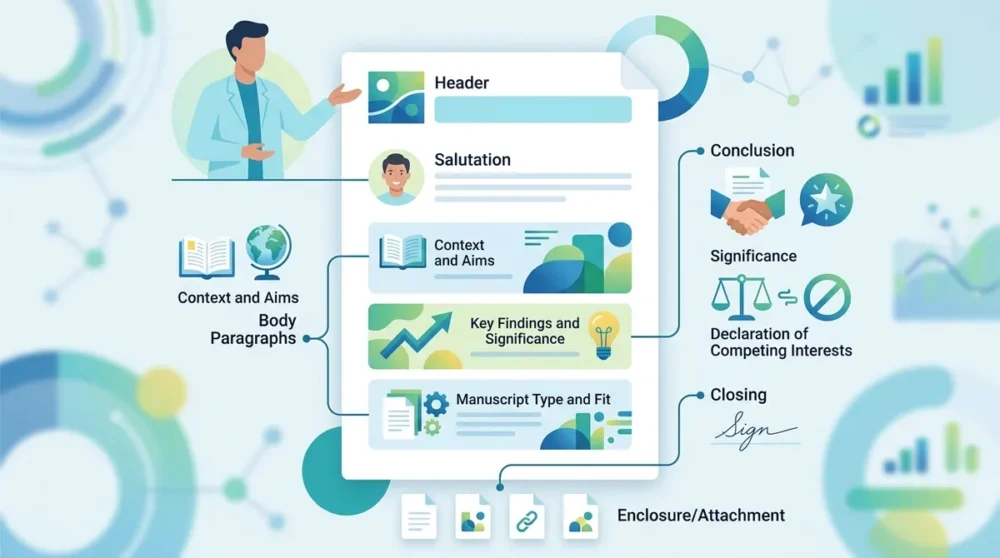
A professional cover letter follows a standard business-letter format. Use the structure below as your guide.
- Salutation: Address the editor by name whenever possible. “Dear Dr. [Name]” is more effective than a generic greeting. Check the journal’s website or recent issues to identify the correct editor.
- Opening paragraph: State the manuscript title, article type, and your request for consideration. Keep this to two or three sentences.
- Body paragraph(s): Summarize the study’s purpose, main findings, novelty, and relevance to the journal’s scope. This is the core of the letter.
- Declarations paragraph: Confirm originality, exclusive submission, ethical compliance (if required), and any conflict-of-interest disclosures.
- Closing paragraph: Thank the editor, state your willingness to provide further information, and sign off professionally.
Keep the entire letter to one page or less. Elsevier’s current guidance explicitly recommends brevity. Editors are busy. A concise, focused letter shows respect for their time.

What to Leave Out of Your Cover Letter
Knowing what to exclude is just as important as knowing what to include. The following elements should generally be omitted unless the journal specifically requests them:
- Suggested peer reviewers (include only if the journal’s submission system asks)
- Funding details (these belong in the manuscript’s acknowledgments section)
- A full rewrite of the abstract
- Excessive promotional language or unsubstantiated claims
- Personal background or career information about the authors
- Conference presentations of the same work (unless the journal requires disclosure)
Overcrowding the cover letter reduces its impact. Stick to what the editor needs to make a triage decision.
Common Cover Letter Mistakes to Avoid
Even experienced researchers make avoidable errors. The table below summarizes the most common mistakes and how to correct them.
| Common Mistake | Why It Hurts | How to Fix It |
|---|---|---|
| Copying the abstract word for word | Adds no value; misses the persuasive purpose | Write a fresh, plain-language summary |
| Using a generic template without customization | Shows no awareness of the journal’s focus | Tailor every letter to the specific journal |
| Failing to declare exclusive submission | Can trigger rejection for ethical reasons | Include a clear originality declaration |
| Addressing the wrong editor or no editor | Appears careless and unprofessional | Research the correct editor name before submitting |
| Exceeding one page | Editor may not read it fully | Edit ruthlessly for brevity |
| Weak or vague novelty statement | Fails to justify why the paper merits review | Be specific about what your study adds |
Adapting Your Cover Letter to Different Journal Requirements
Not all journals have identical requirements. Some ask for reviewer suggestions. Others require disclosure of related submissions or detailed ethical compliance statements. Always read the journal’s Instructions for Authors or Guide for Authors before drafting your letter.
Biomedical and life-science journals, in particular, often require cover letters as a mandatory part of the submission package. Many submission systems such as those used by PubMed-indexed journals include a dedicated cover letter field during the online submission process.
For journals with specific formatting requirements, resources like the Manuscript Formatting Guide for Authors can help you align every document in your submission package with journal expectations.
It is also worth reviewing guidance on how to get a research paper published in 2026 to understand the full context of what editors look for during initial screening.
How Journal Scope Alignment Affects Editorial Decisions
Scope alignment is one of the most consistent rejection triggers at the triage stage. If your cover letter does not clearly explain why the paper fits the journal, the editor may reject it without review, even if the science is strong.
Before writing your cover letter, read several recent issues of the target journal. Identify the types of studies published, the methodologies favored, and the topics covered. Then use this knowledge to write a focused argument for why your paper belongs in that journal specifically.
The article on 10 tips for choosing the right journal for your scientific paper provides a useful framework for this process before you even begin drafting the letter.
The Role of Language Quality in Your Cover Letter
For non-native English-speaking authors, the cover letter presents a particular challenge. It must be grammatically correct, professionally worded, and free of ambiguity. Errors in the cover letter signal to editors that the manuscript may have similar problems, which can reduce confidence in the submission.
According to published research cited by manuscript editing professionals, poor English is one of the most common factors contributing to manuscript rejection. This applies to every document in the submission package, including the cover letter.
If English is not your first language, consider working with a specialist editing service. Scientific editing for non-native English speakers can make a significant difference in how your submission is perceived at the editorial level.
The language editing service at San Francisco Edit is designed precisely for this need, ensuring that every element of your submission — including the cover letter — is polished, precise, and publication-ready.
Can a Professional Editor Help With Your Cover Letter?
Yes, and in many cases, professional support significantly improves the quality of the submission package. A manuscript editor who understands journal requirements can review your cover letter for clarity, tone, completeness, and alignment with the target journal’s scope.
San Francisco Edit works with authors across all scientific and medical disciplines to prepare complete submission packages. This includes editing the manuscript itself and reviewing accompanying documents such as the cover letter. With a 98% acceptance rate among edited papers and more than 325 years of combined staff experience, the team brings exceptional expertise to every submission.
You can learn more about working with a professional editor through the guide on what to expect from a scientific editor. For specific guidance on writing this document, the article on 5 key steps to write a journal submission cover letter is a practical starting point.
Additional depth on the topic is available through resources like the Springer Nature author guidance on cover letters and the Elsevier author submission portal, both of which provide publisher-specific expectations in detail.
A Quick Checklist Before You Submit
Use this checklist to review your cover letter before submitting your manuscript:
- Is the letter addressed to a named editor?
- Does it state the manuscript title and article type clearly?
- Does it summarize the study’s purpose and key findings in plain language?
- Does it explain the novelty and significance of the work?
- Does it demonstrate clear alignment with the journal’s aims and scope?
- Does it include an originality and exclusive submission declaration?
- Is it one page or less?
- Is it free of grammatical errors and informal language?
If you can answer yes to every item on this list, your cover letter is ready. For authors who want a deeper resource on the subject, the comprehensive guide to mastering the effective cover letter for journal submission covers additional nuances and examples.
Conclusion
A cover letter for journal submission is not a formality. It is a strategic document that introduces your research to the editor and makes the case for peer review. Keep it concise, specific, and tailored to the target journal. Address the right editor, declare originality, highlight novelty, and show scope alignment. These elements, done well, set a professional tone for your entire submission.
If you want expert support preparing your manuscript and cover letter for submission, San Francisco Edit offers professional scientific editing services backed by decades of publishing experience. Take the next step toward publication and submit your manuscript for expert editing today.
FAQs
Q: What should be included in a cover letter for journal submission?
A: A cover letter for journal submission should include the manuscript title, article type, a brief summary of the study’s purpose and findings, a statement of novelty and significance, an explanation of how the paper fits the journal’s scope, and a declaration confirming originality and exclusive submission. Ethical compliance statements may also be required depending on the journal.
Q: How long should a journal submission cover letter be?
A: A journal submission cover letter should be kept to one page or less. Elsevier’s current guidance explicitly recommends brevity. Editors are reviewing many submissions, so a concise, focused letter is more effective than a lengthy one.
Q: Do I need a cover letter when submitting a manuscript to a journal?
A: Most peer-reviewed journals, particularly in biomedical and life sciences, require a cover letter as part of the submission package. Even when it is not strictly mandatory, including a well-written cover letter is strongly recommended because it gives you an opportunity to make a direct case to the editor for why your paper merits review.
Q: How do I address a journal editor in a cover letter?
A: Whenever possible, address the cover letter to a named editor using “Dear Dr. [Last Name].” Check the journal’s website, editorial board page, or recent issues to identify the correct handling editor. Avoid generic greetings such as “To Whom It May Concern,” as a personalized salutation conveys professionalism and attention to detail.
Q: Can a manuscript editor help write a cover letter for journal submission?
A: Yes. A professional manuscript editor with experience in academic publishing can review or help draft your cover letter to ensure it is clear, complete, professionally worded, and tailored to the target journal’s requirements. This is especially valuable for non-native English-speaking authors, where language precision in the cover letter can directly influence the editor’s first impression of the submission.