Key Takeaways
-
Review articles synthesize existing published research without presenting new experimental data, offering readers a curated overview of current knowledge and identifying gaps that suggest directions for future research.
-
Different review types serve distinct purposes: narrative reviews offer broad overviews, systematic reviews use reproducible search criteria, meta-analyses combine data statistically, scoping reviews map evidence in new fields, and mini-reviews focus on narrow topics or recent developments.
-
Editors expect most references to be from the past two to five years, clear scope definition, critical analysis rather than mere summarization, and evidence that the review adds unique value not easily found elsewhere.
-
Structure your review with a focused introduction explaining the gap addressed, thematic or chronological body sections that synthesize findings, and conclusions identifying remaining gaps and future research directions.
-
Common rejection reasons include overly broad or narrow scope, incomplete or outdated literature coverage, lack of critical analysis, ignored contradictions, unclear language, and non-compliance with journal formatting requirements.
-
Full-length review articles typically range from 4,000 to 10,000 words with timelines from 6 to 18 months; professional editing significantly improves acceptance rates by clarifying scope, strengthening critical analysis, and ensuring precise language.
If you have ever searched a journal database for background on a topic, you have likely read a review article. But what exactly is a review article, and how does it differ from other manuscript types? Understanding this distinction is essential for any researcher preparing to write or submit scholarly work. A review article synthesizes existing published research rather than reporting new experimental data. It offers readers a curated, critical overview of what is known about a topic. For authors preparing manuscripts for peer-reviewed journals, knowing how to write a strong review article can significantly improve your chances of publication. This guide explains what a review article is, how it is structured, and what editors and peer reviewers look for when they evaluate one.

What Is a Review Article in Academic Publishing
A review article — also called a literature review or review of literature — surveys previously published research on a specific topic. Unlike an original research article, it does not present new experimental data or results. Instead, it critically evaluates and synthesizes what has already been published. The goal is to offer the reader a coherent picture of the current state of knowledge in a field. For a deeper comparison, see this guide on how to write a literature review for a research paper.
Strong review articles do more than summarize. They identify patterns, contradictions, and gaps in the existing literature. They also suggest directions for future research. This makes them highly valuable to the scientific community and frequently cited in journals indexed in PubMed and other major databases.
Review Article vs. Research Article: Key Differences
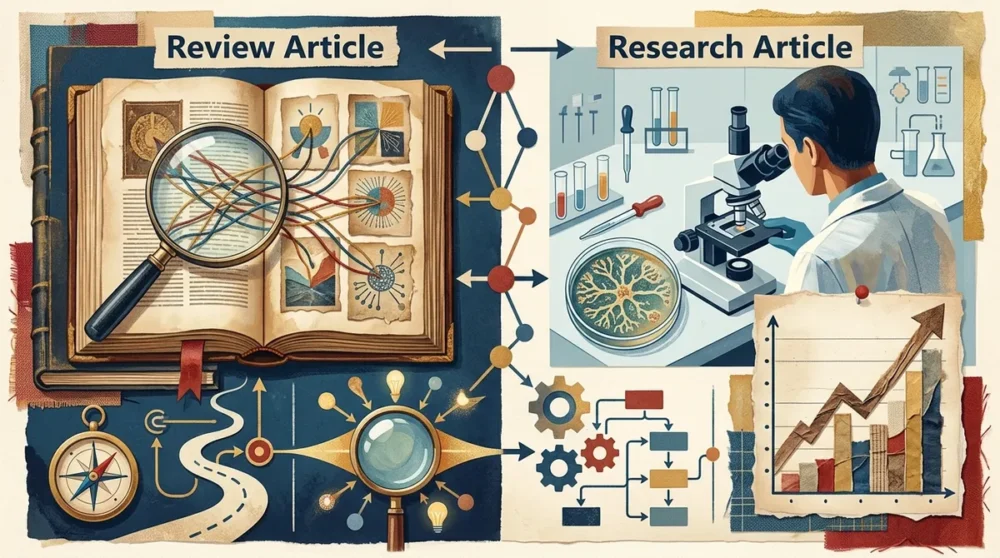
Many early-career researchers confuse review articles with original research articles. Understanding the difference helps you choose the right format for your work and target the right journals.
| Feature | Review Article | Research Article |
|---|---|---|
| Primary purpose | Synthesize existing literature | Report new experimental results |
| New data | No original data collected | Yes, new data is collected and analyzed |
| Structure | Flexible; often thematic or chronological | IMRAD (Introduction, Methods, Results, Discussion) |
| Scope | Broad, covering multiple studies | Narrow, focused on one study |
| Value to readers | Provides a field overview and identifies gaps | Adds one new finding to the field |
Understanding this table helps researchers decide whether their manuscript fits a review or original research format. If you are unsure how your paper should be structured, the knowledge center at San Francisco Edit offers guidance on a range of manuscript types and writing strategies.

Main Types of Review Articles
Not all review articles are the same. Journals recognize several distinct types, each with its own scope and method. Choosing the right type is a critical first step before writing your manuscript.
- Narrative review: A broad overview of a topic based on the author’s selection of relevant literature. It offers depth and context but is less systematic than other types.
- Systematic review: A structured, reproducible search of the literature using defined criteria. It is the gold standard in evidence-based medicine and science.
- Meta-analysis: A statistical synthesis of data from multiple studies. It quantitatively combines results to reach broader conclusions.
- Scoping review: Maps the available evidence on a topic, particularly useful when the field is new or poorly defined.
- Mini-review: A shorter, focused review that covers a narrow topic or recent developments in a specific area.
Each type serves a different purpose. Journals often specify which type they accept, so always check the submission guidelines before you start writing. You can also learn more by exploring this detailed resource on how to write a scientific review article that gets published.

How to Structure a Review Article
Good structure makes your review article easier to read and evaluate. Editors and reviewers assess organization as part of their decision-making process. Follow these steps to build a well-structured review manuscript.
- Define your scope and research question. A clear focus is essential. Your review should address a specific question or gap in the literature, not simply describe everything written on a subject.
- Search the literature systematically. Use databases such as PubMed and others relevant to your field. Document your search terms and criteria so your approach is transparent and reproducible.
- Select and organize your sources. Choose primary research articles, prioritizing those published within the past two to five years. Cell Press guidance notes that recent references keep a review timely and relevant for journal readers.
- Write a focused introduction. Your introduction should explain why the topic matters, what gap exists in the literature, and what your review aims to accomplish. This section sets the context for everything that follows.
- Develop the body with thematic or chronological sections. Organize the synthesis logically. Group related findings, highlight agreements and contradictions, and offer your critical analysis throughout.
- Write a conclusions section that points forward. Summarize the key insights from your synthesis. Identify remaining gaps and suggest directions for future research.
- Prepare an abstract that reflects the full review. Your abstract should briefly explain the scope, approach, and key findings of your review. For more on writing effective abstracts, see this resource on how to write an abstract for a scientific paper.
What Editors Look for When Evaluating a Review Article
Understanding editorial expectations helps you strengthen your manuscript before submission. Editors typically screen review articles on several key dimensions before sending them to peer reviewers.
- Scope fit: Does the review topic align with the journal’s aims and audience?
- Originality: Does the review offer something unique that readers cannot easily find elsewhere?
- Currency: Are references current? Most editors expect the majority of cited work to be from the past two to five years.
- Language quality: Is the manuscript clearly written in accurate English?
- Ethical compliance: Are citations accurate and is plagiarism avoided?
- Formatting: Does the manuscript follow the journal’s submission guidelines?
Peer reviewers then assess additional factors, including whether the review is understandable to non-specialists, whether the evidence is balanced, and whether the conclusions are supported by the literature cited. According to Cell Press guidance on evaluating review articles, reviewers also consider whether the manuscript adds genuine value for the journal’s readership.
Common Weaknesses in Review Article Manuscripts
Many review manuscripts are rejected or returned for major revision due to avoidable problems. Knowing the most common weaknesses helps you correct them before submission.
- Scope is too broad or too narrow to be useful
- Literature coverage is incomplete or heavily outdated
- The review summarizes studies without offering critical analysis
- Key contradictions or gaps in the literature are ignored
- Language is unclear, especially for non-native English-speaking authors
- Formatting does not match the target journal’s requirements
Non-native English speakers face particular challenges when writing review articles. Precise, clear language is essential for communicating complex syntheses to an international readership. Professional language editing can make a significant difference in how reviewers perceive your manuscript.
How Long Should a Review Article Be
Review article length varies widely depending on the journal and review type. Most full-length review articles range from 4,000 to 10,000 words. Systematic reviews and meta-analyses often fall toward the longer end. Mini-reviews may be as short as 2,000 to 3,000 words.
Always check the journal’s author guidelines for specific word count requirements. Some journals also specify limits on the number of references, figures, and tables. Exceeding these limits is a common reason for manuscripts to be returned before peer review even begins. For guidance on structuring your manuscript correctly, see this resource on how to structure a scientific review article from planning to publication.
Publication Timelines for Review Articles
Understanding how long the publication process takes helps you set realistic expectations. Timelines vary by journal, but general patterns apply across most peer-reviewed publications.
| Stage | Typical Timeframe |
|---|---|
| Initial editorial screening | 1–4 weeks |
| Peer review process | 4–12 weeks |
| Author revision period | 2–8 weeks |
| Re-review (if required) | 2–6 weeks |
| Acceptance to publication | 2–8 weeks |
| Best-case total timeline | Under 6 months |
| Revise-and-resubmit path | 12–18 months |
A well-prepared manuscript reduces the risk of avoidable delays. Submitting a clear, well-edited review article from the start is the most effective way to shorten the time to publication. The scientific editing service at San Francisco Edit is designed to help authors at every stage of this process.
How Professional Editing Strengthens a Review Article
Even experienced researchers benefit from professional editing before submission. A skilled scientific editor does much more than correct grammar. They evaluate the logic of your synthesis, the clarity of your argument, and the overall flow of your manuscript.
For review articles specifically, professional editing helps ensure that:
- Your scope is clearly defined and consistently maintained throughout the manuscript
- Your critical analysis is evident and not buried under description
- Transitions between sections are logical and easy to follow
- Your abstract accurately represents the full scope of your review
- Language is precise, consistent, and appropriate for your target journal
San Francisco Edit offers professional editing and proofreading services performed by native English-speaking PhD scientists. With a 98 percent acceptance rate for edited manuscripts and more than 325 years of combined staff experience, the team understands what journals expect from review articles. Whether you are preparing your first review or refining a complex meta-analysis, professional editing gives your manuscript the best possible chance of acceptance. Learn more about what editors do for your work by reading what you can expect from a scientific editor.
For additional guidance on writing manuscripts that meet publication standards, explore the full range of resources in our writing and publishing blog, including articles on how to write a scientific paper, structure your discussion section, and present your research effectively.
Conclusion
A review article is one of the most valuable contributions you can make to your field. It helps researchers navigate large bodies of literature, identifies where knowledge is incomplete, and sets the agenda for future investigation. Writing a strong review article requires clear scope, critical analysis, current references, and precise language. Journals and peer reviewers evaluate all of these dimensions carefully before accepting a manuscript for publication.
Whether you are an early-career scientist writing your first review or an established researcher preparing a systematic review for a high-impact journal, professional editing support can make a measurable difference. Take the next step toward publication and submit your manuscript to San Francisco Edit for expert review and editing by PhD scientists who understand the publication process.
FAQs
Q: What is the difference between a review article and a research article?
A: A review article synthesizes and critically evaluates previously published research without presenting new experimental data. A research article reports the results of an original study conducted by the authors. The two formats serve different purposes and follow different structural conventions in peer-reviewed journals.
Q: Do review articles need to undergo peer review?
A: Yes, most journals require review articles to undergo peer review before acceptance, just like original research articles. Reviewers assess the balance, currency, accuracy, and originality of the review, as well as whether the manuscript is clearly written and adds genuine value for the journal’s readership.
Q: How current should the references be in a review article?
A: Most editors and reviewers expect the majority of references in a review article to come from primary research published within the past two to five years. Including very outdated citations without clear justification can signal that the review does not reflect the current state of the field.
Q: What makes a review article publishable in a scholarly journal?
A: A publishable review article must define a clear scope, offer critical analysis rather than simple description, use current and complete literature coverage, and provide a synthesis that adds something new to the field. Clear, precise language and correct formatting according to the target journal’s guidelines are also essential.
Q: How long should a review article be?
A: Most full-length review articles range from 4,000 to 10,000 words, depending on the journal and review type. Mini-reviews may be shorter, while systematic reviews and meta-analyses often fall toward the longer end. Always check the specific word count requirements in your target journal’s author guidelines before writing.