Key Takeaways
- State the research problem precisely in the first sentence, using specific data or a clear focus to immediately engage readers.
- Balance your opening by following your problem statement with a concise sentence explaining why the research matters contextually.
- Use active voice and straightforward language that can be understood by experts and non-experts across disciplines.
- Allocate approximately 50 words (25% of your abstract) to introduce your research purpose and context effectively.
- Draft your opening by first identifying the key problem your research addresses, using direct and specific language.
- Write your abstract after completing your research, ensuring it accurately reflects your actual findings and conclusions.
- Edit your opening sentences ruthlessly, eliminating unnecessary words, passive constructions, and vague generalizations.
Starting an abstract can feel overwhelming, especially when you have only 150-250 words to capture your entire research project. The opening sentences of your abstract are crucial—they determine whether readers will continue reading or move on to another paper. A strong abstract opening immediately communicates your research purpose and captures attention without wasting precious words on unnecessary background information.
Whether you are preparing your first manuscript for publication or refining your academic writing skills, understanding how to craft an effective abstract opening is essential. This guide will walk you through proven strategies to start your abstract with confidence and clarity, ensuring your research gets the attention it deserves.

Understanding the Purpose of an Abstract Opening
The opening of your abstract serves as a gateway to your research. In just one or two sentences, you must establish the relevance of your study and engage your target audience. Think of it as the hook that draws readers into your work while providing essential context for what follows.
Your abstract opening should answer a fundamental question: Why does this research matter? Readers scanning through dozens or hundreds of abstracts need to quickly grasp the significance of your work. A well-crafted opening statement positions your research within its broader context without diving into excessive detail.
According to PubMed research guidelines, the most effective abstracts follow a clear structure that begins with a concise statement of the problem or research question. This approach immediately orients readers and sets expectations for the information that follows.
The Essential Components of an Effective Abstract Opening
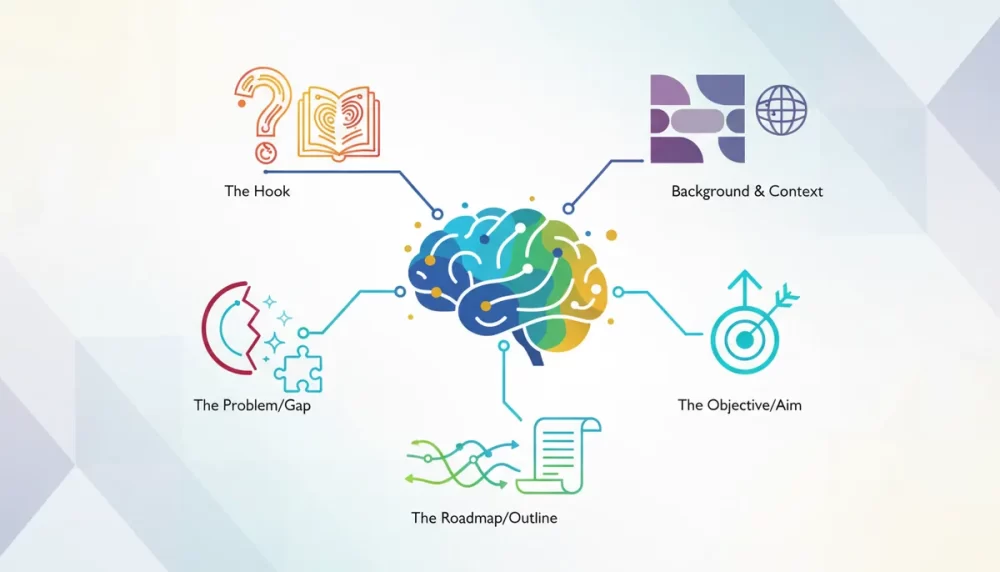
An effective abstract opening contains three key elements that work together to create a compelling introduction to your research. Understanding these components will help you craft an opening that is both informative and engaging.
State the Research Problem or Question
Begin your abstract by clearly stating the research problem, purpose, or question your study addresses. This should be direct and specific, avoiding vague generalizations. For example, instead of writing “Many people struggle with health issues,” write “Approximately 30% of adults over 65 experience age-related cognitive decline.”
Your problem statement should be precise enough to give readers a clear understanding of your research focus, but broad enough to establish its relevance. This balance is critical for drawing in readers who may be scanning multiple abstracts quickly.
Provide Brief Context
After stating your research problem, include one sentence of context that explains why this problem matters. This context should highlight the social, academic, or practical relevance of your research without providing a lengthy literature review. Think of this as your justification for why the study needed to be conducted.
For instance, if your research examines a new treatment method, your context might note the limitations of current approaches or the prevalence of the condition being treated. This establishes the gap your research fills without requiring extensive background explanation.
Use Clear and Direct Language
Clarity is paramount in abstract writing. Use active voice, short sentences, and straightforward language that non-experts can understand. Avoid jargon, complex terminology, and passive constructions that make your writing feel distant or inaccessible.
Remember that abstracts are often read by researchers outside your specific subfield, journal editors, and even general readers. Your opening should be comprehensible to this diverse audience while maintaining academic rigor and precision.
The IMRaD Structure: Allocating Space in Your Abstract
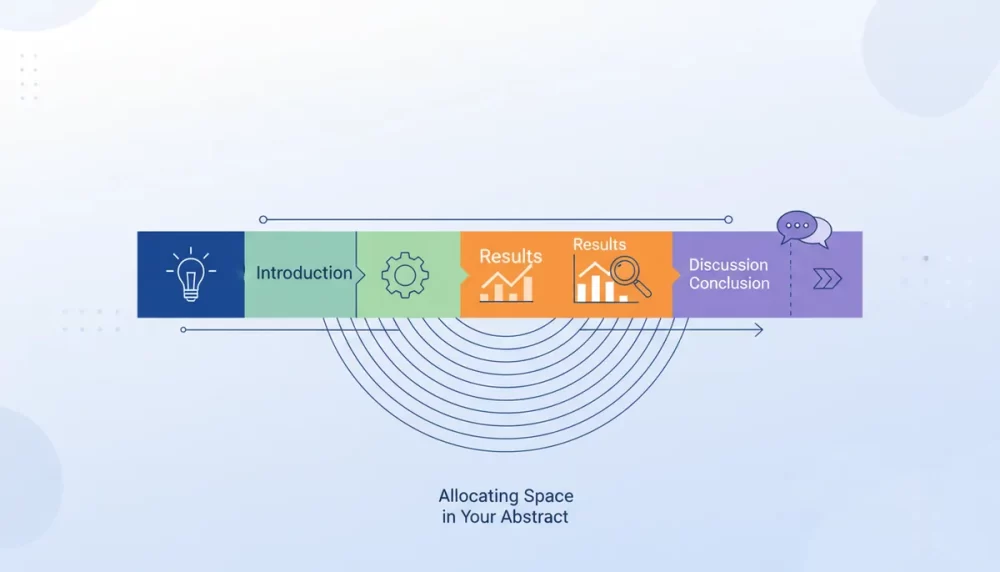
Most scientific abstracts follow the IMRaD structure, which stands for Introduction, Methods, Results, and Discussion. Understanding how to allocate your limited word count across these sections will help you craft a balanced and effective abstract.
The recommended space allocation for a standard 200-word abstract is:
| Section | Percentage of Space | Approximate Word Count | Purpose |
|---|---|---|---|
| Introduction/Purpose | 25% | 50 words | State problem and context |
| Methods | 25% | 50 words | Describe approach and methodology |
| Results | 35% | 70 words | Present key findings |
| Discussion/Implications | 15% | 30 words | Interpret significance |
With approximately 50 words allocated to your introduction, you have limited space to establish your research purpose. This constraint forces you to be strategic about every word you include in your opening sentences.
The introduction section of your abstract should focus solely on the research problem and its relevance. Save detailed background information, literature reviews, and theoretical frameworks for the main body of your paper. Your abstract readers need to quickly understand what you studied and why—everything else is secondary.

Step-by-Step Process for Writing Your Abstract Opening
Creating a strong abstract opening becomes easier when you follow a systematic approach. Here is a practical step-by-step process that will help you craft an effective opening every time.
Step 1: Complete Your Research First
Always write your abstract after completing your research paper. Abstracts summarize finished work, not proposed studies. This distinction is important because your abstract should reflect your actual findings and conclusions, not your initial hypotheses or intended methodology.
Many researchers make the mistake of writing their abstract too early in the process. This often results in an abstract that does not accurately represent the final paper or requires extensive revision later.
Step 2: Use Reverse Outlining
Reverse outlining is a powerful technique for abstract writing. Read through your completed paper and summarize the key point from each major section in one sentence. This gives you the raw material for your abstract and ensures you capture the most important information from your research.
For your opening sentences, focus on the key points from your introduction section. What problem did you identify? Why does it matter? What gap in knowledge does your research address? These questions will guide your abstract opening.
Step 3: Draft Your Opening Statement
Write your opening statement as a single, clear sentence that identifies your research problem or question. Use active voice and specific language. For example:
- “This study examines the effect of mindfulness meditation on workplace stress among healthcare professionals.”
- “Despite advances in treatment, antibiotic resistance remains a growing threat to public health systems worldwide.”
- “Limited research has explored the relationship between sleep quality and academic performance in undergraduate students.”
- “Current methods for detecting early-stage breast cancer lack the sensitivity needed for effective screening in high-risk populations.”
Step 4: Add One Sentence of Context
Follow your opening statement with a brief contextual sentence that explains the significance or relevance of your research problem. This sentence should answer the implicit question “So what?” that readers might have after reading your problem statement.
Your context sentence might reference prevalence rates, current limitations in the field, or the practical implications of the problem. Keep it focused and avoid the temptation to provide extensive background information.
Step 5: Edit for Conciseness
Review your opening sentences and eliminate any unnecessary words or phrases. Common culprits include:
- Filler phrases like “It is important to note that” or “Research has shown that”
- Redundant adjectives or adverbs
- Passive voice constructions
- Vague generalizations that do not add specific information
- Phrases like “This paper will examine” (use present tense instead)
- Multiple introductory clauses that delay your main point
Common Mistakes to Avoid When Starting an Abstract
Understanding what not to do is just as important as knowing the right approach. These common mistakes can weaken your abstract opening and reduce the impact of your research.
Starting with Excessive Background Information
One of the most frequent errors is beginning with too much background or contextual information. While context is important, your abstract opening should not read like a condensed literature review. Readers need to quickly grasp your specific research focus, not a history of the field.
For example, avoid openings like: “For centuries, scientists have studied the effects of environmental factors on human health. In recent decades, this research has expanded to include…” Instead, get straight to your specific research problem.
Using Passive Voice and Weak Verbs
Passive voice makes your writing feel distant and less engaging. Compare these two openings:
- Passive: “The effects of social media on adolescent mental health were examined in this study.”
- Active: “This study examines how social media affects adolescent mental health.”
The active voice version is more direct, engaging, and easier to read. It also uses fewer words, which is valuable given your strict word count limitations.
Including Citations or References
Abstracts should be self-contained and typically do not include citations or references. Your opening should present your research problem and context without referencing specific studies or authors. Save detailed citations for the main body of your paper.
If you feel that a statistic or fact needs attribution to establish credibility, consider whether that information is truly necessary in your abstract. Often, you can convey the same point without the citation.
Writing in Future Tense
Abstracts describe completed research, so they should be written in past or present tense, not future tense. Avoid phrases like “This paper will examine” or “We will investigate.” Instead, use “This paper examines” or “We investigated.”
Different Types of Abstracts and Their Openings
Not all abstracts follow the same format. Understanding the differences between abstract types will help you tailor your opening to meet specific requirements.
Informative Abstracts
Informative abstracts are the most common type in scientific writing. They follow the IMRaD structure and provide a complete summary of your research, including methods, results, and conclusions. The opening of an informative abstract should clearly state the research problem and provide brief context in 1-2 sentences.
Informative abstracts typically range from 150-250 words and are required for most journal submissions. They give readers enough information to understand your study without reading the full paper.
Descriptive Abstracts
Descriptive abstracts are shorter (usually 100-250 words) and more common in humanities research. They describe what the paper is about without providing specific results or conclusions. The opening of a descriptive abstract often frames the research question as a problem or puzzle that the paper will explore.
For descriptive abstracts, your opening might use a more engaging or thought-provoking approach. For example: “What drives individuals to make altruistic choices that contradict their self-interest?” This type of opening draws readers in with an intriguing question rather than a straightforward problem statement.
Conference Abstracts
Conference abstracts can range from 150-1000 words depending on the conference guidelines. The opening approach remains similar—state your research problem clearly—but you may have more space to provide context or background information than in a traditional journal abstract.
Always check the specific guidelines for your target conference or journal. Some may require a structured abstract with labeled sections (Background, Methods, Results, Conclusions), while others prefer an unstructured paragraph format.
Crafting an Engaging Title to Complement Your Opening
Your abstract does not exist in isolation—it works together with your title to attract readers. An effective title is dynamic and informative, conveying your core topic without being overly descriptive or vague.
A strong title should:
- Accurately reflect your research focus and main findings
- Use specific keywords that researchers will search for
- Be concise (typically 10-15 words)
- Avoid jargon or abbreviations that non-specialists might not understand
- Create interest without being sensationalistic
Your title and abstract opening should work together seamlessly. The title introduces your topic at a high level, while your abstract opening provides the specific research problem and context. Together, they create a compelling entry point to your research.
Tips for Writing Abstracts for Non-Native English Speakers
If English is not your first language, writing clear and effective abstracts can present additional challenges. However, with careful attention to language and structure, you can create abstracts that communicate your research effectively to an international audience.
Focus on using simple, direct sentences rather than complex grammatical structures. This approach not only makes your writing clearer for readers but also reduces the likelihood of grammatical errors. When in doubt, choose shorter words and simpler constructions.
Common challenges for non-native English speakers include:
- Incorrect article usage (a, an, the)
- Confusing verb tenses or mixing tenses inconsistently
- Word order problems that make sentences unclear
- Using words that have slightly different meanings than intended
- Overusing complex sentence structures that increase error risk
- Translating phrases directly from your native language
Professional editing services like scientific editing can help ensure your abstract meets the clarity and precision standards required for publication in peer-reviewed journals. San Francisco Edit specializes in helping researchers improve their manuscripts, with native English-speaking PhD scientists who understand the technical requirements of academic writing.
Editing and Refining Your Abstract Opening
Your first draft is rarely your best draft. Effective abstract writing requires careful editing and refinement to ensure every word serves a purpose and contributes to reader understanding.
Read Your Opening Aloud
Reading your abstract opening aloud helps you identify awkward phrasing, run-on sentences, and unclear expressions. If you stumble while reading or need to reread a sentence to understand it, your readers will likely have the same experience.
Pay attention to the rhythm and flow of your sentences. Short, punchy sentences work well for opening statements, while slightly longer sentences can provide necessary context. Varying your sentence length creates a more engaging reading experience.
Check for Clarity and Precision
Every word in your abstract opening should contribute to clarity and precision. Ask yourself these questions:
- Does my opening sentence clearly state my research problem or question?
- Can readers outside my specific subfield understand what I studied?
- Have I avoided unnecessary jargon or technical terms?
- Does my context sentence explain why this research matters?
Verify Consistency with Your Full Paper
Your abstract opening must accurately reflect the content of your full paper. If your paper evolved during the writing process, make sure your abstract captures the final version of your research, not your initial intentions.
Check that your problem statement in the abstract matches how you frame your research in your introduction. Inconsistencies between your abstract and paper can confuse readers and may raise concerns during peer review.
Real-World Examples of Effective Abstract Openings
Examining successful abstract openings from published research can provide valuable insights into effective techniques. Here are examples from different disciplines that demonstrate strong opening strategies.
Medical Research Example
“Hospital-acquired infections affect approximately 1.7 million patients annually in the United States, contributing to significant morbidity and increased healthcare costs. This study evaluates the effectiveness of a novel sterilization protocol in reducing infection rates in surgical wards.”
This opening works because it immediately establishes the scope of the problem with a specific statistic, explains why it matters (morbidity and costs), and clearly states what the study examined. In just two sentences, readers understand the research context and purpose.
Social Science Example
“Despite increasing workplace diversity initiatives, minority professionals remain underrepresented in senior leadership positions across most industries. This research investigates the structural barriers that prevent career advancement for minority employees in Fortune 500 companies.”
This opening identifies a persistent problem, provides context about its prevalence, and clearly states the research focus. It uses straightforward language that is accessible to readers from various backgrounds.
Environmental Science Example
“Coral reef ecosystems face unprecedented threats from rising ocean temperatures and acidification. We examined the adaptive capacity of three coral species in the Great Barrier Reef to identify resilience factors that may inform conservation strategies.”
This example establishes urgency (unprecedented threats), provides geographic specificity (Great Barrier Reef), and clearly states both what was studied and why (to inform conservation). The active voice makes the research feel immediate and relevant.
How Professional Editing Can Strengthen Your Abstract
Even experienced researchers benefit from professional editing, especially when preparing manuscripts for high-impact journals. A fresh set of expert eyes can identify unclear phrasing, grammatical errors, and structural issues that you might miss after working closely with your research for months or years.
San Francisco Edit provides specialized editing services for scientific, medical, and general manuscripts, helping researchers improve their work for publication in peer-reviewed journals. With a 98% acceptance rate for edited papers, their team of native English-speaking PhD scientists understands both the linguistic and technical requirements of academic publishing.
Professional editing services offer several advantages:
- Native English expertise that ensures clarity and precision
- Subject-matter knowledge that maintains technical accuracy
- Experience with journal-specific formatting and style requirements
- Objective feedback on structure and organization
- Quick turnaround times (6-8 days standard, 3-4 days rush)
For researchers whose primary language is not English, professional editing is particularly valuable. It ensures your research is communicated clearly and meets the linguistic standards expected by top-tier journals. Language editing services can transform a technically sound paper with language barriers into a polished manuscript ready for submission.
Abstract Length Guidelines Across Different Contexts
Different publication venues have different abstract length requirements. Understanding these variations will help you tailor your opening to fit within the specified constraints.
| Context | Typical Length | Opening Focus | Key Considerations |
|---|---|---|---|
| Journal Articles | 150-250 words | Problem and brief context | Follow journal-specific guidelines |
| Conference Abstracts | 150-1000 words | Problem with more context allowed | May require structured format |
| Dissertation Abstracts | 150-350 words | Research question and significance | Often more detailed than journal abstracts |
| Grant Proposals | 200-500 words | Problem, significance, and innovation | Emphasize broader impacts |
Regardless of length, your opening sentences should remain focused on clearly stating your research problem and providing essential context. Longer abstracts give you more space to elaborate, but they should not change your fundamental opening strategy.
Always check the specific requirements for your target journal, conference, or funding agency. Some organizations provide detailed instructions about abstract structure, including what information should appear in each section. Following these guidelines carefully increases your chances of acceptance.
Frequently Asked Questions About Starting an Abstract
As you develop your abstract writing skills, you may encounter common questions about best practices and requirements. Here are answers to some of the most frequently asked questions about starting an abstract.
Should I Use First Person or Third Person?
Both first person (we/I) and third person are acceptable in abstracts, though conventions vary by discipline. Scientific and medical fields increasingly accept first person, especially when describing what the researchers did. Social sciences and humanities may use either approach. Check recent abstracts in your target journal to see which style is more common.
Can I Start with a Question?
Starting with a research question can be effective, especially in descriptive abstracts or humanities research. However, in most scientific abstracts, a direct statement of the research problem is more common and efficient. If you do use a question, follow it immediately with a statement of how your research addresses that question.
How Technical Should My Opening Be?
Your opening should be accessible to readers with general knowledge in your field, not just specialists in your specific subfield. Avoid highly technical jargon in your opening sentences. You can introduce more specific terminology later in the abstract when describing your methods or results.
Do I Need to Mention My Results in the Opening?
No, your opening should focus on the research problem and context. Results belong in the middle section of your abstract after you have established what you studied and how you studied it. Jumping to results in your opening can confuse readers who do not yet understand your research context.
Conclusion: Mastering the Art of Abstract Openings
Starting an abstract effectively requires clarity, precision, and strategic thinking about how to use your limited word count. By focusing on a clear statement of your research problem and providing brief but essential context, you create an opening that engages readers and sets the stage for the detailed information that follows.
Remember these key principles as you craft your abstract openings: use active voice, keep sentences short and clear, avoid excessive background information, and ensure every word serves a purpose. Whether you are writing your first abstract or your fiftieth, these strategies will help you communicate your research more effectively.
For researchers preparing manuscripts for publication, professional editing can make a significant difference in your success rate. San Francisco Edit specializes in helping authors improve scientific, medical, and general manuscripts for peer-reviewed journals, with experienced editors who understand both the technical content and the linguistic precision required for publication. Submit your manuscript to receive expert editing that can increase your chances of acceptance and ensure your research reaches the widest possible audience.
FAQs
Q: What is the IMRaD structure for abstracts?
A: The IMRaD structure stands for Introduction, Methods, Results, and Discussion. This standard format allocates approximately 25% of space to introduction (stating the problem), 25% to methods (describing your approach), 35% to results (presenting key findings), and 15% to discussion (interpreting significance). This structure helps organize information logically and ensures all essential components are included within the typical 150-250 word limit.
Q: How long should an abstract opening be?
A: An abstract opening should be 1-2 sentences or approximately 50 words in a standard 200-word abstract. This represents about 25% of your total word count and should include a clear statement of your research problem or question plus one brief sentence of context. Keep it concise and focused, avoiding excessive background information that consumes valuable space needed for methods, results, and conclusions.
Q: Should I write my abstract before or after completing my research paper?
A: Always write your abstract after completing your research paper. Abstracts summarize finished work and should accurately reflect your actual methods, results, and conclusions rather than your initial hypotheses or intended approach. Writing your abstract last ensures it aligns with your final paper and captures the most important findings. Use reverse outlining—summarizing key points from each section—to create an accurate and comprehensive abstract.
Q: Can I include citations or references in my abstract opening?
A: No, abstracts should typically not include citations or references. Abstracts are meant to be self-contained summaries that present your research independently without referencing other studies or authors. If you feel a statistic needs attribution, consider whether that specific detail is truly necessary for your abstract opening or if you can convey the same point without the citation. Save detailed references for the main body of your paper.
Q: What are the most common mistakes when starting an abstract?
A: The most common mistakes include starting with excessive background information instead of getting straight to your research problem, using passive voice and weak verbs that make writing less engaging, including unnecessary jargon that alienates non-specialist readers, and writing in future tense instead of past or present tense. Other errors include failing to provide clear context for why the research matters and trying to include too much information in the opening sentences, which should remain focused and concise.