Key Takeaways
-
Background research systematically reviews existing studies and findings to position your study within the broader field, directly impacting whether your manuscript gets accepted or rejected by journal editors.
-
A strong background section answers three critical questions: what is already known, what remains unknown, and why your specific study is necessary now, building a logical argument that justifies your research.
-
Weak background sections are among the most common reasons manuscripts are rejected before peer review; editors and reviewers quickly identify papers lacking proper context and credibility.
-
Background research differs from literature reviews: it is concise (1-3 paragraphs), contextualizes your specific study, and appears in the Introduction, while literature reviews are comprehensive and standalone.
-
Conduct background research systematically by defining your research question, searching reputable databases like PubMed, prioritizing recent peer-reviewed sources, explicitly identifying the research gap, and organizing your narrative logically.
-
Professional manuscript editors evaluate your background section for logical flow, citation accuracy, relevance, currency of literature, and clarity, helping non-native English authors transform good manuscripts into publication-ready ones.
Every strong research manuscript begins with a solid foundation. That foundation is built on background research. Whether you are writing your first journal article or your twentieth, understanding what background research is — and how to use it effectively — can make a significant difference in whether your manuscript gets accepted or rejected.
In manuscript writing, background research is the process of reviewing existing literature, prior findings, and contextual information relevant to your study. It forms the backbone of your manuscript’s background section, which typically sits within the Introduction. A well-constructed background section tells reviewers why your research matters, what is already known, and where the gap in knowledge lies. Getting this right is one of the most important steps in preparing a publishable paper.

What Is Background Research in a Research Manuscript?
Background research refers to the systematic review of existing studies, findings, and scholarly discussions that relate to your research topic. It is not simply a literature dump. Instead, it is a curated, logical narrative that positions your study within the broader field. For more guidance on writing this section effectively, see how to write the background of your scientific paper.
The background section answers three key questions for your reader:
- What do we already know about this topic?
- What remains unknown or unresolved?
- Why is this specific study necessary now?
A strong background section does more than summarize past work. It builds a logical argument that leads naturally to your research question. Databases like PubMed are valuable tools for identifying peer-reviewed sources that can anchor your background narrative.

Why Background Research Matters for Manuscript Success
Journal editors and peer reviewers read thousands of manuscripts. They quickly identify papers that lack proper context. A weak or incomplete background section is one of the most common reasons manuscripts are rejected before peer review even begins.
Here is why background research is critical to manuscript success:
- It establishes credibility. Citing relevant prior work shows that you understand the field.
- It justifies your study. A clear research gap makes the case for why your work is needed.
- It guides the reader. Contextual information helps readers who are unfamiliar with your specific topic.
- It strengthens your argument. Well-chosen citations reinforce the logic of your study design.
- It satisfies journal requirements. Most peer-reviewed journals expect a thorough and accurate background section.
Understanding key elements every scientist should know about writing an introduction for publication can help you see how background research fits into the broader structure of your manuscript.
How Background Research Differs from a Literature Review
Many authors confuse the background section with a full literature review. They serve related but distinct purposes. The table below clarifies the key differences:
| Feature | Background Section | Literature Review |
|---|---|---|
| Location in manuscript | Part of the Introduction | Standalone section or chapter |
| Purpose | Contextualizes the specific study | Comprehensively surveys a field |
| Length | Concise (1–3 paragraphs typically) | Can be extensive (many pages) |
| Focus | Directly relevant prior work | Broad coverage of a topic |
| Common in | Original research articles | Review articles, theses, dissertations |
For a deeper understanding of how to approach a thorough review of existing literature, explore how to write a literature review for a research paper.
Step-by-Step: How to Conduct Background Research for Your Manuscript
Conducting effective background research is a structured process. Follow these steps to build a strong foundation for your manuscript’s background section.
Step 1: Define the Scope of Your Research Topic
Before you begin searching, clarify what your study is about. Write down your research question in one or two sentences. This helps you stay focused and avoid including irrelevant information in your background section.
Step 2: Search Reputable Academic Databases
Use reliable databases to find peer-reviewed sources. PubMed is an excellent resource for biomedical and life science research. Also consider databases such as Scopus, Web of Science, and Google Scholar. Use specific search terms related to your topic, study population, and outcomes.
Step 3: Evaluate and Select Relevant Sources
Not every article you find will be worth citing. Prioritize sources that are:
- Recently published (within the last five to ten years, unless seminal works)
- Peer-reviewed and published in reputable journals
- Directly relevant to your specific research question
- Representative of the current state of knowledge in the field
- Methodologically sound and widely cited
Step 4: Identify the Research Gap
As you review your sources, look for what is missing. What questions remain unanswered? What populations have not been studied? What methods have not been applied? This gap is the foundation of your study’s justification. For help with structuring this argument, see how to define your research goals using a problem statement.
Step 5: Organize Your Background Narrative
Once you have your sources, arrange them logically. A common approach is to move from broad context to specific issues. Start with general background about the topic, then narrow down to the specific problem your study addresses. This creates a logical funnel structure that leads readers naturally to your research question.
Step 6: Write and Cite Accurately
Write your background section in clear, precise language. Cite every claim that is not your own original finding. Make sure your citation format matches the requirements of your target journal. Inaccurate or missing citations are a common reason for manuscript revision requests.
What Manuscript Editors Look for in the Background Section
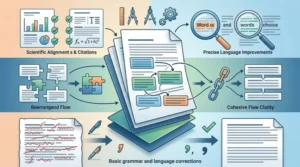
When a professional manuscript editor reviews your background section, they assess more than grammar and spelling. A skilled editor evaluates the content, logic, and completeness of the section. This is what makes expert editing so valuable.
Here is what a qualified manuscript editor typically examines:
- Logical flow: Does the narrative move clearly from general context to the specific research gap?
- Citation accuracy: Are the right sources cited, and are they formatted correctly for the target journal?
- Relevance: Are all cited studies directly relevant to the research topic?
- Currency: Does the background include recent literature, or is it outdated?
- Completeness: Are any important prior studies missing that reviewers would expect to see?
- Clarity: Is the writing clear enough for an international readership?
Editors with subject-matter expertise are especially effective in this role. They can assess whether the manuscript’s scientific framing is appropriate and whether the background accurately represents the state of the field. Learn more about what you can expect from a scientific editor during this process.
Common Mistakes in Background Research for Manuscripts
Even experienced researchers make errors in their background sections. Knowing these common mistakes helps you avoid them before submission.
| Common Mistake | Why It Is a Problem | How to Fix It |
|---|---|---|
| Citing outdated sources only | Suggests unfamiliarity with current research | Include recent publications (last 5 years) |
| Including irrelevant citations | Dilutes the argument and confuses readers | Only cite directly relevant studies |
| Failing to identify the research gap | Leaves reviewers questioning why the study was done | Explicitly state what remains unknown |
| Poor citation formatting | Signals careless preparation to journal editors | Follow target journal citation guidelines exactly |
| Overly long background section | Delays presentation of the research question | Be concise and focused in your narrative |
For guidance on structuring your paper to avoid these and other errors, see how to structure a research paper correctly. You may also find it useful to review common reasons why scientific manuscripts are rejected by journals.
How Professional Editing Strengthens Your Background Section
Writing a strong background section is challenging even for fluent English speakers. For non-native English authors, it presents an additional layer of difficulty. Clear, precise language is essential because reviewers from top journals expect a professional standard of writing throughout the manuscript.
Professional scientific editing services go beyond grammar correction. They provide content-level review that assesses whether your background section is logically structured, accurately cited, and well-positioned for your target journal. This is exactly where San Francisco Edit adds measurable value.
San Francisco Edit is a specialist manuscript editing service staffed by native English-speaking PhD scientists. The team brings subject-matter expertise across life sciences, medicine, engineering, and social sciences. With over 325 combined years of editing experience and a 98% manuscript acceptance rate, San Francisco Edit reviews your background section for logical flow, citation accuracy, language clarity, and alignment with your target journal’s expectations. For non-native English authors especially, this kind of expert review can transform a good manuscript into a publication-ready one. Explore how scientific editing enhances publication chances for non-native English speakers.
You can also consult the knowledge center for additional resources on writing and editing your manuscript effectively. And for a broader perspective on what complete manuscript preparation involves, visit the PubMed Central open access archive to review published examples in your field.
Background Research in Context: The Full Manuscript Picture
Background research does not exist in isolation. It connects directly to every other section of your manuscript. Your background section should set up your methods, inform your results interpretation, and tie into your discussion. A weak background section creates ripple effects throughout the entire paper.
Here is how background research connects to other key manuscript sections:
- Introduction: The background section is embedded here and leads to your research question.
- Methods: Your background justifies the study design you chose. See how to write a methods section.
- Results: Your findings are interpreted in light of what prior studies showed.
- Discussion: You revisit the background to compare your results with existing evidence. Learn more at how to write a discussion section for a research paper.
When your background research is thorough and well-presented, it creates a coherent narrative that runs through the entire manuscript. This coherence is what journal reviewers and editors find most compelling in a submission. For a complete view of manuscript structure, explore 11 essential steps to write a manuscript for publication.
Conclusion
Background research is not a formality. It is the intellectual foundation of your entire manuscript. A well-conducted and clearly written background section shows reviewers that you understand the field, have identified a genuine knowledge gap, and have designed your study to address it. It builds the case for why your work deserves to be published.
Taking time to conduct thorough background research — and to present it effectively — directly improves your chances of journal acceptance. If you are unsure whether your background section is as strong as it could be, professional manuscript editing can provide the expert review your paper deserves.
When you are ready to take the next step, submit your manuscript to San Francisco Edit and let our team of PhD scientists help you achieve publication success.
FAQs
Q: What is the background of the study in a research manuscript?
A: The background of the study is a section within the Introduction that provides contextual information about the research topic. It summarizes what prior studies have established, identifies remaining knowledge gaps, and explains why the new study is necessary.
Q: How is background research different from a literature review?
A: Background research focuses specifically on contextualizing your study and is typically a concise part of the Introduction. A literature review is a broader, more comprehensive survey of existing scholarship, often appearing as a standalone section in review articles, theses, or dissertations.
Q: What do manuscript editors look for in the background section?
A: Professional manuscript editors assess the logical flow, citation accuracy, relevance of sources, currency of literature, and clarity of writing in the background section. Editors with subject-matter expertise can also evaluate whether the scientific framing accurately reflects the current state of the field.
Q: How long should the background section of a research manuscript be?
A: The background section is typically one to three focused paragraphs within the Introduction. Length depends on the complexity of the topic and the target journal’s guidelines, but brevity and clarity are always preferable to excessive length.
Q: Why is background research important for non-native English authors?
A: Non-native English authors must ensure that their background section is not only scientifically accurate but also linguistically clear and precise. A poorly written background section can mislead reviewers or signal insufficient preparation, making professional editing especially valuable for international authors.