
Key Takeaways
- Research objectives are specific, measurable statements that outline what a study aims to accomplish, serving as the foundation for successful scientific investigation.
- Apply the SMART framework (Specific, Measurable, Achievable, Realistic, Time-bound) to create clear and effective research objectives.
- Use precise, action-oriented language with appropriate verbs that match your research type (describe, compare, evaluate, assess, etc.).
- Break down your research into a general objective and 3-5 specific objectives that collectively cover your entire investigation.
- Ensure your objectives directly address gaps in existing knowledge and align logically with your research methodology.
- Avoid common mistakes like using vague language, creating overly broad objectives, or confusing objectives with methodological descriptions.
- Craft objectives that are independently achievable, measurable, and contribute meaningful insights to your field of study.
Research objectives serve as the foundation of any successful study, providing clear direction and measurable goals that guide your investigation from start to finish. Whether you’re a graduate student preparing your first manuscript or an established researcher seeking publication in peer-reviewed journals, understanding how to craft effective research objectives is essential. These concise statements transform broad research questions into actionable steps, helping you maintain focus while ensuring your work contributes meaningful insights to your field. In 2026, as scientific publishing becomes increasingly competitive, well-defined objectives can be the difference between acceptance and rejection.
For international researchers and non-native English speakers, articulating research objectives with precision presents unique challenges. The clarity and structure of your objectives directly impact how journal editors and reviewers perceive your work. Scientific editing services can help ensure your objectives meet the exacting standards of top-tier publications, but understanding the fundamentals yourself empowers you to design stronger studies from the outset.
This comprehensive guide walks you through everything you need to know about research objectives, from their definition and purpose to practical strategies for writing objectives that strengthen your manuscript and increase publication success rates.

What Are Research Objectives and Why They Matter
Research objectives are specific, measurable statements that outline exactly what your study aims to accomplish. They appear in your manuscript’s introduction section, typically following your problem statement, and establish the scope and depth of your investigation. Unlike broad research questions that identify problems or gaps in existing knowledge, objectives provide concrete goals with clear outcomes that can be evaluated upon study completion.
The importance of well-crafted research objectives extends far beyond simple project organization. They serve multiple critical functions in the research process:
- Define the boundaries of your investigation, preventing scope creep and unnecessary data collection
- Guide your methodology selection and resource allocation decisions
- Provide evaluation criteria for measuring study success
- Communicate your research intent clearly to reviewers, editors, and readers
- Establish credibility by demonstrating systematic planning and professional execution
- Help identify potential limitations and challenges before data collection begins
Research conducted by PubMed-indexed journals consistently shows that manuscripts with clearly stated objectives receive more favorable initial reviews. When objectives align logically with methodology and results, reviewers can easily assess whether the study achieved its intended purpose. This clarity becomes particularly valuable for researchers working in competitive fields where publication rates directly impact career advancement.
For medical professionals and early-career scientists, understanding the distinction between research aims, questions, and objectives prevents common submission errors. While research aims provide the general intention of your study and research questions identify what you want to discover, objectives specify the measurable steps you will take to answer those questions.
The Essential Components of Effective Research Objectives
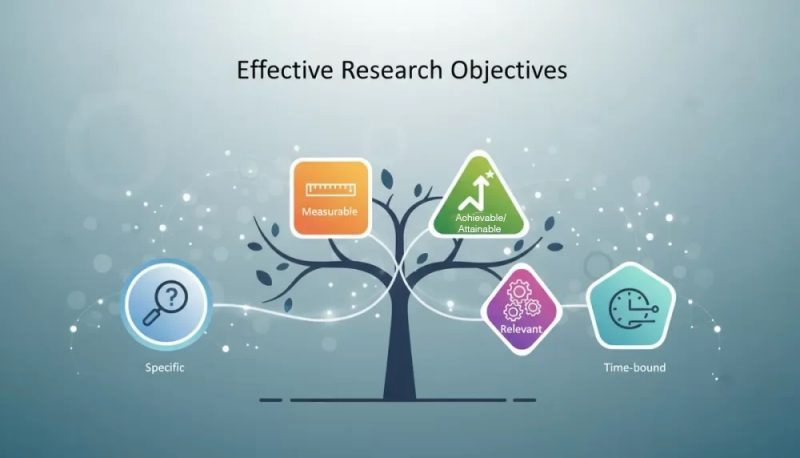
Creating research objectives that strengthen your manuscript requires understanding the key characteristics that distinguish effective objectives from vague statements of intent. The most successful research objectives follow the SMART framework, which has become the gold standard in scientific research planning across disciplines.
The SMART Criteria for Research Objectives
SMART objectives ensure your research goals remain focused, achievable, and measurable. Each letter represents a critical quality:
- Specific: Your objective should clearly state what you intend to investigate, study, or measure. Avoid vague language like “explore” or “investigate” without defining parameters. Instead, specify exactly what variables, populations, or phenomena you will examine.
- Measurable: Include clear criteria for success. How will you know when you have achieved the objective? What data, metrics, or outcomes will demonstrate completion? Measurable objectives allow for objective evaluation of results.
- Achievable: Your objectives must be realistic given your resources, timeline, and expertise. Overly ambitious objectives that exceed your capacity undermine study credibility and increase the likelihood of incomplete results.
- Realistic: Ensure your objectives align with current scientific knowledge and methodological capabilities. Consider practical constraints such as access to study populations, equipment availability, and ethical considerations.
- Time-bound: Specify the timeframe for achieving each objective. This helps with project management and demonstrates feasibility to reviewers who evaluate whether your study design can reasonably accomplish the stated goals.
Action-Oriented Language
Strong research objectives begin with action verbs that clearly communicate your intended activities. The choice of verb should accurately reflect the type of investigation you will conduct:
- For descriptive studies: identify, describe, classify, document, record
- For comparative studies: compare, contrast, differentiate, distinguish
- For experimental studies: determine, measure, evaluate, assess, test
- For correlational studies: examine relationships, investigate associations, explore connections
- For explanatory studies: explain, understand, clarify, elucidate
The specific verb you choose sets clear expectations for your methodology and results. For example, “to describe the prevalence of diabetes in rural populations” requires different methods than “to evaluate the effectiveness of a new diabetes screening protocol.” Language editing services can help ensure your verb choices accurately represent your research intentions, especially for non-native English speakers navigating nuanced terminology.

Understanding Different Types of Research Objectives
Research objectives typically fall into distinct categories based on their function within your study. Understanding these categories helps you structure a comprehensive set of objectives that cover all aspects of your investigation.
General Objectives Versus Specific Objectives
Most research studies include both a general objective and multiple specific objectives that break down the broader goal into manageable components:
General Objective: This overarching statement describes the primary goal of your entire research project. It provides the big picture of what you hope to accomplish and often closely mirrors your research aim. General objectives tend to be broader and may not always meet all SMART criteria individually.
Example: “To examine the relationship between workplace stress and cardiovascular health outcomes in healthcare professionals.”
Specific Objectives: These detailed statements break down your general objective into concrete, measurable steps. Each specific objective should be independently achievable and collectively comprehensive. Most studies include three to five specific objectives that address different aspects of the research question.
Examples of specific objectives supporting the general objective above:
- To measure cortisol levels and blood pressure in 200 hospital nurses working different shift patterns over six months
- To identify specific workplace stressors reported most frequently by participants using validated survey instruments
- To determine correlations between stress biomarkers and cardiovascular risk factors including hypertension and elevated heart rate
- To compare cardiovascular outcomes between nurses reporting high versus low workplace stress levels
Primary and Secondary Objectives
Another common classification distinguishes between primary and secondary objectives:
- Primary objectives address your main research question and represent the core purpose of your study. Results related to primary objectives typically appear first in your findings and receive the most detailed analysis.
- Secondary objectives explore additional questions or relationships that provide supplementary insights. While valuable, secondary objectives are not essential to your study’s primary contribution.
This distinction helps reviewers understand your study’s priorities and allows for more flexible evaluation. A study might fully achieve primary objectives while only partially completing secondary objectives, yet still represent a successful investigation worthy of publication.

Step-by-Step Process for Writing Research Objectives
Crafting effective research objectives requires systematic thinking and iterative refinement. Follow this proven process to develop objectives that strengthen your manuscript and guide successful research execution.
Step 1: Conduct Thorough Literature Review
Before writing any objectives, you must understand the current state of knowledge in your field. Comprehensive literature review reveals gaps, inconsistencies, and unanswered questions that your research can address. Pay particular attention to:
- Recent publications in high-impact journals within your discipline
- Systematic reviews and meta-analyses that synthesize existing evidence
- Methodological limitations acknowledged in previous studies
- Calls for future research explicitly stated by other investigators
- Contradictory findings that require clarification
- Emerging areas where limited research currently exists
This foundation ensures your objectives address meaningful questions rather than duplicating existing work. For researchers preparing manuscripts for submission, San Francisco Edit can help ensure your literature review effectively establishes the rationale for your research objectives.
Step 2: Define Your Research Problem Clearly
Your research problem statement articulates the specific issue, gap, or question your study addresses. A well-defined problem statement should:
- Identify the broader topic area and its significance
- Specify the particular aspect you will investigate
- Explain why this problem matters to your field
- Describe the consequences of leaving this problem unaddressed
Your research objectives will flow directly from this problem statement, so invest time ensuring it is clear, specific, and justified. The problem statement answers “what needs to be studied,” while objectives answer “what will this study specifically accomplish.”
Step 3: Formulate Your General Aim
Write a single sentence describing the overall purpose of your research. This general aim should connect directly to your research problem and indicate the broad approach you will take. At this stage, focus on clarity rather than perfect SMART compliance. Your general aim establishes the direction for more specific objectives that follow.
Example: “This study aims to investigate the effectiveness of telemedicine interventions for managing chronic pain in elderly patients living in rural areas.”
Step 4: Break Down Into Specific Objectives
Transform your general aim into three to five specific, measurable objectives. Each objective should address a distinct aspect of your research question while collectively covering your entire investigation. Consider these questions for each potential objective:
- Can this objective be achieved with available resources and time?
- Does this objective require its own methodology or data collection approach?
- Will achieving this objective contribute necessary information to answer my research question?
- Can I measure success in achieving this objective with clear criteria?
Step 5: Apply the SMART Framework
Review each objective against SMART criteria and refine language to improve specificity and measurability. Replace vague terms with precise descriptions, add quantifiable elements, and ensure realistic scope. This refinement process often requires multiple iterations.
| Weak Objective | Strong SMART Objective | Improvement Made |
|---|---|---|
| To study patient satisfaction | To measure patient satisfaction scores using the validated PSQ-18 survey among 150 outpatients within three months | Added specific measurement tool, sample size, and timeframe |
| To look at the effects of exercise | To determine the impact of 30-minute daily walking on HbA1c levels in 100 diabetic adults over 12 weeks | Specified exercise type, duration, measured outcome, population, and period |
| To explore genetic factors | To identify single nucleotide polymorphisms associated with drug resistance in 200 malaria parasite samples using whole genome sequencing | Defined specific genetic elements, sample size, and methodology |
Step 6: Ensure Logical Flow and Coherence
Arrange your specific objectives in logical sequence, typically following either chronological order of research activities or hierarchical order from broad to specific. Each objective should connect clearly to others while remaining independently achievable. Check that collectively your objectives fully address your general aim without unnecessary overlap or redundancy.
Common Mistakes to Avoid When Writing Research Objectives
Even experienced researchers sometimes struggle with objective formulation. Awareness of common pitfalls helps you avoid errors that weaken manuscripts and increase rejection risk.
Overly Broad or Ambitious Objectives
One of the most frequent mistakes involves objectives that exceed realistic scope. Attempting to answer too many questions or cover excessive ground leads to superficial analysis and incomplete results. Remember that demonstrating depth in a focused area typically outweighs breadth across multiple topics. Journal editors prefer studies that thoroughly investigate specific questions rather than those that skim multiple issues without substantive findings.
Vague or Unmeasurable Language
Objectives containing imprecise terms like “explore,” “understand,” or “investigate” without operational definitions create ambiguity about what constitutes success. These verbs can be appropriate if followed by specific parameters, but alone they leave too much room for interpretation. Similarly, avoid subjective terms that cannot be objectively measured or verified.
Confusing Objectives with Methodology
Research objectives describe what you aim to achieve, not how you will achieve it. A common error involves writing objectives that actually describe methods: “To conduct interviews with 50 participants” is a methodological statement, not an objective. The objective should state what you aim to learn from those interviews: “To identify barriers to medication adherence through qualitative interviews with 50 diabetic patients.”
Misalignment with Research Design
Your objectives must match your chosen research design and methodology. Stating an objective to “determine causation” when using a cross-sectional study design creates fundamental inconsistency, as cross-sectional designs cannot establish causality. Similarly, objectives requiring longitudinal data cannot be achieved with single-point-in-time measurements. Knowledge center resources can help you ensure alignment between objectives and methodology.
Including Too Many or Too Few Objectives
While no absolute rule exists, most research papers benefit from three to five specific objectives. Fewer than three may indicate insufficient depth, while more than five often signals inadequate focus or overly fragmented investigation. If you find yourself listing numerous objectives, consider whether some can be combined or whether some represent methods rather than goals.
How Research Objectives Differ from Related Concepts
Understanding the distinctions between research objectives and related terms prevents confusion and improves manuscript organization. These concepts work together to structure your research, but each serves a distinct purpose.
Research Objectives Versus Research Questions
Research questions and objectives are closely related but serve different functions:
| Aspect | Research Questions | Research Objectives |
|---|---|---|
| Form | Interrogative statements (questions) | Declarative statements describing goals |
| Purpose | Identify what you want to know | Specify what you will accomplish |
| Scope | Can be broader and more exploratory | More specific and action-oriented |
| Function | Guide inquiry and investigation | Provide measurable targets for evaluation |
| Example | What factors influence medication adherence in elderly patients? | To identify demographic and clinical factors associated with medication adherence rates below 80% in patients over 65 years |
Research questions typically precede objectives in the conceptual development of your study. You first identify what you want to know (questions), then specify what you will do to find out (objectives). Some journals prefer questions while others favor objectives, so review target journal guidelines when preparing your manuscript.
Research Objectives Versus Research Aims
Research aims represent the broad intent of your study, sitting at a higher level than specific objectives. An aim describes the general purpose while objectives break that purpose into concrete steps. Think of the aim as your destination and objectives as the specific routes you will take to get there. Most studies have one overall aim supported by multiple objectives.
Research Objectives Versus Hypotheses
Hypotheses are testable predictions about expected outcomes based on theory or previous evidence. They state specific relationships you anticipate finding between variables. Objectives describe what you will investigate, while hypotheses predict what you expect to discover. Not all research requires hypotheses (descriptive and exploratory studies often do not), but all research requires clear objectives.
Research Objectives in Different Study Types
The nature and structure of research objectives vary across different research paradigms and study designs. Understanding these variations helps you craft objectives appropriate to your specific investigation type.
Quantitative Research Objectives
Quantitative objectives focus on measuring variables, testing relationships, and analyzing numerical data. They typically employ verbs like measure, compare, determine, evaluate, and assess. These objectives specify the variables under study, the population of interest, and the statistical relationships you will examine.
Example quantitative objectives:
- To measure the difference in blood glucose control between patients receiving standard care versus intensive monitoring over six months
- To determine the correlation between daily step count and BMI reduction in overweight adults
- To compare complication rates between surgical technique A and technique B in 300 consecutive patients
Qualitative Research Objectives
Qualitative objectives emphasize understanding experiences, perspectives, and meanings rather than quantifying variables. They use verbs like explore, understand, describe, interpret, and discover. These objectives acknowledge the interpretive nature of qualitative research while still providing clear direction.
Example qualitative objectives:
- To explore how cancer survivors describe their experiences with long-term treatment side effects through in-depth interviews
- To understand the decision-making process parents use when choosing vaccination schedules for their children
- To describe the organizational culture in high-performing emergency departments using ethnographic observation
Mixed Methods Research Objectives
Mixed methods studies combine quantitative and qualitative approaches, requiring objectives that reflect both paradigms. These objectives explicitly state how the two approaches will be integrated and what each will contribute to the overall investigation. For researchers working on complex mixed methods manuscripts, scientific editing services ensure clear articulation of how different objective types work together.
Placing Research Objectives in Your Manuscript
Proper placement of research objectives within your manuscript structure enhances clarity and helps reviewers quickly understand your study’s purpose and scope. Standard academic writing conventions dictate specific locations for objectives depending on your discipline and target journal.
Typical Placement in Introduction Section
Research objectives most commonly appear toward the end of the introduction section, after you have:
- Introduced the general topic and its significance
- Reviewed relevant literature establishing context
- Identified the specific gap or problem your study addresses
- Stated your research question or aim
This logical flow brings readers from broad context to specific intent, with objectives serving as the transition from introduction to methods. Some journals prefer objectives as the final paragraph of the introduction, while others accept them in a separate “Objectives” subsection. Always consult your target journal’s author guidelines.
Integration with Other Manuscript Elements
Your objectives should connect seamlessly to other manuscript components. The methods section should describe procedures for achieving each objective. Results should be organized to address each objective systematically. The discussion should evaluate whether objectives were met and interpret findings in that context. This alignment demonstrates logical coherence and strengthens your manuscript’s overall impact.
Abstract Presentation
Most structured abstracts include an “Objectives” section that succinctly states your main objective. This condensed version should capture the essence of your investigation in one to two sentences maximum. The abstract objective may be slightly broader than your detailed specific objectives, focusing on the primary goal rather than every sub-objective.
Evaluating and Refining Your Research Objectives
Once you have drafted research objectives, critical evaluation ensures they will effectively guide your investigation and strengthen your manuscript. Use this systematic review process before finalizing objectives.
Self-Assessment Checklist
Review each objective against these criteria:
- Does it start with a clear action verb that accurately describes the intended activity?
- Is the objective specific enough that another researcher could understand exactly what you intend to investigate?
- Can you identify concrete criteria for determining when this objective has been achieved?
- Is the objective achievable with your available resources, expertise, and timeframe?
- Does it align with your research question and contribute to answering that question?
- Is it free from methodological descriptions that belong in the methods section?
- Does it avoid promising more than the study design can deliver?
Peer Review and Expert Feedback
Share your objectives with colleagues, mentors, or collaborators before beginning data collection. Fresh perspectives often identify ambiguities or logical gaps that you missed. Ask reviewers specifically whether they understand what you plan to do, whether the objectives seem achievable, and whether collectively the objectives address your research question comprehensively.
For researchers preparing manuscripts for peer-reviewed publication, professional editing services provide valuable objective assessment. San Francisco Edit specializes in helping scientists strengthen their manuscripts, including refinement of research objectives to meet the exacting standards of top-tier journals. With a 98 percent acceptance rate for edited papers, their expert PhD editors understand precisely what journal reviewers expect.
Revision Based on Study Evolution
Research rarely proceeds exactly as initially planned. As your study progresses, you may need to refine objectives to reflect practical realities, unexpected findings, or emergent opportunities. Such refinement is normal and acceptable, but should be documented. If objectives change substantially during the study, acknowledge this in your methods section to maintain transparency and methodological integrity.
Research Objectives and Publication Success
The quality of your research objectives directly influences publication outcomes. Understanding how objectives impact the peer review process helps you craft statements that improve acceptance chances.
What Journal Editors Look For
Journal editors conducting initial manuscript screening pay close attention to research objectives because they quickly reveal study quality and suitability. Editors assess whether:
- Objectives address significant questions relevant to the journal’s scope
- The study design can feasibly achieve stated objectives
- Objectives demonstrate originality and contribute new knowledge
- Results actually address the stated objectives
- The level of ambition matches the journal’s impact factor and standards
Well-crafted objectives signal professional competence and careful planning, increasing the likelihood your manuscript advances to peer review rather than receiving desk rejection. For non-native English speakers, ensuring objectives are expressed with grammatical precision and appropriate terminology becomes especially important. Language editing services can help eliminate linguistic barriers that might otherwise overshadow strong research content.
Common Reviewer Criticisms
Peer reviewers frequently raise concerns about research objectives, including:
- Mismatch between objectives and results: When results fail to address stated objectives or address different questions entirely, reviewers question study validity and execution
- Overly ambitious scope: Objectives promising comprehensive answers to complex questions raise doubts about feasibility and depth of analysis
- Lack of specificity: Vague objectives leave reviewers uncertain about what the study actually accomplished
- Poor alignment with methods: When methodology cannot achieve stated objectives, reviewers question research design competence
- Absence of novel contribution: Objectives that duplicate existing research without clear advancement fail to meet publication standards
Addressing these potential concerns during objective formulation prevents major revision requests or rejection. Academic researchers can benefit from testimonials from colleagues who have successfully navigated the publication process with professional editing support.
Examples of Strong Research Objectives Across Disciplines
Examining well-crafted objectives from various fields illustrates how SMART principles apply across disciplines while accommodating field-specific conventions.
Medical Research Example
General Objective: To evaluate the effectiveness of a novel anticoagulation protocol for preventing thromboembolism in post-surgical patients.
Specific Objectives:
- To compare the incidence of deep vein thrombosis between patients receiving the novel protocol versus standard prophylaxis in 400 orthopedic surgery patients over 12 months
- To measure bleeding complication rates in both treatment groups using standardized clinical criteria
- To determine patient compliance rates with each anticoagulation protocol through medication logs and follow-up interviews
- To calculate the cost-effectiveness of the novel protocol compared to standard care including medication costs, monitoring requirements, and complication treatment expenses
Social Science Research Example
General Objective: To investigate the relationship between remote work arrangements and employee job satisfaction in the technology sector.
Specific Objectives:
- To measure job satisfaction scores among 300 technology workers using the Job Satisfaction Survey across three work arrangement categories (fully remote, hybrid, fully on-site)
- To identify specific factors contributing to satisfaction differences through focus group discussions with 30 participants representing each work arrangement
- To examine whether demographic variables (age, gender, caregiving responsibilities) moderate the relationship between work arrangement and job satisfaction using regression analysis
Environmental Science Example
General Objective: To assess the impact of agricultural runoff on water quality in coastal watersheds.
Specific Objectives:
- To measure nitrogen and phosphorus concentrations at 15 sampling sites across three watersheds monthly for 24 months
- To determine correlations between nutrient levels and adjacent land use patterns using geographic information system analysis
- To evaluate changes in aquatic biodiversity indicators between high-runoff and low-runoff sites through macroinvertebrate sampling
- To model predicted water quality changes under three agricultural management scenarios using validated watershed models
These examples demonstrate how strong objectives specify populations, measurement methods, timeframes, and analytical approaches while remaining focused on achievable goals rather than methodological details.
Tools and Resources for Developing Research Objectives
Various tools and resources can support the objective development process, particularly for early-career researchers building these skills.
University Writing Centers and Research Support Services
Many academic institutions offer workshops and consultations focused on research planning and proposal writing. These services provide personalized feedback on your objectives and can help identify weaknesses before submission. Take advantage of these free resources, particularly if you are preparing your first major research proposal or dissertation.
Professional Editing and Manuscript Preparation Services
For researchers preparing manuscripts for submission to competitive journals, professional editing services offer expert evaluation and refinement of research objectives. San Francisco Edit provides comprehensive scientific editing by PhD-level experts who understand the specific requirements of peer-reviewed journals across disciplines. Their editors assess not only language quality but also logical coherence, ensuring your objectives align perfectly with your methodology, results, and conclusions.
With turnaround times of six to eight days for standard projects and three to four days for rush jobs, professional editing services accommodate tight submission deadlines. The investment in expert editing often proves worthwhile, as evidenced by San Francisco Edit’s exceptional 98 percent publication success rate. Their global client base includes researchers from universities and institutions worldwide who rely on their expertise to navigate the demanding peer review process.
Published Research as Learning Tools
Reading recently published articles in your target journal provides valuable models for objective formulation. Pay particular attention to how authors in your field structure objectives, what level of specificity they employ, and how objectives connect to methods and results. This analysis helps you understand unstated conventions and expectations specific to your discipline and target publication.
Research Objectives in Grant Proposals
Research objectives play an equally critical role in grant applications, where they help funding agencies evaluate project merit, feasibility, and alignment with funding priorities. Grant proposal objectives typically require even greater specificity than journal article objectives because reviewers assess not only scientific merit but also practical viability and resource requirements.
Connecting Objectives to Funding Agency Priorities
Successful grant objectives explicitly address the funding agency’s stated priorities and mission. Before writing objectives, carefully review the funding announcement to identify key themes, target populations, or methodological approaches the agency emphasizes. Frame your objectives using language that mirrors agency priorities while maintaining scientific integrity and specificity.
Timeline and Milestone Integration
Grant proposals typically require detailed timelines showing when each objective will be addressed. This integration demonstrates feasibility and careful planning. For each objective, specify the timeline for data collection, analysis, and reporting. Include concrete milestones that allow progress monitoring and evaluation throughout the funding period.
For researchers preparing comprehensive grant applications requiring manuscript quality writing, business editing services can ensure your proposal presents your objectives with maximum clarity and persuasive impact. Strong grant proposals often become the foundation for future journal publications, making the investment in quality writing support doubly valuable.
Research objectives represent more than administrative requirements or formulaic statements. They embody careful thinking about what questions matter, what investigations are feasible, and what contributions your work will make to scientific knowledge. Whether you are a graduate student beginning your research career, an established investigator pursuing new directions, or a medical professional conducting clinical studies, the ability to craft clear, focused, and achievable research objectives directly influences your success in publishing peer-reviewed research.
The competitive nature of scientific publishing in 2026 demands excellence at every stage of manuscript preparation. Research objectives that precisely articulate your study’s purpose and scope give reviewers confidence in your work’s quality before they even examine your methodology or results. By following the principles outlined in this guide, you can develop objectives that strengthen your manuscripts and increase publication success.
For researchers seeking to maximize their publication potential, professional manuscript editing provides essential support. Submit your manuscript to San Francisco Edit for comprehensive review by PhD-level scientific editors who specialize in helping researchers achieve publication in top-tier journals. With over 325 years of combined editing experience, their expert team understands exactly what transforms good research into publishable manuscripts that advance scientific knowledge and career success.
FAQs
Q: What is the difference between research objectives and research questions?
A: Research questions are interrogative statements that identify what you want to discover, while research objectives are declarative statements that specify the measurable goals you will accomplish to answer those questions. Questions guide inquiry broadly, while objectives provide specific, actionable targets. For example, a research question might ask “What factors influence medication adherence?” while the corresponding objective would state “To identify demographic and clinical factors associated with medication adherence rates below 80% in patients over 65 years.”
Q: How do you write SMART research objectives?
A: SMART research objectives follow five criteria: Specific (clearly state what you will investigate), Measurable (include criteria for success), Achievable (realistic given your resources), Realistic (aligned with scientific capabilities), and Time-bound (specify the timeframe). Start with an action verb, identify your study population, specify what you will measure or examine, and include the timeline. For example: “To measure the difference in blood glucose control between patients receiving standard care versus intensive monitoring over six months.”
Q: Where should research objectives be placed in a research paper?
A: Research objectives typically appear toward the end of the introduction section, after you have introduced the topic, reviewed relevant literature, and identified the research gap. They serve as the transition from introduction to methods, appearing after your problem statement and research aim. Some journals prefer objectives as the final paragraph of the introduction, while others accept them in a separate subsection. Always consult your target journal’s author guidelines for specific placement requirements.
Q: Why are research objectives important in a study?
A: Research objectives provide essential direction and focus for your entire investigation. They define study boundaries, guide methodology selection, establish evaluation criteria for success, and communicate your intent clearly to reviewers and readers. Well-crafted objectives prevent scope creep, ensure efficient resource allocation, and demonstrate professional planning. Studies with clear objectives receive more favorable reviews and higher publication success rates because reviewers can easily assess whether the research achieved its intended purpose and contributed meaningful insights to the field.
Q: What are the steps to formulate research objectives?
A: Formulating research objectives involves five key steps: First, conduct thorough literature review to identify gaps in existing knowledge. Second, define your research problem clearly and specifically. Third, write a general aim describing your overall study purpose. Fourth, break down this aim into three to five specific, measurable objectives that address different aspects of your research question. Fifth, refine each objective using SMART criteria to ensure they are specific, measurable, achievable, realistic, and time-bound. Review objectives with colleagues for feedback before finalizing them.