Key Takeaways
-
Impact statements answer ‘So what?’ and ‘Who cares?’ by explaining real-world significance in plain language, directly increasing manuscript acceptance chances at competitive journals requiring them since 2026.
-
An impact statement differs fundamentally from an abstract: it focuses on outcomes and applications for non-specialists (50-150 words) rather than summarizing methods and findings for technical audiences (150-300 words).
-
Effective impact statements must include five specific components: core finding in plain language, significance explanation, identified beneficiaries, practical applications, and geographic scope—covering economic, environmental, and social outcomes.
-
Common fatal errors include using jargon, repeating abstract content, being vague about beneficiaries, focusing only on academia, and overstating findings—all easily correctable with professional editing support.
-
Professional manuscript editors improve publication success by identifying key messages, simplifying language without losing accuracy, aligning with journal standards, and ensuring all required elements are present.
-
Impact statements now matter for funding agencies, institutional performance reviews, research discoverability, and public engagement—reflecting a fundamental shift where research is judged by real-world contribution, not only academic merit.
You have spent years conducting research. You have gathered data, run experiments, and drawn meaningful conclusions. But when you submit your manuscript, the journal editor asks for something you did not expect: an impact statement. What exactly is it? Why does it matter? And how can it affect whether your paper gets published?
An impact statement is a short, plain-language summary that answers two essential questions: So what? and Who cares? It moves beyond technical findings to explain what your research means for the real world. In 2026, impact statements have become a standard requirement at many peer-reviewed journals, funding agencies, and research institutions. Understanding how to write one well can significantly improve your manuscript’s chances of acceptance.
What Is an Impact Statement in Manuscript Editing?
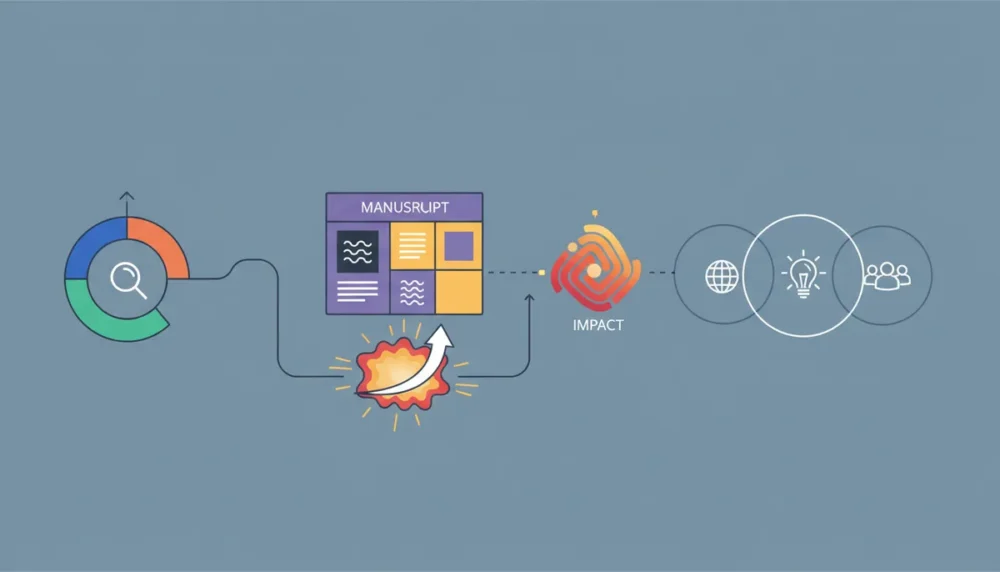
In the context of scientific editing, an impact statement is a concise paragraph that communicates the broader significance of your research. It is written in accessible language, free from heavy technical jargon, so that non-specialist readers can understand it. These readers may include journal editors, policymakers, funders, and members of the public.
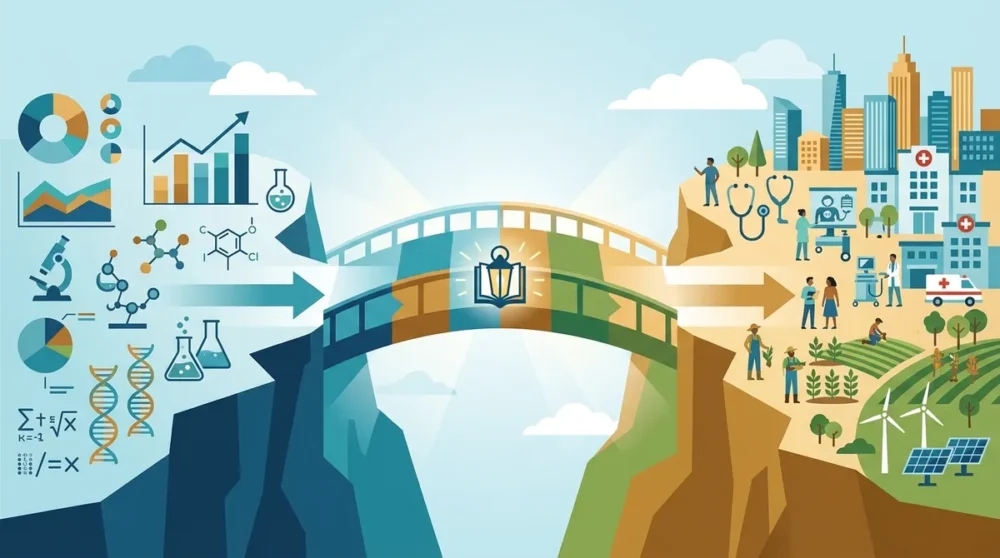
Unlike an abstract, which summarizes your methodology and findings, an impact statement focuses on outcomes and relevance. It tells readers why your research matters beyond the academic community. Think of it as the bridge between your science and the people it affects.
The rise of dedicated Engagement and Practice Impact Editors at major journals reflects how seriously this component is now taken. Journals want to promote research that connects with broader audiences and drives practical change.
Impact Statement vs. Abstract: Key Differences
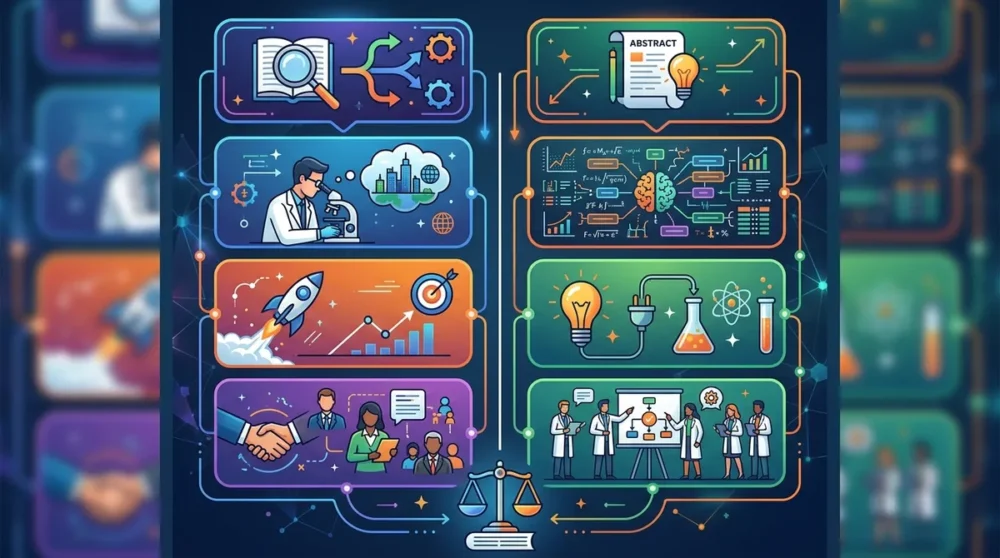
Many researchers confuse the impact statement with the abstract. While both are short summaries, they serve very different purposes. The table below outlines the key distinctions. You can also explore more about abstracts at resources like how to write an abstract that gets your paper published.
| Feature | Abstract | Impact Statement |
|---|---|---|
| Purpose | Summarizes the study | Explains real-world significance |
| Audience | Specialist researchers | Non-specialists, funders, public |
| Language | Technical terminology accepted | Plain, accessible language required |
| Content | Methods, results, conclusions | Outcomes, benefits, applications |
| Length | 150–300 words (varies by journal) | Typically 50–150 words |
| Tone | Formal and scientific | Clear, direct, and accessible |
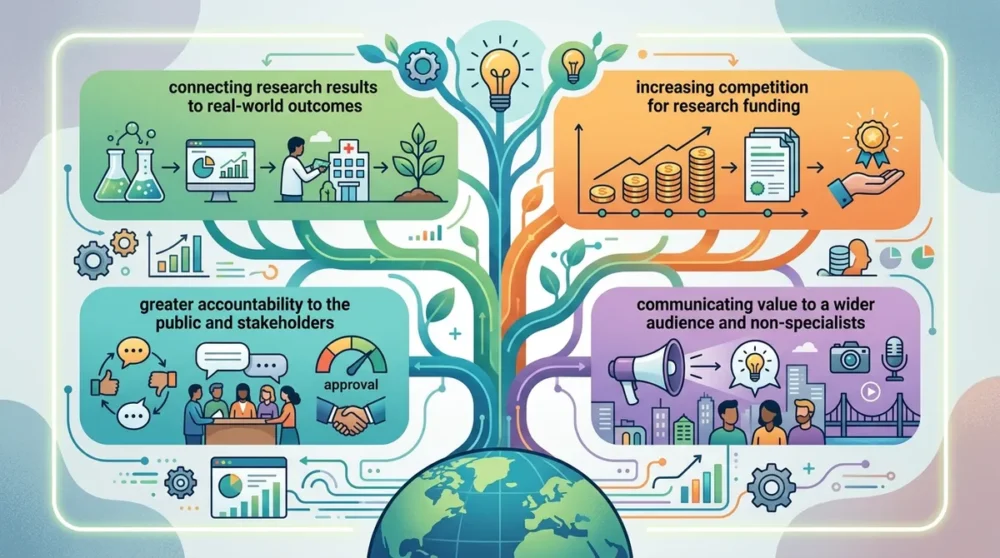
Why Are Impact Statements Increasingly Important?
Academic journals receive thousands of manuscript submissions every year. According to Springer Nature Author Services, well-edited manuscripts are significantly more likely to advance to peer review. In that competitive environment, a strong impact statement can make your manuscript stand out from the very first read.
Here are the key reasons why impact statements now matter more than ever:
- Journal requirements: Many high-impact journals now require impact statements as part of the submission process.
- Funding accountability: Funding agencies use impact statements to evaluate whether research delivers measurable value.
- Institutional reporting: Universities and research institutions include them in performance reviews and grant reporting.
- Research visibility: A compelling impact statement improves how your work is indexed and discovered online.
- Public engagement: Policymakers and the public need to understand research without reading full technical papers.
The demand for impact statements reflects a broader shift in how science is communicated. Research is no longer judged only by academic merit. It is also evaluated by its real-world contribution.
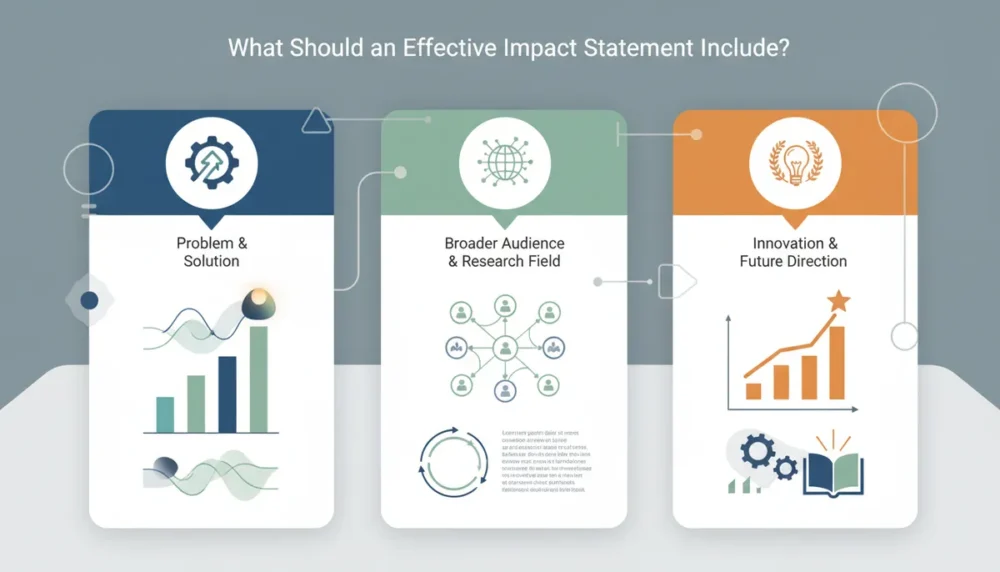
What Should an Effective Impact Statement Include?
A strong impact statement addresses specific elements clearly and concisely. Professional manuscript editors consistently look for the following components when reviewing impact statements:
- The core finding: State what you discovered in plain language. Avoid technical terms where possible.
- The significance: Explain why this finding matters. What problem does it solve or what question does it answer?
- The audience: Identify who benefits from this research. Is it patients, farmers, engineers, or educators?
- The application: Describe how this research can be used in practice. What can stakeholders actually do with this information?
- The scope: Where relevant, indicate whether the impact is local, national, or global in reach.
Effective impact statements address economic, environmental, and social outcomes. They move beyond theoretical contributions to show tangible, real-world effects. Exploring how to determine a central message for your scientific article can help you identify the right angle for your impact statement.
Common Mistakes Researchers Make With Impact Statements
Even experienced researchers often struggle with this component. Below are the most frequent errors found during professional manuscript review:
- Using jargon: Technical language defeats the purpose. If a non-scientist cannot understand it, it needs rewriting.
- Repeating the abstract: The impact statement should not summarize your methods. It should explain why your results matter.
- Being too vague: Phrases like “this research is important” do not explain anything. Be specific about who benefits and how.
- Focusing on academics only: A good impact statement reaches beyond the research community to real-world stakeholders.
- Overstating findings: Do not claim your research will revolutionize a field if it offers incremental progress. Be honest and precise.
These mistakes are common but correctable. This is exactly where professional language editing can add significant value to your manuscript preparation process.
How Professional Editors Help You Write a Stronger Impact Statement
Professional manuscript editors bring a unique skill set to impact statement development. They understand both the technical content of your research and how to translate it for a wider audience. A hospital-based study published on PubMed found that establishing professional manuscript editing services generated 3,931 editing requests in 2017–2018, with a statistically significant increase in research publications (P=0.0097). This finding highlights the direct link between professional editing support and publication success.
Here is what a professional editor does when working on your impact statement:
- Identifies the key message: Editors help authors distill complex research into one or two core takeaways.
- Simplifies the language: They replace technical terms with clear, accessible alternatives without losing accuracy.
- Aligns with journal expectations: Each journal has different standards. Editors tailor the statement to fit the target publication.
- Checks for completeness: Editors ensure all required elements are present, from significance to application to audience.
- Strengthens the narrative: A good impact statement tells a short story. Editors craft language that engages the reader and builds a case for your research’s value.
San Francisco Edit specializes in this kind of support. With editors who are native English-speaking PhD scientists, the team helps authors across all disciplines craft impact statements that resonate with journal editors, funders, and the broader public. Their testimonials reflect a 98% publication success rate across edited manuscripts.
Impact Statements for Different Research Disciplines
The tone and content of an impact statement will vary depending on your field. Below is a brief guide to how different disciplines approach this requirement:
| Discipline | Focus of Impact Statement | Likely Beneficiaries |
|---|---|---|
| Medicine & Clinical Research | Patient outcomes, treatment improvements | Clinicians, patients, healthcare systems |
| Environmental Science | Ecosystem health, climate policy | Policymakers, conservation groups |
| Agricultural Research | Crop yield, food security | Farmers, food agencies, governments |
| Engineering | Efficiency, infrastructure, technology | Industry professionals, urban planners |
| Social Sciences | Behavior, policy, community wellbeing | Policymakers, educators, NGOs |
| Life Sciences | Drug targets, biological mechanisms | Pharmaceutical industry, researchers |
Regardless of discipline, the core requirement remains the same: explain what your research means for the real world in plain, direct language. You can learn more about discipline-specific approaches in the knowledge center.
Steps to Write a Compelling Impact Statement for Your Manuscript
Writing a strong impact statement does not have to be overwhelming. Follow these steps to get it right:
- Start with your conclusion: What is the single most important thing your research discovered? Write it in one sentence using plain language.
- Ask “So what?”: Challenge yourself to explain why that finding matters outside the lab or the classroom.
- Identify your audience: Who outside academia would care about this? Name them specifically.
- Describe the benefit: What will change because of your research? Think in terms of health, economy, environment, or society.
- Keep it short: Aim for 75–150 words. Every sentence must earn its place.
- Read it aloud: If it sounds confusing or overly technical, simplify it further.
- Get expert feedback: Have a professional editor review it before submission. This is especially valuable for non-native English-speaking authors.
For non-native English authors, this step can be particularly challenging. The scientific manuscript editing service for non-native English speakers at San Francisco Edit is designed to help bridge that gap with precision and care. You can also review guidance on how to get a research paper published in 2026 for the full picture of what modern journals expect.
The Role of Impact Statements in Research Funding
Impact statements are not only a journal requirement. They are also central to grant applications and funding reports. Funding bodies want to know that their investment produces measurable outcomes. A well-crafted impact statement demonstrates that your research delivers value beyond citations.
Researchers who understand how to write for funders as well as journal editors gain a significant advantage. If you are preparing a grant application alongside your manuscript, explore resources on writing scientific proposals for grant funding to align your impact language across both documents.
According to resources from Nature, journals increasingly expect authors to communicate research impact as part of responsible science communication. Similarly, guidance from the National Institutes of Health (NIH) emphasizes that impact narratives are integral to research evaluation and funding decisions.
Conclusion: Make Your Research Speak Beyond the Lab
An impact statement is not a formality. It is a powerful tool that helps your research reach the people who need it most. It tells journal editors, funders, and the public why your work matters in a language they can understand. Getting it right takes clarity, precision, and often the support of an experienced editor.
Whether you are a PhD candidate submitting your first manuscript, a clinician translating clinical findings into a publishable paper, or a senior researcher managing a full team’s output, professional editing makes a measurable difference. Explore how expert scientific editing can strengthen every section of your manuscript, including your impact statement.
When you are ready to take your manuscript to the next level, submit your manuscript to San Francisco Edit and work with a team that knows exactly what journals expect in 2026.
FAQs
Q: What is the difference between an impact statement and an abstract in a manuscript?
A: An abstract summarizes your research methods, results, and conclusions for specialist readers. An impact statement explains the real-world significance of your findings in plain language for non-specialist audiences such as policymakers, funders, and the general public. The two serve complementary but distinct purposes.
Q: Why do journals now require impact statements as part of manuscript submission?
A: Journals increasingly require impact statements because they help demonstrate the practical value of research beyond academic circles. In 2026, editors, funding agencies, and institutional stakeholders all expect authors to show how their work contributes to economic, social, or environmental outcomes in a clear and accessible way.
Q: How can a professional manuscript editor help me write a better impact statement?
A: A professional manuscript editor helps identify your core research message, simplifies technical language for a broader audience, and aligns the statement with the expectations of your target journal. Editors with scientific expertise can ensure your impact statement is accurate, concise, and persuasive without overstating your findings.
Q: What should I include in an impact statement for a scientific manuscript?
A: An effective impact statement should include your core finding in plain language, an explanation of why it matters, the specific audience or community that benefits, how the research can be applied in practice, and the broader scope of the impact. Keeping the statement between 75 and 150 words is generally recommended.
Q: Can non-native English speakers get help writing impact statements for journal submissions?
A: Yes. Professional editing services specializing in scientific manuscripts offer targeted support for non-native English-speaking authors who need to communicate complex research clearly and fluently. This kind of editing ensures that language barriers do not prevent strong research from reaching its intended audience and gaining publication.