
Key Takeaways
-
A strong problem statement must be specific, observable, and actionable—vague concerns like 'writing needs improvement' should be replaced with precise statements like 'introduction lacks stated research gap in three of five paragraphs' to guide targeted revision.
-
Every effective problem statement requires four key elements: current state, desired state, gap analysis, and proposed solution—this structure ensures both editor and author understand the problem and path to resolution, reducing revision cycles.
-
Prioritize manuscript problems systematically by addressing structural issues first (missing sections, unsupported conclusions), then clarity and language problems, then formatting issues—this mirrors peer-review evaluation and prevents wasted effort polishing sections needing rewriting.
-
Root cause analysis strengthens problem statements by identifying underlying reasons for issues (e.g., translation loss rather than knowledge gaps), enabling editors to propose realistic, achievable solutions tailored to authors' constraints and capacity.
-
Clear problem statements aligned with journal requirements reduce author resistance, shorten revision timelines, and build trust by providing specific, evidence-based feedback that helps authors prioritize changes and make informed decisions.
-
Use measurable criteria to validate problem statements: confirm each issue is specific, observable by any trained reader, quantified where possible, relevant to publication requirements, and solvable within the author's revision timeline.
A weak problem statement can derail even the most rigorous research manuscript. Whether you are a PhD candidate preparing your first submission or a seasoned clinician translating complex data into publishable prose, identifying manuscript issues with precision is the first step toward successful publication. An example problem statement tailored for manuscript editing does more than flag errors—it bridges the gap between what is currently wrong and what the manuscript needs to achieve its publication goals.
Editors who articulate problems clearly reduce revision cycles and align expectations with authors from the start. This article presents 15 practical example problem statements across the most common manuscript challenges, complete with actionable strategies for addressing each one. These examples will help academic researchers, early-career scientists, medical professionals, and non-native English authors understand how effective problem framing transforms the editing process. You can also explore the knowledge center at San Francisco Edit for additional resources on manuscript preparation and editing best practices.

What Makes a Strong Problem Statement in Manuscript Editing
A strong problem statement is specific, observable, and actionable. It describes the current state of the manuscript, explains why the issue matters, and points toward a measurable solution. Vague concerns like “the writing needs improvement” do not give authors clear direction. Instead, precise statements such as “the introduction lacks a stated research gap in three of its five paragraphs” guide targeted revision.
Effective problem statements also consider root causes. Poor sentence structure might stem from translation issues rather than conceptual confusion. Inconsistent terminology may reflect a formatting oversight rather than a knowledge gap. Understanding why a problem exists helps editors propose realistic, achievable solutions within the constraints of the author’s timeline and capacity. For a deeper look at how to frame research challenges effectively, read more about how to define a problem statement in research.

The Core Components of a Manuscript Editing Problem Statement
Every effective example problem statement should include four key elements:
- Current state: What is happening in the manuscript right now?
- Desired state: What should the manuscript look like after editing?
- Gap analysis: What is the measurable distance between current and desired?
- Proposed solution: What specific editing action will close the gap?
This four-part structure ensures that both editor and author share the same understanding of the problem and the path to resolution. It also supports more efficient revision because authors know exactly what changes are expected and why those changes matter for publication success.
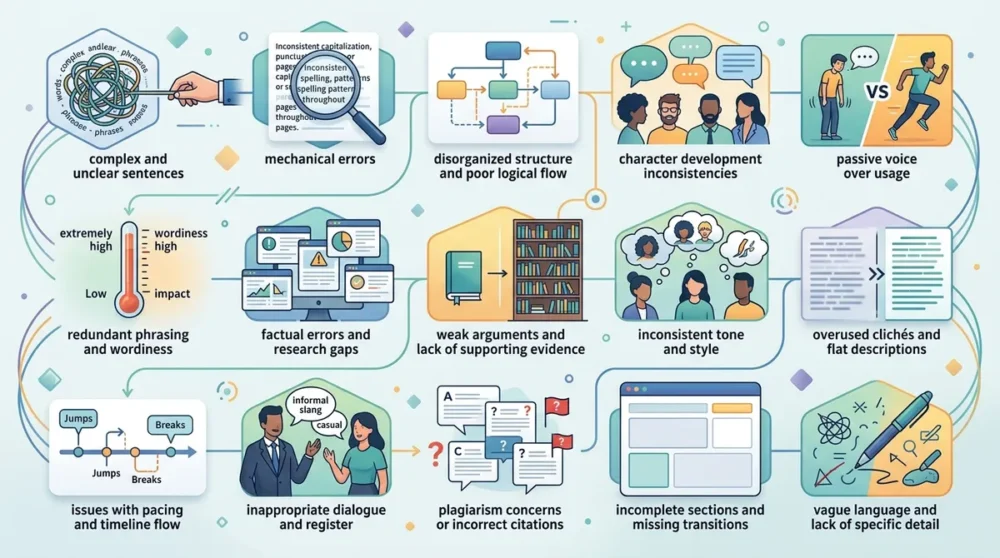
15 Example Problem Statements for Common Manuscript Issues
1. Unclear Research Objective
Example problem statement: “The manuscript’s introduction does not state a clear research objective. Reviewers cannot determine what the study aimed to achieve. The objective should be explicitly stated in the final paragraph of the introduction.”
2. Inconsistent Terminology
Example problem statement: “The terms ‘participants,’ ‘subjects,’ and ‘patients’ are used interchangeably throughout the manuscript. This inconsistency creates ambiguity. A single term should be selected and applied uniformly across all sections.”
3. Weak Abstract Structure
Example problem statement: “The abstract omits the study’s main findings and clinical implications. Readers cannot assess the paper’s relevance without this information. The abstract should be restructured to include background, methods, results, and conclusion.” For guidance on this section, review these expert strategies for writing an abstract that gets published.
4. Missing Topic Sentences
Example problem statement: “Approximately 60% of paragraphs in the Discussion section lack clear topic sentences. This forces readers to search for the main point. Each paragraph should begin with a sentence that signals its primary argument.”
5. Passive Voice Overuse
Example problem statement: “The Methods section uses passive voice in over 80% of sentences, reducing readability and obscuring who performed each procedure. Rewriting key sentences in active voice will improve clarity and align with many journal style guides.”
6. Grammar Issues from Non-Native English Writing
Example problem statement: “The manuscript contains recurring article errors (missing or incorrect use of ‘a,’ ‘an,’ and ‘the’), subject-verb agreement mistakes, and awkward sentence constructions consistent with non-native English writing. Systematic language editing is required throughout all sections.”
7. Insufficient Literature Review
Example problem statement: “The introduction cites only 8 references from the past 10 years, and none address the most recent methodological advances in the field. Adding current literature from databases such as PubMed will strengthen the research context and demonstrate awareness of current scholarship.”
8. Results Section Lacks Specificity
Example problem statement: “The Results section reports findings descriptively without statistical values in four of seven tables. Journals require exact p-values, confidence intervals, and effect sizes. These must be added before submission.” For more help, explore how to write a results section that gets published.
9. Discussion Does Not Address Study Limitations
Example problem statement: “The Discussion section does not acknowledge the study’s limitations, which peer reviewers will almost certainly flag. A dedicated limitations paragraph must be added to demonstrate methodological transparency and scholarly integrity.”
10. Inconsistent Reference Formatting
Example problem statement: “The reference list applies three different citation styles across 42 references. The target journal requires strict APA 7th edition formatting. All references must be standardized before submission.”
11. Figures Lack Descriptive Legends
Example problem statement: “Five of the manuscript’s eight figures have legends with fewer than one sentence of description. Peer reviewers expect self-explanatory legends. Each legend should describe the figure’s content, methods, and any abbreviations used.”
12. Methods Section Is Irreproducible
Example problem statement: “The Methods section omits reagent concentrations, equipment model numbers, and statistical software versions. Independent researchers could not replicate this study based on the current description. These details must be added for the manuscript to meet reproducibility standards.” See expert tips for writing a strong Methods section for actionable guidance.
13. Structural Inconsistency Across Sections
Example problem statement: “The manuscript uses different heading levels inconsistently—some subheadings are bold, others are italicized, and two are left unmarked. The journal’s author guidelines require a standardized three-level heading hierarchy. Full structural alignment is needed.”
14. Overlong Introduction
Example problem statement: “The introduction is 1,400 words, exceeding the journal’s 800-word guideline by 75%. Much of the excess is background information better suited to the Discussion. The introduction must be condensed to focus exclusively on the research gap and study rationale.” For concise framing strategies, read about how to write a concise journal paper introduction.
15. Conclusion Does Not Reflect Findings
Example problem statement: “The manuscript’s conclusion makes two claims that are not supported by the data presented in the Results section. This misalignment will likely trigger a major revision request or rejection. The conclusion must be revised to reflect only what the data support.”

How to Prioritize Multiple Problem Statements in One Manuscript
Most manuscripts have more than one issue. Prioritizing problems systematically ensures that the most critical barriers to publication are addressed first. Use the following ranked approach:
- Structural problems: Issues that affect the logic or completeness of the manuscript (e.g., missing sections, unsupported conclusions)
- Clarity and language issues: Problems that impair readability or introduce ambiguity
- Formatting and style issues: Deviations from journal guidelines that require standardization
- Minor corrections: Typographical errors, punctuation inconsistencies, and reference formatting
This ranking mirrors how peer reviewers typically evaluate manuscripts. Addressing higher-order concerns first prevents editors from polishing language in sections that may need to be rewritten. It also helps authors understand which revisions require the most effort and attention. You can learn more about structuring a manuscript effectively through this guide on essential steps to write a manuscript for publication.
Comparing Vague Concerns vs. Effective Problem Statements
The table below illustrates the difference between vague editing observations and well-defined problem statements that drive actionable revision:
| Vague Concern | Effective Problem Statement | Why It Matters |
|---|---|---|
| “The abstract needs work.” | “The abstract omits results and conclusions, covering only background and methods.” | Authors know exactly what is missing and where to add it. |
| “The writing is unclear.” | “Sentences in the Results section average 42 words, exceeding recommended readability thresholds.” | Provides a measurable standard for revision. |
| “References are a mess.” | “Three different citation formats are used across 42 references; journal requires Vancouver style.” | Identifies the exact standard to apply and the scope of the problem. |
| “The discussion is weak.” | “The Discussion does not connect findings to the three studies cited in the introduction.” | Gives authors a specific task rather than a vague directive. |
| “Grammar needs improvement.” | “Article usage errors appear in 35% of sentences across Sections 2 and 3.” | Localizes the problem and quantifies its extent for focused correction. |
How Root Cause Analysis Strengthens Problem Statements
Identifying a problem is only half the work. Understanding its root cause ensures that the solution addresses the underlying issue rather than just its symptoms. For example, a manuscript may have unclear methods not because the author lacks knowledge, but because the original draft was translated from another language and precision was lost in translation.
Root cause analysis in manuscript editing typically follows this process:
- Identify where the problem occurs (which section, which paragraph)
- Determine how frequently the problem appears (isolated or recurring)
- Assess whether the problem is structural, linguistic, or conceptual
- Evaluate whether the issue stems from journal requirements or the author’s writing approach
- Propose a targeted solution that fits within the author’s revision capacity and deadline
This approach is particularly valuable for non-native English authors, who may need specialized support for non-native English speakers that goes beyond surface-level grammar correction. Understanding the source of linguistic patterns allows editors to provide targeted, respectful, and effective guidance.
Aligning Editor and Author Expectations Through Problem Statements
One of the most valuable functions of a well-crafted example problem statement is its ability to align expectations. When editors communicate problems clearly, authors understand the rationale behind each suggested change. This reduces resistance to edits and shortens the back-and-forth communication that often extends revision timelines.
Clear problem statements also build trust. Authors who receive specific, evidence-based feedback are more likely to engage constructively with the editing process. They can prioritize their time, understand the stakes of each revision, and make informed decisions about which changes to implement. Studies on professional editing practices confirm that manuscripts with clearly defined problem statements experience more efficient revision cycles overall. For researchers wondering about the full value of professional editing, this resource on why you should have your paper edited offers clear answers.
The Role of Editing Services in Addressing Complex Manuscript Problems
Not all manuscript problems are easy to self-diagnose. Authors who are deeply familiar with their own work often overlook structural gaps, tonal inconsistencies, or logical leaps that are immediately apparent to an experienced editor. This is where professional scientific editing services provide measurable value.
San Francisco Edit works with authors across life sciences, medicine, engineering, social sciences, and the humanities to identify and articulate manuscript problems with precision. Edited by native English-speaking PhD scientists, manuscripts submitted to San Francisco Edit receive detailed, actionable feedback grounded in a thorough understanding of peer-review standards and journal expectations. With a 98% acceptance rate among edited manuscripts, the results speak for themselves. You can read what authors say on the testimonials page or explore the full range of services offered. For additional guidance on the publication journey, this resource on how to get a research paper published in 2026 is an excellent starting point. Authors can also visit PubMed to identify target journals and review published work in their field as a benchmark for manuscript quality.
Key Characteristics of an Actionable Problem Statement
Before finalizing any problem statement in the editing process, confirm it meets these criteria:
- Specific: It names a section, type of error, or measurable pattern
- Observable: The problem can be identified by any trained reader, not just the original editor
- Measurable: It quantifies the extent of the issue where possible (frequency, word count, number of instances)
- Relevant: It connects directly to publication requirements or reader comprehension
- Solvable: It proposes a realistic action the author can take within their revision timeline
Applying these criteria consistently across all identified issues ensures that the editing feedback is both credible and useful. Authors working under submission deadlines especially benefit from this level of clarity because it eliminates guesswork and allows them to focus revision efforts efficiently. For further context on the standards that govern strong scientific manuscripts, the International Committee of Medical Journal Editors (ICMJE) guidelines provide an authoritative reference point for medical and scientific writing standards.
Conclusion
A well-crafted example problem statement is one of the most powerful tools in the manuscript editing process. It transforms vague editorial concerns into clear, targeted, and actionable guidance. Whether the challenge involves language precision, structural logic, reference formatting, or alignment with journal standards, the ability to articulate what is wrong—and why it matters—directly improves the likelihood of successful publication.
For researchers and authors who want professional support identifying and resolving manuscript problems, San Francisco Edit offers expert editing by PhD-level scientists with decades of combined experience. With turnaround times as fast as three to four days for rush projects and a documented 98% publication success rate, professional editing is one of the most strategic investments a researcher can make. Take the next step toward a stronger, publication-ready manuscript and submit your manuscript for expert review today.
FAQs
Q: What is an example problem statement in the context of manuscript editing?
A: An example problem statement in manuscript editing is a precise, structured description of a specific issue within a manuscript—such as missing statistical values in the Results section or inconsistent terminology across sections. It identifies the current state, the desired state, and the action needed to resolve the gap. Effective problem statements are specific and measurable, not vague or general.
Q: How do editors identify the right problems to highlight in a problem statement?
A: Editors assess manuscripts systematically, reviewing each section for structural, linguistic, and formatting issues that could affect readability or journal acceptance. They consider root causes—such as translation challenges or structural misalignment—to ensure that their problem statements address underlying issues rather than surface symptoms. Priority is given to problems most likely to result in peer reviewer rejection or major revision requests.
Q: How does a clear problem statement improve the editing process for authors?
A: A clear problem statement aligns editor and author expectations from the outset, reducing unnecessary back-and-forth communication during revision. It gives authors a precise understanding of what needs to change, why it matters, and what a successful revision looks like. This efficiency is especially valuable for researchers working within tight submission deadlines.
Q: What is the difference between a vague editing comment and a strong problem statement?
A: A vague editing comment offers little actionable direction—for example, ‘the abstract needs work’ does not tell the author what is missing or how to fix it. A strong problem statement specifies the issue, its location, its frequency, and its impact on publication readiness, such as ‘the abstract omits results and clinical implications, which are required by the target journal’s author guidelines.’ The latter enables focused, efficient revision.
Q: Should problem statements in manuscript editing include proposed solutions?
A: Yes. A well-crafted problem statement should not only describe the issue but also propose a realistic, achievable solution within the author’s revision capacity and timeline. This ensures that the feedback is constructive rather than merely critical, and it helps authors take immediate, informed action to improve their manuscripts before submission.