
Key Takeaways
-
Write your abstract last, after completing the full manuscript, to ensure accuracy and clarity since your results and conclusions are clearer once the entire paper is finished.
-
Include specific, quantitative results with actual numbers or statistics rather than vague statements like ‘results showed improvement’ to meet peer-review standards.
-
Follow the standard four-part structure: purpose (40-60 words), methods (50-70 words), results (60-80 words), and conclusion (40-60 words), totaling 200-300 words.
-
Avoid common fatal errors: no citations, no undefined abbreviations, no title repetition, compliance with word limits, and no brand names or proprietary terms.
-
Always verify and align your abstract format with the specific target journal’s guidelines before submission, as non-compliance is a common reason for desk rejection.
-
State your research purpose directly in the opening sentence with a specific research question rather than lengthy background narrative to immediately engage editors.
Writing an abstract for a lab report is one of the most important — and most underestimated — parts of scientific writing. It is the first thing editors and reviewers read. It is often the only section that appears in database searches. A poorly written abstract can lead to immediate rejection, even if the research itself is excellent.
For academic researchers, early-career scientists, and medical professionals preparing manuscripts for peer-reviewed journals, mastering this skill is essential. The abstract must be concise, complete, and compelling. It needs to summarize your entire study in 200–300 words. That is a significant challenge. This guide walks you through seven clear steps to write a lab report abstract that meets journal standards and improves your chances of publication. Whether you are submitting to a top-tier scientific journal or a specialized clinical publication, these steps will help you present your work with clarity and confidence.

What Is a Lab Report Abstract?
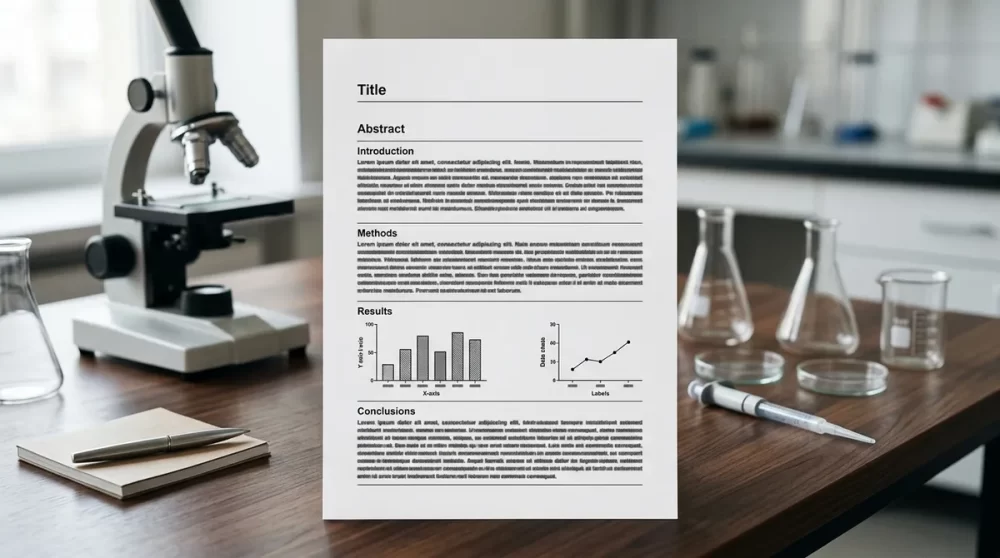
An abstract is a short, self-contained summary of your lab report or research manuscript. It covers the core elements of your study: the purpose, the methods, the results, and the conclusions. Readers use it to decide whether your full paper is worth reading. Journal editors use it to assess whether your work fits their scope.
A well-written abstract stands alone. It does not rely on the reader having access to the full paper. It contains no citations, no undefined abbreviations, and no unnecessary background information. Think of it as a miniature version of your entire manuscript, compressed into a single, powerful paragraph or structured block of text.
For researchers submitting to databases like PubMed, a strong abstract also improves discoverability, helping your work reach the right audience in your field.
Standard Structure of a Lab Report Abstract
Most journals follow a standard four-part structure for lab report abstracts. Understanding this structure before you start writing saves time and reduces the risk of rejection. The table below outlines each component, its purpose, and typical word allocation.
|
Section |
Purpose |
Suggested Word Count |
|---|---|---|
|
Background / Purpose |
Explains why the study was conducted and the hypothesis or research question |
40–60 words |
|
Materials & Methods |
Briefly describes the experimental approach, participants, or techniques used |
50–70 words |
|
Results |
Presents the key findings, including data and statistical outcomes |
60–80 words |
|
Conclusion / Significance |
States what the results mean and their implications for the field |
40–60 words |
Some journals require a structured abstract with labeled sections. Others prefer a single unbroken paragraph. Always check journal-specific guidelines before finalizing your abstract format. For example, NCUR 2026 guidelines specify a maximum of 300 words, while USCAP 2026 limits abstract bodies to 2,500 characters including spaces. These limits vary widely across disciplines.

7 Steps to Write a Strong Lab Report Abstract
Step 1: Write the Abstract Last
This is one of the most practical pieces of advice for any researcher. Write your abstract after completing the full manuscript. Your results and conclusions are clearer once the entire paper is finished. Trying to write the abstract first often leads to vague, incomplete summaries that need complete revision later.
Once your full lab report is done, go back and extract the essential points from each section. Use your own work as the source material. This approach keeps the abstract accurate and aligned with your actual findings.
Step 2: State Your Purpose Clearly
Your opening sentence must answer one question: Why did you conduct this study? Be direct. Avoid lengthy background narratives. State the specific research question, objective, or hypothesis in plain, precise language.
For example, instead of writing “Research has long explored the effects of various compounds on cellular metabolism,” write “This study investigated the effect of compound X on glucose uptake in human liver cells.” The second version is immediate and informative.
Step 3: Summarize Your Methods Concisely
Describe what you did without excessive detail. Journal editors and reviewers do not need a full methods section in the abstract. They need enough information to understand your experimental approach and assess its validity.
-
State the type of study (experimental, observational, clinical trial, etc.)
-
Mention the key materials, organisms, or patient populations involved
-
Note the primary techniques or analytical tools used
-
Avoid brand names — use generic terms instead
-
Omit procedural details that are standard in your field
Step 4: Report Your Key Results With Data
This is the most critical section of your abstract. Results must be specific and quantitative where possible. Vague statements like “the results showed improvement” are not acceptable in peer-reviewed scientific writing. Include your most significant findings, supported by actual numbers or statistics.
Also report both positive and negative results where relevant. Manuscript editors consistently recommend including limitations and unexpected findings. This demonstrates scientific rigor and intellectual honesty, two qualities that peer reviewers value highly.
Step 5: State Your Conclusion and Its Significance
Your conclusion should answer: What do these results mean? How do they advance understanding in your field? This is where you connect your findings to the broader scientific context. Keep this section brief but impactful.
Avoid overstating your findings. Do not claim broader implications than your data can support. Peer reviewers flag overreaching conclusions quickly, and this can delay or prevent publication. A measured, precise conclusion is far more credible than an inflated one.
Step 6: Remove All Common Mistakes
Before submitting your abstract, review it carefully for the following common errors that professional manuscript editors encounter regularly:
-
Citations in the abstract: Abstracts should not include references. They must stand alone.
-
Undefined abbreviations: Spell out all terms on first use, even well-known acronyms.
-
Repetition from the title: Do not repeat the exact title wording in your first sentence.
-
Exceeding word limits: Respect the journal’s stated limit. Aim for 200–300 words for most submissions.
-
Passive voice overuse: Mix active and passive voice appropriately for clarity.
-
Brand names or proprietary terms: Use generic scientific terminology only.
-
Missing conclusions: Every abstract must end with a clear statement of significance.
Step 7: Proofread and Align With Journal Guidelines
After writing and revising your abstract, proofread it carefully. Check for grammar, spelling, and punctuation errors. Read it aloud to catch awkward phrasing. Then compare your final draft against the target journal’s specific abstract requirements.
Every journal has its own formatting rules. Some require structured abstracts with labeled headings. Some cap word counts strictly. Others require a separate layman abstract of 50–200 words for general audiences, as seen in ARVO 2026 guidelines. Non-compliance with these requirements is a common reason for desk rejection — before your paper even reaches peer review.

Common Abstract Mistakes to Avoid at a Glance
The table below provides a quick reference for what to include and what to avoid when writing a lab report abstract for journal submission.
|
Include |
Avoid |
|---|---|
|
Clear research purpose or hypothesis |
Long introductory background paragraphs |
|
Brief description of methods |
Detailed procedural steps or equipment specs |
|
Specific, quantitative results |
Vague statements like “results were promising” |
|
Concise conclusion with implications |
Overstated or unsupported conclusions |
|
Plain, precise language |
Unexplained jargon or acronyms |
|
Compliance with journal word limits |
Citations, figures, or tables |
How Manuscript Editors Improve Lab Report Abstracts
Even experienced researchers benefit from professional editing support. A manuscript editor brings an objective, expert perspective to your abstract. They identify weaknesses you may have overlooked, especially when you have been immersed in the research for months or years.
Here is what a professional manuscript editor typically does to strengthen a lab report abstract:
-
Eliminates redundant phrases and tightens sentence structure
-
Ensures the abstract flows logically from purpose to conclusion
-
Checks alignment with target journal formatting requirements
-
Improves linguistic clarity, especially for non-native English authors
-
Verifies that key results are stated with appropriate precision
-
Removes informal language and non-scientific expressions
For non-native English authors in particular, professional language editing is often the difference between acceptance and rejection. Research consistently shows that poor English clarity is a leading cause of manuscript rejection at international journals. You can find additional guidance on this and related topics in our knowledge center.
Tips for Writing Abstracts Across Different Scientific Disciplines
The core structure of a lab report abstract remains consistent across fields, but emphasis varies. Here are discipline-specific tips to keep in mind:
-
Life Sciences and Medicine: Emphasize clinical relevance, patient populations, and statistical significance of outcomes.
-
Engineering and Physical Sciences: Focus on technical parameters, measurement precision, and practical applications of findings.
-
Social Sciences: Highlight study design, sample size, and the theoretical framework guiding the research.
-
Biomedical Research: Include details on model systems, disease relevance, and translational implications.
Understanding what peer reviewers in your specific field prioritize helps you tailor your abstract effectively. Consulting published abstracts in your target journal is also a valuable research step. Resources like the PubMed Central open-access archive offer thousands of published abstracts you can study for format and style reference.
When to Seek Professional Editing Support
Writing a strong abstract is a skill that improves with practice. However, there are situations where professional editing support is clearly the right choice:
-
You are submitting to a high-impact journal for the first time.
-
English is not your primary language and you are concerned about clarity.
-
Your previous submission was rejected and you are unsure why.
-
You need a fast turnaround without sacrificing quality.
-
You are managing multiple manuscripts at once and need reliable editing support.
San Francisco Edit is a specialist editing service with more than 325 combined years of staff experience in academic and scientific manuscript editing. Their team of native English-speaking PhD scientists has a 98% publication success rate across edited manuscripts. Whether you need scientific editing for a journal article or support with grant applications, dissertations, or research proposals, their expertise covers a wide range of document types and scientific disciplines. You can also review detailed information about services and pricing and payment options before getting started.
You can also read what researchers say about their experience on the testimonials page or browse frequently asked questions on the FAQ page to understand the full range of services available.
Conclusion
Learning how to write an abstract of a lab report is a foundational skill for every researcher aiming for publication. A strong abstract increases visibility, attracts readers, and signals to editors that your work is rigorous and well-presented. By following the seven steps outlined in this guide — writing last, stating your purpose clearly, summarizing methods, reporting results with data, drawing precise conclusions, eliminating common errors, and aligning with journal guidelines — you give your manuscript its best possible start.
If you want expert support to ensure your abstract and full manuscript meet the highest editorial standards, submit your manuscript to San Francisco Edit today and take the next step toward successful publication.
FAQs
Q: How long should a lab report abstract be for journal submission?
A: Most peer-reviewed journals require abstracts between 200 and 300 words. However, specific limits vary by journal and conference — NCUR 2026, for example, sets a maximum of 300 words, while USCAP 2026 caps abstracts at 2,500 characters. Always check your target journal’s author guidelines before submitting.
Q: What are the key components of a lab report abstract?
A: A well-structured lab report abstract includes four essential components: the background or purpose of the study, a brief description of the methods used, the key results with quantitative data where possible, and a conclusion that states the significance of the findings. Each section should be concise and directly relevant to the research.
Q: Can I include citations or references in my lab report abstract?
A: No. Abstracts must stand alone as self-contained summaries and should not include citations, references, or footnotes. If your abstract cannot be understood without referencing other works, revise it until it is fully independent. This is a standard requirement across virtually all scientific and medical journals.
Q: What common mistakes do manuscript editors fix in lab report abstracts?
A: Professional manuscript editors frequently address issues such as vague or unsupported conclusions, undefined abbreviations, excessive jargon, repetition of the title, missing quantitative data in the results section, and failure to comply with journal-specific word or character limits. Addressing these issues significantly improves the abstract’s impact and publication potential.
Q: When should a non-native English author seek professional editing for their abstract?
A: Non-native English authors are strongly encouraged to seek professional language editing before submitting to any international peer-reviewed journal. Poor linguistic clarity is one of the most commonly cited reasons for manuscript rejection. A professional editor ensures that the abstract reads fluently, precisely, and in accordance with the expectations of journal editors and peer reviewers.