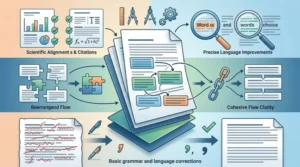
Key Takeaways
-
Write your abstract last, after completing the full manuscript, to ensure it accurately reflects your final results and conclusions rather than early drafts.
-
Use the IMRAD structure (Introduction/Purpose, Methods, Results, Conclusions) and always check your target journal's guidelines for whether they require structured headings or unstructured prose.
-
Report specific data with exact figures, percentages, p-values, and effect sizes rather than vague language like 'significant improvement' or 'promising results.'
-
Keep your purpose section to 1-3 sentences defining the knowledge gap; avoid lengthy background information that transforms the abstract into a literature review.
-
Strictly adhere to word or character limits—most journals enforce 250-300 words or 2,000-2,500 characters—and cut filler words rather than essential data when over limit.
-
Have a non-specialist or native English speaker review your abstract for clarity and grammar, especially if English is not your first language, since errors damage credibility and reduce discoverability in databases.
Your abstract is the first thing editors, reviewers, and readers see. In many cases, it is the only part they read before deciding whether to continue. A poorly written abstract can lead to rejection — even when the research itself is strong. Knowing how to write a scientific abstract correctly is one of the most important skills any researcher can develop.
This guide walks you through every component of a strong scientific abstract. Whether you are a PhD candidate submitting your first journal article, a clinician reporting trial results, or a non-native English speaker navigating language barriers, this step-by-step approach will help you produce an abstract that is clear, concise, and publication-ready. You will also learn how professional scientific editing can sharpen your abstract before submission.

What Is a Scientific Abstract and Why Does It Matter
A scientific abstract is a short, self-contained summary of your manuscript. It gives readers a snapshot of your study’s purpose, methods, results, and conclusions. Most journals and conferences set strict word or character limits — typically between 250 and 300 words, or 2,000 to 2,500 characters including spaces.
The abstract appears before the full paper. It is indexed in databases like PubMed, which means it drives discoverability. A well-written abstract increases citations and improves your chances of acceptance. A vague or disorganized one signals poor manuscript quality — even if the science is sound.

The Standard Structure of a Scientific Abstract
Most scientific abstracts follow an IMRAD-style structure: Introduction/Purpose, Methods, Results, and Discussion/Conclusions. Some journals require structured abstracts with labeled sections. Others prefer unstructured prose. Always check the target journal’s author guidelines before you begin.
Here is a breakdown of what each section should contain:
1. Purpose or Background
This section explains why you conducted the study. State the knowledge gap your research addresses. Keep this to one to three sentences. Define any critical acronyms here and avoid lengthy background information. The goal is to frame the problem quickly and precisely.
2. Methods
Describe how you conducted the study. Include the study design, participant details, key procedures, and the type of analysis used (e.g., statistical methods, qualitative coding). For qualitative work, mention two to three major themes and, where relevant, include positionality. Sample size should be stated clearly.
3. Results
Report your key findings objectively. Use specific data — percentages, p-values, effect sizes — rather than vague language like “significant improvement.” Do not overstate findings or include results not supported by your data. This section is the most scrutinized part of your abstract.
4. Conclusions
Summarize what your results mean. Your conclusion must follow directly from the evidence presented. Avoid introducing new information here. State the clinical, scientific, or practical implications of your work in one to two sentences.

Abstract Word and Character Limits by Organization
Different journals and conferences have different requirements. Understanding these limits helps you plan your abstract before writing. The table below shows real 2026 guidelines from major scientific organizations.
| Organization / Conference | Limit Type | Limit |
|---|---|---|
| ARVO 2026 | Characters (title + body + captions) | 2,500 characters |
| MDA Conference 2026 | Characters or words | ~2,500 characters / 300 words |
| FIP Montreal 2026 | Words (excluding title/authors) | 500 words max |
| AAHB Protocol Abstracts 2026 | Words | 300 words |
| CUR (Undergraduate Research) 2026 | Words | 250–300 words |
| ASE Abstracts | Characters | 2,250 characters |
Always check whether the character count includes the title, authors, and figure captions. For example, ARVO limits abstract titles to 150 characters including spaces. These details matter during submission.

Step-by-Step: How to Write a Scientific Abstract
Writing an abstract is easier when you follow a clear process. Here are the steps in order:
- Write the abstract last. Finish your full manuscript first. Your abstract should reflect the final version of your paper — not an early draft.
- Identify your key message. Ask yourself: What is the single most important takeaway from this study? Build your abstract around that message.
- Draft each section separately. Write the purpose, methods, results, and conclusions as individual blocks. This makes it easier to revise each part without disrupting the whole.
- Check the word or character limit. Count carefully. Most journals are strict. If you are over the limit, cut filler words and redundant phrases — not data.
- Read it as a non-specialist. If a reader unfamiliar with your subfield can follow the abstract, it is clear enough. If not, simplify your language.
- Proofread for grammar and consistency. Errors in an abstract damage your credibility. Check verb tense, spelling, and terminology consistency throughout.
- Align with journal-specific guidelines. Some journals follow specific reporting frameworks, such as SPIRIT for clinical protocols. Confirm compliance before submitting.
Common Mistakes to Avoid When Writing a Scientific Abstract
Many authors — including experienced researchers — make the same errors. Being aware of these pitfalls can save you from unnecessary rejection.
- Vague language: Phrases like “results were promising” or “data suggested improvement” lack scientific precision. Use exact figures.
- Too much background: The purpose section is not a literature review. Two to three sentences are sufficient to establish context.
- Missing methods: Some authors skip study design or sample size details. These are essential for reviewers to evaluate the research quality.
- Conclusions not supported by results: Your conclusion must follow directly from the data you reported in the abstract itself.
- Exceeding the word limit: Submissions that exceed limits are often rejected automatically by submission systems.
- Unclear acronyms: Define every acronym on first use, even if it is defined in the main text.
- Poor grammar and awkward phrasing: This is especially common for non-native English authors and can distract reviewers from the science.
Tips for Non-Native English Authors
If English is not your first language, writing a precise and fluent abstract is especially challenging. Scientific vocabulary is complex, and small language errors can change the meaning of your findings. Most major conferences and journals recommend — and some require — that non-native English speakers seek review from a native English speaker before submission.
Professional language editing services can make a significant difference. Editors not only fix grammar — they improve sentence flow, reduce ambiguity, and ensure your abstract reads with the clarity and confidence that high-impact journals expect. You can explore more resources on this topic in the knowledge center at San Francisco Edit.
Structured vs. Unstructured Abstracts
Some journals require structured abstracts with explicit headings such as “Background,” “Methods,” “Results,” and “Conclusions.” Others prefer a single flowing paragraph. Here is a comparison:
| Abstract Type | Format | Commonly Used In |
|---|---|---|
| Structured | Labeled sections (Background, Methods, Results, Conclusions) | Clinical journals, medical research, conference proceedings |
| Unstructured | Continuous prose without section headers | Basic science journals, humanities, review articles |
Always match your format to the journal’s requirements. Using a structured format when the journal asks for unstructured prose — or vice versa — is an avoidable mistake that signals a lack of attention to detail.
How Professional Editing Improves Your Abstract
A professional manuscript editor does far more than fix spelling. When reviewing an abstract, an experienced editor will:
- Eliminate redundant words to stay within character limits
- Ensure each section follows logically from the previous one
- Strengthen the precision and clarity of scientific language
- Verify that conclusions are supported by the reported results
- Check consistency with the full manuscript and journal guidelines
- Apply native English fluency that improves tone and readability
This matters because abstracts cannot be edited after publication. Once your paper is indexed, the abstract is permanent. Getting it right before submission is essential — not optional.
San Francisco Edit is a globally recognized specialist editing service with a 98% manuscript acceptance rate. Every abstract is edited by native English-speaking PhD scientists who understand your field. With standard turnaround of six to eight days and rush delivery in three to four days, professional editing fits your submission timeline. Learn more about the team and approach or read what researchers say in the testimonials.
Abstract Writing for Different Study Types
The structure of your abstract may vary depending on your study design. Here is what to emphasize for each type:
- Randomized controlled trials: Include intervention type, control condition, sample size, primary outcome, and statistical results.
- Observational studies: State the cohort or population, exposure, outcome, and key effect estimates with confidence intervals.
- Qualitative studies: Describe methodology, participant selection, data collection method, and three to five key themes.
- Systematic reviews and meta-analyses: Report number of studies included, PICO framework elements, and pooled effect size.
- Protocol abstracts: Follow reporting standards such as SPIRIT; emphasize study aims, design, and planned analyses.
For additional guidance on structuring your full manuscript, visit the knowledge center. You can also explore the FAQ page for answers to common questions about manuscript preparation. For reference, the PubMed Central database provides access to thousands of published abstracts across disciplines — a useful resource for studying format and style in your field.
Final Checklist Before You Submit
Before you send your manuscript, run through this checklist for your abstract:
- Does the abstract match the final version of the manuscript exactly?
- Is it within the journal’s word or character limit?
- Does it follow the required format (structured or unstructured)?
- Are all acronyms defined on first use?
- Are the results reported with specific data?
- Do the conclusions follow directly from the results stated?
- Has it been reviewed for grammar, clarity, and flow?
If any of these items are incomplete, your abstract is not ready. Take the time to revise before submitting. The abstract is the gateway to your research — treat it accordingly. For researchers who want expert support, you can submit your manuscript for professional editing and receive detailed feedback on your abstract and full paper from experienced PhD editors.
Conclusion
Writing a strong scientific abstract requires clarity, precision, and adherence to structure. It is not simply a summary — it is a persuasive document that must convince editors and reviewers that your work deserves to be read. Follow the IMRAD structure, stay within word limits, report specific results, and always align with journal guidelines.
If you want to maximize your chances of publication, professional editing support makes a measurable difference. San Francisco Edit works with researchers across every scientific and medical discipline — globally — to produce abstracts and manuscripts that meet the highest publication standards. Submit your manuscript today and take the next step toward successful publication.
FAQs
Q: What is the standard structure for a scientific abstract?
A: Most scientific abstracts follow an IMRAD-based structure: Purpose/Background, Methods, Results, and Conclusions. Structured abstracts use labeled headings, while unstructured abstracts present the same information as continuous prose. Always follow the specific format required by your target journal or conference.
Q: How many words should a scientific abstract be?
A: Most journals and conferences set a limit of 250 to 300 words, while some use character-based limits of 2,000 to 2,500 characters including spaces. Always check the submission guidelines for your specific target journal or conference, as limits vary significantly across organizations.
Q: What are the most common mistakes in writing a scientific abstract?
A: Common mistakes include using vague language instead of specific data, providing too much background information, omitting key methods details, drawing conclusions not supported by the reported results, exceeding word limits, and failing to define acronyms. Poor grammar and unclear phrasing — especially from non-native English authors — are also frequently cited as reasons for rejection.
Q: How do manuscript editors improve a scientific abstract?
A: Professional manuscript editors improve abstracts by eliminating redundant language, ensuring logical flow between sections, strengthening scientific precision, verifying that conclusions are supported by stated results, and checking compliance with journal guidelines. For non-native English authors, editors also improve grammatical accuracy and natural fluency to match the standards of high-impact journals.
Q: Should the abstract be written before or after the full manuscript?
A: The abstract should always be written after the full manuscript is complete. This ensures that the abstract accurately reflects the final version of your paper, including the actual results and conclusions. Writing the abstract too early often leads to inconsistencies that reviewers and editors will notice during evaluation.