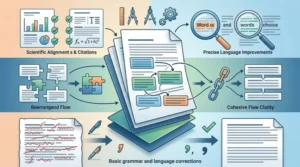
Key Takeaways
-
Write your abstract last, after completing the full paper, to ensure accuracy and reflect final conclusions rather than early hypotheses.
-
Include five core elements following IMRaD structure: background/problem, objective, methods, results, and conclusion—organize as one sentence per component initially.
-
Stay within the target journal's word limit (typically 150-250 words) as exceeding it is a common reason for desk rejection before peer review.
-
Clearly articulate the novelty and significance of your findings using specific language like 'for the first time' or 'previously unreported' to attract citations.
-
Use clear, simple language with short sentences, active voice, and avoid dense jargon to ensure readability across a broad scientific audience.
-
Check your target journal's author guidelines for abstract format requirements (structured vs. unstructured) and incorporate strategic keywords naturally for database indexing.
Your abstract is the first thing editors, reviewers, and readers see. It can determine whether your paper gets read — or ignored. For researchers submitting to peer-reviewed journals, a weak abstract can lead to rejection before reviewers even open the full manuscript. That is a costly mistake after months or years of research.
Learning how to write an abstract for a research paper is one of the most valuable skills any author can develop. A well-crafted abstract summarizes your entire study in 150–250 words. It must stand alone, communicate your findings clearly, and convince readers your work is worth their time. Whether you are a PhD candidate, a clinician, or an international researcher writing in English as a second language, mastering abstract writing will strengthen your publication record.
This guide breaks the process into 7 clear, actionable steps. It also explains what editors look for when reviewing abstracts — and how professional scientific editing support can make a measurable difference in your submission outcomes.
What Is a Research Paper Abstract?
An abstract is a short, self-contained summary of your research paper. It appears at the top of the manuscript, just below the title. Readers use it to decide whether the full paper is relevant to their work. Journal editors use it to assign reviewers and assess fit. Databases like PubMed index abstracts so researchers worldwide can find your work.
A strong abstract captures the problem you studied, how you studied it, what you found, and why it matters. It does all of this without referencing figures, tables, or citations from the paper. Think of it as a standalone document that lives within your manuscript.

Structured vs. Unstructured Abstracts
Many journals require a structured abstract with labeled sections. Others prefer a flowing, unstructured paragraph. Knowing the difference helps you format correctly from the start.
| Type | Format | Common Use | Typical Word Limit |
|---|---|---|---|
| Structured | Labeled sections (Background, Methods, Results, Conclusion) | Biomedical and clinical journals | 250–300 words |
| Unstructured | Single flowing paragraph | Humanities, social sciences, some STEM fields | 150–200 words |
| Semi-structured | Short labeled subheadings within a paragraph | Mixed-methods or interdisciplinary research | 200–250 words |
Always check your target journal’s author guidelines before writing. Following the correct format is a basic but essential requirement.

7 Steps to Write a Research Paper Abstract
Step 1: Complete Your Full Paper First
Always write the abstract last. This may seem counterintuitive, but it is the most effective approach. Once your paper is complete, you know exactly what you found and what matters most. Writing the abstract earlier often leads to vague or inaccurate summaries.
Your abstract should reflect your final conclusions, not your early hypotheses. Writing it last ensures accuracy and saves time during revision.
Step 2: Identify the Core Components
Every effective abstract contains five core elements. Use this checklist before you write:
- Background/Problem: What gap or issue does your research address?
- Objective/Purpose: What did you aim to achieve or test?
- Methods: How did you conduct the study? Include study design, sample, and key techniques.
- Results: What were your main findings? Use specific data where possible.
- Conclusion/Implications: What do your findings mean? Why do they matter?
These five elements follow the IMRaD structure (Introduction, Methods, Results, and Discussion) used widely in scientific writing. Sticking to this framework makes your abstract logical and easy to follow.
Step 3: Write One Sentence Per Component
Start with a draft. Write one sentence for each of the five components listed above. This gives you a five-sentence skeleton that you can expand and refine. Many strong abstracts follow this pattern closely.
For example:
- Background: “Antibiotic resistance remains a leading cause of treatment failure in hospital-acquired infections.”
- Objective: “This study examined the efficacy of a novel combination therapy in reducing resistant bacterial strains.”
- Methods: “We conducted a randomized controlled trial involving 120 patients across three clinical sites.”
- Results: “The combination therapy reduced resistant strain prevalence by 42% compared to standard treatment.”
- Conclusion: “These findings support the adoption of combination therapy as a first-line intervention in resistant infection management.”
This skeleton approach helps non-native English writers and early-career researchers structure their abstracts with confidence. You can visit our knowledge center for additional writing guidance and examples.
Step 4: Follow the Word Count Guidelines
Abstracts are typically 150–250 words long. Some journals allow up to 300 words. Scientific journals often specify a maximum of 200 words. Exceeding the word limit is one of the most common reasons manuscripts are returned without review.
Key tips for staying within the word count:
- Cut unnecessary background that belongs in the introduction, not the abstract.
- Avoid repeating information across sections.
- Remove filler phrases like “It is important to note that…”
- Use numbers instead of written-out figures where appropriate.
- Focus on results, not procedural detail.
Step 5: Use Clear, Simple Language
Your abstract must be readable by a broad scientific audience. Avoid dense jargon unless it is standard in your field. Use active voice where possible. Short sentences improve clarity.
For non-native English speakers, this step presents the greatest challenge. A sentence that reads naturally in your first language may feel awkward when translated into English. That is where professional language editing becomes essential. Even a single unclear sentence can undermine the credibility of an otherwise strong abstract.
Common language mistakes to avoid:
- Overlong sentences with multiple clauses
- Passive constructions that obscure the subject
- Ambiguous pronouns (“it,” “this,” “they”) without clear referents
- Inconsistent verb tenses across sections
Step 6: Highlight Novelty and Significance
Reviewers and editors want to know: what is new about your work? Your abstract must clearly state the novelty of your findings. Do not assume readers will infer your contribution from the data alone.
Use specific language to frame your contribution. Phrases like “for the first time,” “novel mechanism,” or “previously unreported” signal originality — provided the claim is accurate and supported by your data. Vague statements like “this study contributes to our understanding” add little value.
According to research published by institutions supporting scientific communication at MIT, abstracts that clearly articulate novelty are significantly more likely to attract citations and reader engagement.
Step 7: Include Keywords Strategically
Most journals ask for a keyword list to accompany the abstract. These keywords are used by databases to index your paper. Choose terms that reflect the core topics of your study and match common search terms in your field.
In addition to the keyword list, naturally incorporate relevant terms within the abstract itself. This improves discoverability on platforms like PubMed and similar scientific databases. Do not stuff keywords artificially — integrate them where they fit naturally.
Common Mistakes in Research Abstract Writing
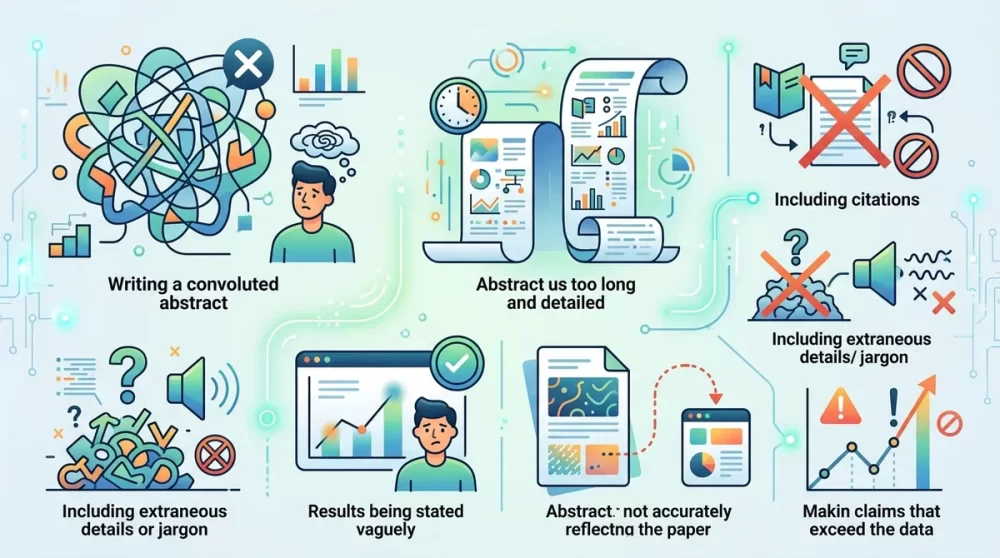
Even experienced researchers make errors when writing abstracts. Here are the most frequent problems our editors identify:
- Vague results: Stating “results showed improvement” without providing data or percentages.
- Missing methods: Omitting the study design or sample size, leaving reviewers without context.
- Speculation without data: Drawing conclusions that go beyond what the results actually show.
- Referencing figures or tables: Abstracts must stand alone — never reference “Figure 1” or “Table 2.”
- Exceeding word limits: Submitting an abstract that is too long for the target journal.
- Misalignment with the paper: Writing an abstract that does not accurately reflect the full manuscript.
Differences Between STEM and Humanities Abstracts
Abstract conventions differ between disciplines. STEM fields follow the IMRaD structure closely, with emphasis on methods and quantitative results. Humanities and social sciences focus more on the theoretical framework, thesis, and argumentative contribution.
| Discipline | Primary Focus | Methods Emphasis | Results Format |
|---|---|---|---|
| Life Sciences / Medicine | Problem, Methods, Results, Conclusion | High — specific design and sample details | Quantitative data with statistical support |
| Engineering | Problem, Approach, Outcome | Moderate — technical approach described | Performance metrics or system outcomes |
| Humanities / Social Sciences | Thesis, Background, Argument | Low — methodology briefly noted | Qualitative interpretation or theoretical insight |
If you are unsure which format applies to your manuscript, the FAQ section on our website offers additional guidance by document type and discipline.
How Professional Editing Strengthens Your Abstract
Writing your own abstract is always a good starting point. But having a professional editor review it adds significant value — especially for non-native English speakers and researchers preparing their first submission.
A skilled editor will review your abstract for:
- Logical flow and structural completeness
- Clarity and conciseness of language
- Adherence to journal word limits and style requirements
- Accuracy of keyword integration
- Alignment between the abstract and the full manuscript
San Francisco Edit is a specialist editing service trusted by researchers worldwide. With more than 325 years of combined staff experience in academic and scientific editing, and a 98% publication success rate, the team brings unmatched expertise to every manuscript. All editing is performed by native English-speaking PhD scientists — not AI tools — ensuring your abstract receives the human precision it deserves. You can read what authors say on our testimonials page.
For researchers managing tight submission timelines, standard turnaround is 6–8 days, with rush options available in 3–4 days. Full pricing and payment details are available on our website.
A Quick Abstract Writing Checklist
Before submitting your manuscript, run through this final checklist for your abstract:
- Does the abstract include background, objective, methods, results, and conclusion?
- Is it within the journal’s specified word limit?
- Does it stand alone without referencing figures, tables, or citations?
- Is the language clear, concise, and free of unnecessary jargon?
- Does it accurately reflect the content and findings of the full paper?
- Have you included relevant keywords for database indexing?
- Is the novelty of your findings clearly stated?
Conclusion
Knowing how to write an abstract for a research paper is a skill that directly affects your publication success. A strong abstract gets your paper read, reviewed favorably, and cited more frequently. A weak one can stop your manuscript at the first gate.
Follow the seven steps outlined in this guide: write last, identify core components, draft one sentence per section, respect word limits, use clear language, state your novelty, and include strategic keywords. Then use the checklist to verify your draft before submission.
If you want expert eyes on your abstract and full manuscript, the team at San Francisco Edit is ready to help. With decades of experience across life sciences, medicine, engineering, and the humanities, we help authors at every stage of their career publish with confidence. Submit your manuscript today and take the next step toward successful publication.
FAQs
Q: How long should a research paper abstract be?
A: Most research abstracts are between 150 and 250 words. Some journals, particularly in biomedical fields, allow up to 300 words for structured abstracts. Always check the specific word limit in your target journal’s author guidelines before writing.
Q: What are the key sections of a research abstract?
A: A well-structured abstract includes five core sections: background or problem statement, study objective, methods, key results, and conclusions or implications. Scientific journals commonly follow the IMRaD format, which mirrors the structure of the full manuscript.
Q: What are the most common mistakes when writing a research abstract?
A: Common mistakes include presenting vague results without specific data, omitting methods or study design, referencing figures or tables (which abstracts should not do), exceeding the journal’s word limit, and failing to clearly state the novelty of the findings.
Q: Should I write the abstract before or after the full paper?
A: Always write the abstract after completing the full paper. This ensures your summary accurately reflects your final conclusions and key findings. Writing the abstract too early often results in inaccuracies that require significant revision later.
Q: How can professional editing improve my research abstract?
A: A professional editor reviews your abstract for logical flow, language clarity, adherence to journal word limits, keyword integration, and alignment with the full manuscript. For non-native English speakers in particular, expert editing can significantly improve readability and journal acceptance rates.