Key Takeaways
-
Select your target journal before writing: Review its scope, audience, word count limits, and formatting rules to avoid desk rejection and ensure your research aligns with the journal's focus.
-
Follow the IMRaD structure (Introduction, Methods, Results, Discussion): This globally accepted format provides reviewers with a familiar framework and significantly increases your chances of acceptance.
-
Write your abstract last after completing all sections, keeping it to 150-300 words with clear structure: background, objective, methods, results, and conclusion to maximize discoverability.
-
Ensure your methods section includes reproducibility details: study design, participant characteristics, data collection procedures, statistical methods, and ethical approvals so other researchers can replicate your work.
-
Strictly comply with journal formatting requirements using the official template unmodified: font, spacing, margins, and page limits are non-negotiable and desk rejection happens before peer review for violations.
-
Invest in professional editing and thorough proofreading before submission: grammatical errors, unclear language, and inconsistent terminology are common rejection reasons even when the science is sound.
Getting your research published in a peer-reviewed journal is one of the most rewarding milestones in an academic career. But knowing how do you write a manuscript that editors actually accept can feel overwhelming, especially if you are preparing your first submission. The process involves much more than typing up your findings. It requires careful planning, precise structure, and attention to every formatting detail your target journal demands.
Whether you are a PhD candidate, a clinician documenting a clinical trial, or a seasoned researcher managing a growing publication pipeline, this guide breaks the process into clear, actionable steps. Follow these eleven steps to write a manuscript that stands out, meets journal standards, and improves your chances of acceptance.

Step 1: Choose the Right Target Journal First
Before you write a single word, identify the journal where you plan to submit. Review its scope, audience, and recent publications. Make sure your research fits the journal’s focus. Submitting to the wrong journal is one of the fastest routes to desk rejection.
Check the journal’s author guidelines carefully. Note the required word count, formatting rules, reference style, and section structure. These details will shape every decision you make while drafting. Resources like PubMed can help you identify top journals in your field and review published examples.
Step 2: Understand the IMRaD Structure
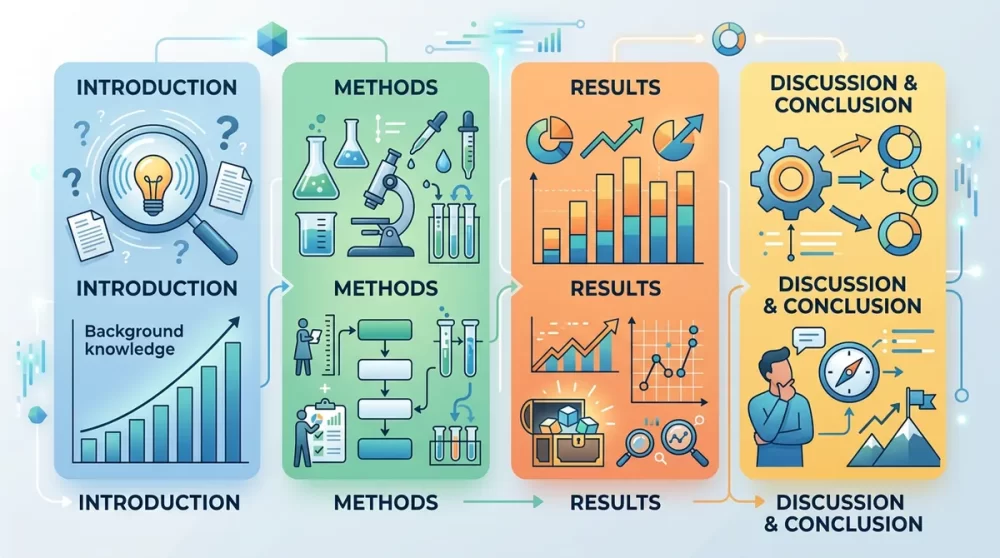
Most scientific and medical manuscripts follow the IMRaD format. This stands for Introduction, Methods, Results, and Discussion. It is the globally accepted structure for research articles and gives reviewers a familiar framework to evaluate your work.
Here is a breakdown of each section:
- Introduction: State the research problem, review the existing literature, and present your hypothesis or objective.
- Methods: Describe exactly how you conducted your study. Include enough detail for reproducibility.
- Results: Present your findings clearly using text, tables, and figures. Do not interpret yet.
- Discussion: Interpret your results, compare them with existing literature, and explain their significance.
Some journals also require a separate Literature Review or Conclusion section. Always confirm with the journal’s specific guidelines before drafting.

Step 3: Write a Strong Title and Abstract
Your title and abstract are the first things an editor and reviewer read. They are also what appears in search results and databases. A weak title or abstract can cost you before reviewers even reach your methods section.
Follow these tips for writing an effective title and abstract:
- Keep the title specific and descriptive — avoid vague phrases
- Include key terms that reflect your study’s topic and findings
- Write the abstract last, after all other sections are complete
- Stay within the word limit, typically 150–300 words
- Structure the abstract: background, objective, methods, results, and conclusion
- Avoid abbreviations and citations in the abstract unless required

Step 4: Select Targeted Keywords
Most journals ask for 5–6 keywords. These terms improve your manuscript’s discoverability in academic databases. Choose keywords that reflect your methods, topic, and findings. Avoid repeating words already in your title, as databases often combine title and keyword fields for indexing.
Step 5: Apply Correct Formatting Standards
Journals are strict about formatting. Non-compliance leads to immediate desk rejection. Do not alter templates in any way — not margins, not spacing, not fonts.
General formatting standards commonly required include:
| Formatting Element | Standard Requirement |
|---|---|
| Font | Times New Roman, 12pt |
| Line Spacing | Double-spaced throughout |
| Margins | 2.5 cm on all sides |
| Title Formatting | Bold, centered, title case |
| Section Headings | Structured levels (H1, H2, H3) |
| Template | LaTeX or Word, unmodified |
Always use the template provided by the journal or conference. For example, CVPR 2026 limits papers to 8 pages including all figures and tables, with additional pages only for references. ICLR 2026 allows 9 pages for initial submission, expanding to 10 for camera-ready versions. These limits are strictly enforced.
Step 6: Write a Clear and Detailed Methods Section
Reproducibility is a cornerstone of modern scientific publishing. In 2026, journals increasingly require methodological transparency statements. Your methods section must be detailed enough for another researcher to replicate your study.
Include the following in your methods section:
- Study design and rationale
- Participant or sample characteristics
- Data collection procedures and instruments
- Statistical methods used for analysis
- Ethical approvals and consent processes
Step 7: Present Results Objectively
The results section should present your findings without interpretation. Use clear, concise language. Support your narrative with well-labeled tables and figures. Avoid duplicating data — if a figure shows it, you do not need to repeat every number in the text.
Number all tables and figures sequentially. Write clear captions that allow each visual to stand alone. Reviewers often scan figures first before reading the full text, so quality visuals matter.
Step 8: Write a Focused Discussion and Conclusion
The discussion is where you interpret your results. Connect your findings to existing research using sources from authoritative databases. Acknowledge the limitations of your study — reviewers appreciate honesty. Avoid overstating your conclusions. End with a clear statement of your study’s contribution to the field.
Your conclusion should be brief and decisive. It summarizes the main finding and its significance. It may also suggest directions for future research.
Step 9: Manage References Accurately
Reference errors are surprisingly common and can signal carelessness to reviewers. Use reference management software such as Mendeley, Zotero, or EndNote to keep your citations organized. Always format references exactly as the journal requires — whether APA, Vancouver, AMA, or another style.
Double-check every reference against the original source. Verify DOIs, volume numbers, page ranges, and author names. A well-managed reference list reflects the thoroughness of your entire manuscript. Searching PubMed Central can help you locate accurate citation details for biomedical literature.
Step 10: Ensure Ethical Compliance and Originality
Journals require authors to declare that their manuscript is original work not under consideration elsewhere. Dual submission — submitting the same paper to two venues simultaneously — violates most journal policies and can result in permanent blacklisting.
Your submission checklist should confirm the following:
- The manuscript has not been published or submitted elsewhere
- All authors have reviewed and approved the submission
- Ethical approval numbers and consent statements are included
- Data availability and reproducibility statements are present
- Conflicts of interest are fully disclosed
For further guidance on ethical publishing standards, the Committee on Publication Ethics (COPE) provides comprehensive guidelines used by thousands of journals worldwide.
Step 11: Edit, Proofread, and Seek Professional Review
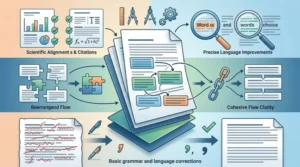
This step is where many authors fall short. Writing a strong draft is only part of the process. Editing and proofreading are just as important. Grammatical errors, unclear phrasing, and inconsistent terminology can lead to rejection — even when the science is sound.
Professional editing addresses several critical areas:
- Grammar, syntax, and sentence clarity
- Logical flow and coherence between sections
- Accuracy and consistency in technical terminology
- Compliance with journal formatting and style requirements
- Precision of language for non-native English authors
For non-native English-speaking authors especially, professional scientific editing can make the difference between acceptance and rejection. San Francisco Edit provides expert manuscript editing by native English-speaking PhD scientists. Their editors understand journal standards across life sciences, medicine, engineering, and social sciences. With a 98% acceptance rate for edited manuscripts and more than 325 years of combined editorial experience, San Francisco Edit is a trusted partner for researchers worldwide. You can explore their client testimonials to see the results authors have achieved.
If you are unsure where to begin, visit the knowledge center for detailed guidance on writing research papers, abstracts, and introductions. You can also review frequently asked questions about the editing process before getting started.
Conference Paper Requirements at a Glance (2026)
If you are targeting a conference rather than a journal, page limits and deadlines vary by venue. Here is a quick reference for major 2026 conferences:
| Conference | Page Limit (Main Text) | Reference Pages | Notes |
|---|---|---|---|
| MICCAI 2026 | 8 pages | +2 pages | Review period: Feb 26 – Jun 12, 2026 |
| ICLR 2026 | 9 pages (submission) / 10 (camera-ready) | Unlimited | Unlimited appendices allowed |
| CVPR 2026 | 8 pages (incl. figures/tables) | Additional pages only | Strict template compliance required |
Always verify the current guidelines directly on the official conference website, as these details can change close to submission deadlines. Additionally, reviewing Taylor & Francis Author Services provides helpful formatting templates for journal manuscript preparation.
Common Reasons Manuscripts Are Desk Rejected
Understanding what causes rejection helps you avoid the most costly mistakes. Desk rejection happens before peer review even begins. Here are the most frequent reasons:
- Manuscript does not match the journal’s scope or audience
- Formatting non-compliance (altered margins, wrong font, exceeded page limits)
- Poor English language quality that hinders clarity
- Missing ethical declarations or consent statements
- Dual submission policy violations
Addressing each of these points before submission significantly increases your manuscript’s chances of moving forward to peer review. If you are ready to take the next step, you can submit your manuscript for professional editing and get expert feedback tailored to your target journal.
Conclusion
Knowing how do you write a manuscript for publication means mastering both the science and the craft of academic writing. From choosing the right journal to formatting every heading correctly, each step matters. Skipping even one element — like a reproducibility statement or a properly structured abstract — can cost you weeks of waiting and ultimately a rejection.
Take the time to follow a proven structure, comply strictly with journal requirements, and invest in professional editing before you submit. The effort pays off in faster acceptance, higher publication rates, and greater visibility for your research. San Francisco Edit’s team of expert editors is ready to help you present your work at its absolute best. Send us your manuscript today and take the first step toward successful publication.
FAQs
Q: What is the IMRaD structure and why is it important for manuscript writing?
A: IMRaD stands for Introduction, Methods, Results, and Discussion. It is the globally accepted structure for scientific and medical research manuscripts. Journals and reviewers expect this format because it provides a clear, logical framework for evaluating research quality and reproducibility.
Q: How do I format a manuscript to avoid desk rejection?
A: Always follow the target journal’s author guidelines precisely. Use the required font (typically Times New Roman 12pt), double-spacing, 2.5 cm margins, and the journal’s official template without modification. Formatting errors such as altered margins or incorrect fonts often result in immediate desk rejection before peer review begins.
Q: Should I use a professional editing service before submitting my manuscript?
A: Yes, professional editing is strongly recommended, particularly for non-native English-speaking authors. Poor language clarity and grammatical errors are among the most common reasons for manuscript rejection. A qualified scientific editing service ensures your manuscript meets journal language standards and presents your research in the clearest possible way.
Q: How many keywords should I include in my manuscript submission?
A: Most journals require between 5 and 6 keywords. Select terms that accurately reflect your research topic, methods, and findings. Avoid repeating words already used in your title, as indexing databases often combine both fields for discoverability purposes.
Q: What are dual submission policies and why do they matter?
A: Dual submission means submitting the same manuscript to two or more journals or conferences at the same time. Almost all journals prohibit this practice. Violating dual submission policies can result in manuscript withdrawal, retraction after publication, and damage to your professional reputation. Always confirm your manuscript is submitted to only one venue at a time.