Key Takeaways
-
Most journals require 150–250 words for abstracts, but always verify your target journal's exact guidelines as requirements vary significantly by discipline, publisher, and publication type.
-
Allocate words strategically across four essential components: background (15–20%), methods (25–30%), results (35–40%), and conclusions (15–20%) to ensure no critical information is omitted.
-
Exceeding the word limit by even one word can trigger automatic desk rejection through submission management software, so count carefully using the same tools your journal uses.
-
Convert passive voice to active voice and eliminate redundant phrases like 'it was found that' to recover 15–25 words without losing scientific content or meaning.
-
Structured abstracts require explicit headings (Background, Methods, Results, Conclusion) while unstructured abstracts present the same four components as flowing paragraphs—verify your journal's format requirement before finalizing.
-
Results deserve the most abstract space since reviewers read this section most carefully; include specific data points and numbers rather than vague statements like 'results were significant.'
A perfectly crafted 200-word abstract can outperform a 400-word one when editors understand the hidden psychology of journal reviewers who scan hundreds of submissions weekly. Most authors focus on meeting minimum word counts, but professional editors know that strategic abstract trimming within journal limits dramatically improves acceptance rates. Reviewers are busy. They decide within seconds whether a manuscript deserves closer attention. A concise, well-structured abstract signals that the author respects their time — and that the research itself is clearly organized.
Understanding how long an abstract has to be goes far beyond simply counting words. It requires knowing each target journal’s specific requirements, mastering the art of compression, and preserving every essential element within a tight word budget. Whether you are a PhD candidate submitting your first paper, a clinician translating research into publishable form, or a faculty member managing your department’s output, abstract length is a critical variable that can determine whether your manuscript reaches peer review or faces immediate desk rejection.
This guide covers the 11 rules professional manuscript editors apply when optimizing abstract length for maximum impact and journal compliance.

Standard Abstract Length Requirements Across Major Journal Categories
The most common answer to how long does an abstract have to be is 150–250 words. However, this range applies specifically to most biomedical and general science journals. Requirements vary significantly across disciplines and publication types. Always verify the exact guidelines of your target journal before finalizing your abstract.
Here is a summary of standard abstract length ranges by journal category:
| Journal/Publication Type | Typical Word Limit | Format |
|---|---|---|
| Medical journals | 150–250 words | Structured (with headings) |
| General science journals | 100–300 words | Unstructured or structured |
| Humanities journals | Up to 400 words | Unstructured paragraph |
| Conference abstracts | 400–500 words | Structured or unstructured |
| Open access journals | 150–300 words | Varies by publisher |
Medical journals typically require 150–250 words in a structured format. These journals, many indexed on PubMed, demand precise language and clearly labeled sections. Science journals range from 100–300 words depending on article type. Some Wiley publications cap abstracts at just 180 words. Conference abstracts are notably more generous, typically permitting 400–500 words. Humanities journals often allow up to 400 words due to the interpretive nature of the discipline.
Publisher-specific variations add another layer of complexity. A journal from one publisher may allow 250 words while another from the same field caps at 150. Editors working with multiple submissions must track these differences carefully. Our knowledge center provides detailed guidance on navigating publisher-specific requirements.
The Four Essential Components That Must Fit Within Word Limits
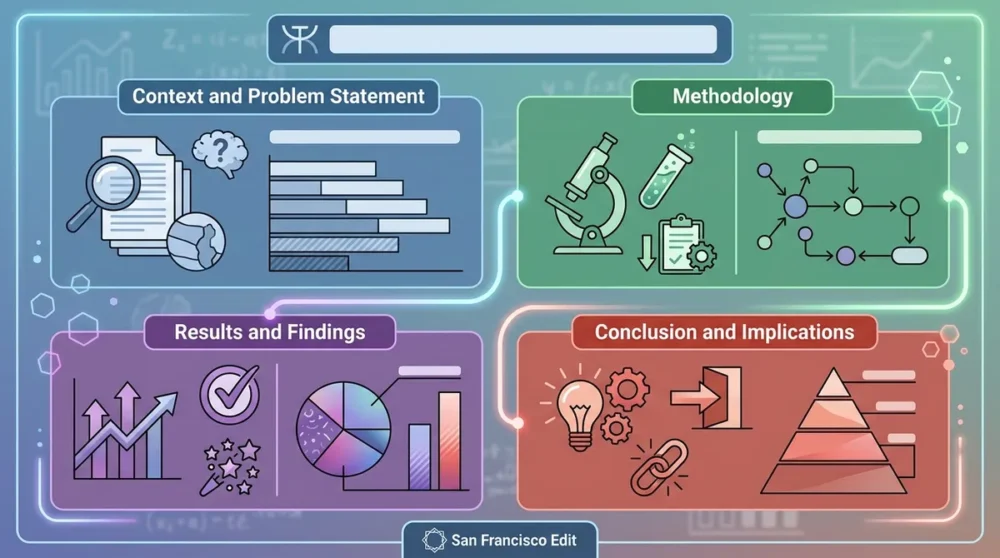
Every effective abstract contains four structural components regardless of word limit. Professional editors allocate words strategically across these sections to ensure nothing critical is omitted.
The four components are:
- Background and purpose — Establishes why the study matters
- Methods — Explains how the study was conducted
- Results — Presents the key findings
- Conclusions — Communicates the broader impact
Background and purpose should consume no more than 15–20% of your word limit. For a 250-word abstract, that is roughly 40–50 words. Authors frequently overwrite this section, sacrificing space needed for results. Editors compress background statements to one or two sentences that clearly state the research gap and study aim.
Methods require careful compression. Allocate approximately 25–30% of total words here. Focus on study design, population, and primary analytical approach. Omit procedural details that belong in the full text. For example, instead of listing every instrument used, name the core method only.
Results deserve the most space — approximately 35–40% of the abstract. This is the section reviewers read most carefully. Include your primary outcome with specific data points where possible. Numbers are persuasive and space-efficient. Avoid vague statements like “results were significant” — state the actual finding.
Conclusions should occupy the remaining 15–20%. This section must connect your findings to the broader field. One to two precise sentences are sufficient. Avoid overstating implications or introducing new information not supported by your results.
Recommended word allocation ratios for a 200-word abstract:
- Background: 30–40 words
- Methods: 50–60 words
- Results: 70–80 words
- Conclusions: 30–40 words
Omitting any of these four sections reduces acceptance chances significantly. Editors at San Francisco Edit consistently identify incomplete abstracts as one of the leading causes of desk rejection in manuscripts submitted for professional review.

Structured vs Unstructured Abstract Requirements
Journals specify either a structured or unstructured abstract format — and the distinction matters for both content and word count management.
Structured abstracts use explicit headings such as Background, Methods, Results, and Conclusion. Most medical and clinical journals require this format. The headings themselves may or may not count toward the word limit depending on the journal’s policy. Always check the author guidelines. When headings count toward the limit, editors must be even more precise with body text.
Unstructured abstracts present the same information as a single flowing paragraph without labeled sections. General science, social science, and humanities journals frequently prefer this format. The challenge here is maintaining logical flow while covering all four components within the word limit.
Word distribution in structured abstracts follows a more rigid pattern because each section heading anchors a specific portion of content. Editors recommend the following approach when converting between formats:
- Identify the four structural components in the original text
- Measure word counts for each section independently
- Add or remove heading labels based on target journal requirements
- Adjust transitions for unstructured flow if converting to paragraph format
Converting a structured abstract to an unstructured one requires adding transitional phrases that guide the reader without headings. This often adds 10–15 words, which must be offset by trimming elsewhere. Our team provides expert scientific editing services that include format conversion for journal-specific compliance.

Professional Editing Techniques to Meet Strict Word Counts
Experienced editors use a systematic approach to reduce abstract length without losing meaning. The goal is surgical precision — cutting words, not content.
Eliminating redundant phrases is the fastest way to reduce word count. Common examples include phrases like “it was found that,” “the results showed that,” and “in order to.” These can be deleted or replaced with single words without changing the meaning.
Converting passive voice to active voice saves words and improves clarity. Compare:
- Passive: “Blood samples were collected by the research team” (9 words)
- Active: “The research team collected blood samples” (7 words)
Across an entire abstract, passive-to-active conversion can recover 15–25 words. This technique also improves readability scores, which matters for non-native English authors seeking clear, direct communication. Our language editing services specifically target these constructions.
Replacing wordy constructions with precise terms is equally effective. For example, “conducted an investigation into” becomes “investigated,” and “a large number of” becomes “many.” These substitutions maintain full meaning while freeing up words for essential content.
Strategic use of abbreviations and acronyms saves space in longer abstracts. Define the abbreviation once, then use it throughout. However, avoid overloading short abstracts with too many acronyms — this reduces readability for reviewers unfamiliar with niche terminology.
Preserving technical accuracy while cutting length requires judgment. Never remove a statistical result, sample size, or primary outcome measure in favor of descriptive language. Data is always more valuable per word than interpretation. If you need expert guidance on trimming your abstract without sacrificing scientific integrity, consider submitting your manuscript through our manuscript submission portal for professional review.
Common Word Count Mistakes That Lead to Desk Rejection
Understanding how long an abstract has to be also means knowing which errors immediately disqualify a submission. These mistakes are more common than authors realize.
Including citations in the abstract is a frequent error. Most journals prohibit references within the abstract. Even if a citation is essential context, it adds words and often violates submission guidelines. Remove all citations from the abstract and ensure the text stands alone without reference support.
Exceeding the word limit by even one word can trigger automatic desk rejection at journals using submission management software. Many platforms flag overlength abstracts immediately. Editors count words using the same tools the journal uses — typically Microsoft Word’s word count function, which may handle hyphenated terms and abbreviations differently than manual counting.
Omitting key methodological details weakens the abstract and raises reviewer concerns about study validity. Even under tight word limits, the core method must be present. A clinical trial abstract that omits randomization details or sample size is incomplete regardless of how well-written the rest may be.
Background sections that consume half the word limit are a hallmark of first-time authors. Reviewers do not need extensive context — they are domain experts. Keep background to two sentences maximum. Use the freed words for results, which are what reviewers actually evaluate. For additional tips, explore our frequently asked questions on manuscript preparation.
Journal-Specific Abstract Guidelines for Top Publishers
Each major publisher has its own abstract specifications. Editors must consult current author guidelines directly, as requirements can change between submission cycles.
Elsevier journals vary widely by title. Most Elsevier journals in medicine and life sciences require 150–250 words. Some titles specify structured abstracts with defined headings; others accept unstructured paragraphs. Elsevier’s submission portal checks abstract length automatically and will reject overlength submissions without author notification in some cases.
Wiley publications are known for stricter limits. Several Wiley journals cap abstracts at 180 words — well below the typical range. Authors submitting to Wiley titles should aim for 170–175 words to provide a small buffer. Wiley also specifies that structured abstracts must use their standard heading set, not author-defined labels.
Nature and Science have some of the most demanding abstract requirements. Nature limits abstracts to approximately 150 words for research articles and uses a highly specific unstructured format. Science requires abstracts of 125 words or fewer. Both journals expect abstracts that communicate findings to a broad scientific audience, not just specialists. This requires additional editing to reduce field-specific jargon.
Open access journals, including those in the PLOS and Frontiers families, generally allow 200–300 words. Frontiers journals require structured abstracts with specific headings and often request a minimum word count as well as a maximum.
Key steps before finalizing any abstract for submission:
- Download the most current author guidelines from the journal’s official website
- Note whether structured or unstructured format is required
- Confirm the exact word limit and whether headings are included in the count
- Check whether keywords appear separately or within the abstract text
- Verify submission software requirements for abstract entry
Checking guidelines from PubMed Central’s journal database and cross-referencing with the publisher’s official site ensures you are working from the most accurate and up-to-date information. For international authors who submit to multiple journals simultaneously, tracking these differences across submissions is a significant editorial task. San Francisco Edit’s globally operating team assists authors across all disciplines in meeting these precise requirements, with a 98% acceptance rate for edited manuscripts. Explore our full range of services and transparent pricing to find the right support for your next submission.
Remember: word limits are maximums, not targets. An abstract that communicates all four structural components clearly at 180 words is stronger than one that strains to reach 250. Editors who understand this principle consistently help authors produce abstracts that stand out in competitive journal queues. To learn more about how our expert team can improve your manuscript from abstract to references, visit our client resources page or read testimonials from researchers we have helped publish successfully.
Conclusion
Mastering abstract length is one of the most practical skills in academic publishing. The rules are clear: most journals require 150–250 words, structured or unstructured depending on the discipline, with all four components — background, methods, results, and conclusions — represented proportionally. Exceeding the limit, omitting key sections, or misjudging format requirements are avoidable errors that cost authors time and publication opportunities.
Professional editors approach abstracts with precision tools: systematic redundancy removal, active voice conversion, and journal-specific compliance checks. These techniques do not just reduce word count — they improve clarity, which is what reviewers and readers respond to most.
If your abstract needs expert attention before submission, our team is ready to help. Submit your manuscript today and let San Francisco Edit’s experienced PhD editors ensure your abstract meets every journal requirement while making the strongest possible first impression.
FAQs
Q: Should I write my abstract before or after completing the full manuscript?
A: Professional editors recommend writing the abstract after the full manuscript is complete. This ensures the abstract accurately reflects the finalized methods, results, and conclusions rather than a preliminary version that may shift during revision.
Q: Do keywords count toward the abstract word limit?
A: In most journals, keywords are listed separately from the abstract text and do not count toward the word limit. However, always verify this in the target journal’s author guidelines, as a small number of journals include keywords within the abstract field.
Q: Can I exceed the word limit if my study is particularly complex?
A: No. Word limits are strict requirements, and exceeding them — even by one word — can result in automatic desk rejection at journals using submission management software. A skilled editor can condense even complex studies into the required limit without losing essential content.
Q: How do graphical abstracts relate to traditional text abstracts?
A: Graphical abstracts are visual summaries that some journals request alongside the standard text abstract, not as a replacement for it. Both must be prepared independently, and the text abstract must still meet all word count and structural requirements.
Q: What happens if different co-authors want different abstract lengths?
A: The journal’s word limit is the deciding factor — not author preference. When co-authors disagree on content or length, the resolution should always be guided by the target journal’s specific requirements and the principle of maximizing clarity within those limits.