
Every researcher knows the frustration of a rejected manuscript. Often, the problem is not the quality of the science — it is poor structure. Understanding how a research paper is structured is one of the most important skills any author can develop. A well-structured manuscript communicates your findings clearly, guides reviewers through your logic, and dramatically improves your chances of acceptance in a peer-reviewed journal.
Whether you are a PhD candidate submitting your first paper or an experienced clinician writing up trial results, structure matters. Most scientific journals expect manuscripts to follow the IMRaD format — Introduction, Methods, Results, and Discussion. But a complete manuscript includes several additional components that editors and reviewers scrutinize closely. This article breaks down the five key sections that define research paper structure, with practical guidance on what each section must contain and how professional scientific editing can help you get it right.

Why Research Paper Structure Matters for Publication
Peer-reviewed journals receive thousands of submissions every year. Reviewers and editors have limited time. A manuscript with a clear, logical structure signals professionalism and makes the reviewer’s job easier. Papers that are hard to follow — regardless of the quality of the data — are far more likely to be rejected.
Published research consistently shows that poor preparation and unclear writing contribute heavily to manuscript rejection. The structure of a paper is the first thing a reviewer assesses. It sets the tone for how your entire study is perceived. Journals indexed on PubMed and other major databases uphold strict standards, and manuscripts that do not meet structural expectations are often desk-rejected before peer review even begins.
For non-native English speakers and early-career researchers, getting the structure right is especially critical. Professional language editing services can help ensure your manuscript meets these standards before submission.

The Standard IMRaD Framework Explained
The IMRaD format is the most widely accepted structure in scientific and academic publishing. It promotes clarity, logical flow, and consistency across disciplines including medicine, life sciences, and engineering. Here is a quick overview of the four core sections:
| Section | Purpose | Recommended Length |
|---|---|---|
| Introduction | Establish context and research gap | 1.5–2 pages |
| Methods | Describe study design and procedures | 2–3 pages |
| Results | Present findings objectively | 6–8 pages |
| Discussion | Interpret findings and implications | 4–6 pages |
Note that the IMRaD format applies most directly to scientific and medical disciplines. Humanities, social sciences, and business research may use alternative structures, though the core principle of logical, progressive flow remains universal.

5 Key Sections That Define How a Research Paper Is Structured
1. The Front Matter: Title, Authors, Abstract, and Keywords
Before the body of your paper begins, the front matter establishes your manuscript’s identity. These components are often the first — and sometimes only — parts a reader or editor sees before deciding to read further.
A strong title is specific, concise, and descriptive. It should reflect the study’s main finding or focus without being vague or overly long. Author names, institutional affiliations, and corresponding author details must be accurate and formatted according to journal guidelines.
The abstract deserves special attention. It must be self-contained and should cover:
- Background and context of the study
- The specific research objective or question
- Methodology used
- Key findings or results
- Main conclusion and its significance
Abstracts are typically limited to 150–250 words in a single paragraph and must not include citations. Keywords (usually a maximum of three to five) should be specific to the topic and selected carefully to improve discoverability in databases. One common mistake is selecting keywords that are too broad, which reduces targeted visibility.
2. Introduction: Establishing the Research Context
The Introduction answers three essential questions: What is already known? What gap exists? What does this study do to fill that gap? A strong Introduction moves from broad context to a specific, focused research question.
Recommended length is approximately 1.5 to 2 pages. One of the most common structural errors is an Introduction that runs significantly over this limit — overshooting the prescribed word count by more than 15% is a frequently flagged problem in manuscript review. Keep it focused and purposeful.
Key elements of a well-written Introduction include:
- A clear opening that situates the study within the broader field
- A concise review of relevant prior literature
- Identification of the gap or unresolved question
- A clear statement of the study’s aim or hypothesis
Manuscript editors check that the Introduction logically leads the reader toward the study’s rationale, with smooth transitions and well-chosen citations. Explore the knowledge center at San Francisco Edit for additional guidance on writing effective introductions.
3. Methods: Ensuring Reproducibility and Transparency
The Methods section is the backbone of your manuscript’s scientific credibility. It must be detailed enough for another researcher to replicate your study. Vague or incomplete methods are a major cause of rejection and post-publication criticism.
This section typically covers:
- Study design and participant selection
- Data collection procedures and instruments
- Ethical approvals and informed consent statements
- Statistical methods and software used
- Any protocols or guidelines followed
The recommended length is 2 to 3 pages. Methods should be written in the past tense and in a logical, chronological order. For medical researchers especially, adherence to reporting guidelines (such as CONSORT for clinical trials or STROBE for observational studies) is often a journal requirement. Professional editors verify that all required elements are present and properly explained.
4. Results and Discussion: Presenting and Interpreting Findings
The Results and Discussion sections are where your research findings come alive. They are also where structural problems most commonly arise — particularly when authors blur the boundary between objective reporting and interpretation.
Results should present data clearly and objectively, without interpretation. Use tables and figures to summarize complex data. Guidelines suggest:
- 6 to 8 figures (approximately one per page)
- 1 to 3 tables (approximately one per page)
- Narrative text that highlights key findings without repeating every data point
The Discussion then interprets those findings. It should answer: What do the results mean? How do they relate to prior literature? What are the limitations? What are the implications for the field? Recommended length is 4 to 6 pages. Avoid the common mistake of simply repeating Results content in the Discussion — this section must add analytical value.
Manuscript editors play a critical role here. They verify logical flow between Results and Discussion, ensure transitions are smooth, and confirm that claims made in the Discussion are fully supported by the Results. For researchers seeking guidance on this process, client testimonials at San Francisco Edit highlight how professional editing has helped authors achieve acceptance without revisions.
5. Conclusion, References, and Declarations
The final section of a well-structured research paper ties everything together. The Conclusion should be brief and direct. It summarizes the main findings, restates their significance, and may suggest directions for future research. It must not introduce new data or arguments.
The References section is equally important. Most journals require between 20 and 50 references formatted according to a specific style guide — APA, MLA, Chicago, or a journal-specific format. Mechanical editing ensures that every citation is consistent, complete, and correctly formatted. Errors in references are surprisingly common and can seriously undermine a manuscript’s credibility.
Declarations typically required by journals include:
- Conflict of interest statements
- Funding acknowledgments
- Author contribution statements
- Data availability statements
- Ethical approval details
Missing or incomplete declarations can result in immediate rejection at many top-tier journals. A thorough manuscript editor will flag any missing declarations and advise on the correct format for the target journal.
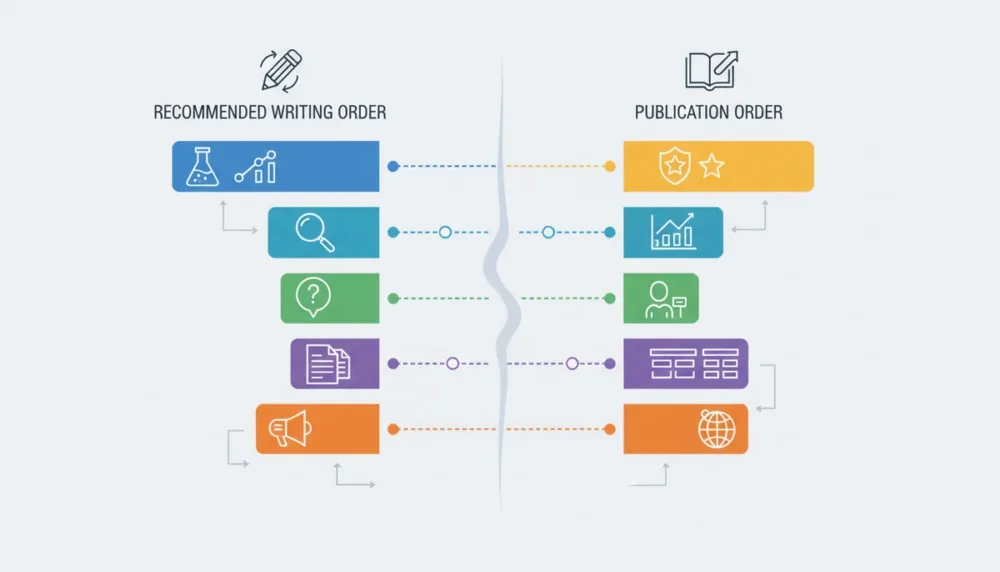
The Recommended Writing Order vs. Publication Order
One insight that surprises many early-career researchers is that the best writing order is not the same as the final publication order. Experienced authors and writing coaches recommend this sequence:
- Write Methods and Results first (you have the data — start here)
- Write the Introduction and Discussion next (once you know what you found)
- Write the Conclusion after the Discussion is complete
- Finalize the Title and Abstract last (summarize what you have written)
This approach reduces writer’s block and ensures each section is grounded in actual content rather than speculation. Resources from authoritative publishing platforms such as Elsevier’s publishing guidance support this method.
How Professional Manuscript Editing Improves Structure
Even experienced authors benefit from a second pair of expert eyes. Professional manuscript editors do far more than correct grammar. They assess:
- Whether each section fulfills its intended purpose
- Logical flow and transitions between sections
- Whether headings accurately reflect content
- Adherence to target journal guidelines and word limits
- Consistency of terminology and formatting throughout
San Francisco Edit specializes in exactly this kind of deep structural and linguistic review. With a team of native English-speaking PhD scientists and more than 325 combined years of editing experience, San Francisco Edit has supported a remarkable 98% publication success rate across the manuscripts it has edited. Whether you need scientific editing for a journal article or language editing for a manuscript written in English as a second language, the service is designed to help authors at every stage.
You can also review pricing and payment options or visit the FAQ page to learn more about the editing process before you begin.
Common Structural Mistakes to Avoid
Understanding how a research paper is structured also means knowing what not to do. The most frequent structural errors include:
- An Introduction that is too long or too vague, failing to identify a clear research gap
- A Methods section that omits key procedural details, making replication impossible
- A Results section that includes interpretation instead of objective data reporting
- A Discussion that repeats Results without adding analytical depth
- A Conclusion that introduces new claims not supported by the Results
- References with inconsistent formatting or missing details
- Missing declarations required by the target journal
Catching these errors before submission — not after rejection — is where professional editing makes the greatest difference. Visit the knowledge center for free resources on manuscript writing and structure.
Conclusion
Knowing how a research paper is structured is essential for any author who wants to publish successfully. The IMRaD framework, combined with strong front matter, complete declarations, and a properly formatted reference list, gives your manuscript the professional foundation it needs to stand out in peer review. Structure is not a formality — it is the architecture of scientific communication.
If you are ready to give your manuscript the best possible chance of acceptance, let a team of expert editors review your work from title to references. Submit your manuscript to San Francisco Edit today and take the next step toward successful publication.
FAQs
Q: What is the IMRaD structure in a research paper?
A: IMRaD stands for Introduction, Methods, Results, and Discussion. It is the most widely accepted format for scientific and medical research papers. This structure promotes logical flow and clarity, making it easier for reviewers and readers to follow your study from question to conclusion.
Q: How long should each section of a research paper be?
A: General guidelines recommend approximately 1.5–2 pages for the Introduction, 2–3 pages for Methods, 6–8 pages for Results, and 4–6 pages for the Discussion. The abstract should be 150–250 words in a single paragraph. These are guidelines, not absolute rules, and individual journal requirements always take priority.
Q: What is the best order to write the sections of a research paper?
A: Most experienced authors recommend writing Methods and Results first, since you already have the data. Follow with the Introduction and Discussion, then the Conclusion, and finalize the Title and Abstract last. This approach ensures each section is grounded in actual findings rather than assumptions.
Q: How do manuscript editors help improve research paper structure?
A: Professional manuscript editors assess far more than grammar and spelling. They evaluate logical flow between sections, verify that each section fulfills its intended purpose, check that headings accurately reflect content, and ensure the manuscript adheres to target journal formatting and length requirements. This structural review significantly improves the likelihood of acceptance.
Q: What common structural mistakes lead to manuscript rejection?
A: The most common errors include a vague or overlong Introduction, a Methods section that lacks sufficient detail for replication, a Results section that mixes in interpretation, and a Discussion that simply repeats findings without analytical depth. Missing declarations or incorrectly formatted references are also frequent causes of rejection at peer-reviewed journals.