
Key Takeaways
-
Use a funnel structure that moves from broad background context to your specific research question or hypothesis, as this proven approach signals focused research and prevents desk rejection by editors.
-
Clearly identify and articulate the research gap—what is missing or unresolved in current literature—as a vague gap statement is a leading cause of rejection and undermines your entire manuscript’s significance.
-
Keep introductions between 250-600 words and avoid common mistakes like writing too broadly, including results, citing outdated sources, or being vague about your objective, as these trigger early rejection.
-
Write your introduction after completing methods and results sections so it accurately reflects your actual study scope and findings rather than your initial plans, then revise thoroughly before submission.
-
End your introduction with a precise, unambiguous statement of your study’s aim, research question, or hypothesis that directly addresses the identified gap and gives readers exact clarity on what you studied.
-
For non-native English authors, focus on precise verb tenses, clear sentence structures, and grammatically exact objective statements, as poor English significantly increases rejection risk regardless of scientific quality.
The introduction is one of the most important sections of any academic manuscript. It is often the first thing journal editors and peer reviewers read. A weak introduction can lead to rejection before reviewers even reach your methods or results. A strong one signals that your research is focused, relevant, and worth publishing.
Writing a compelling research paper introduction takes more than good ideas. It requires a clear structure, precise language, and a deep understanding of what editors expect. Whether you are a PhD candidate submitting your first paper or a seasoned clinician writing up a clinical study, mastering this section is essential for publication success.
This guide breaks down exactly what goes into a strong research paper introduction, how to structure it correctly, and how to avoid the mistakes that lead to rejection.
What Is a Research Paper Introduction?
In academic manuscript writing, the introduction is the opening section of a journal article. It is part of the IMRAD structure — Introduction, Methods, Results, and Discussion — which is the standard format used by most peer-reviewed journals worldwide. You can learn more about this in our guide on how to structure a research paper correctly.
The introduction does several things at once. It establishes the broader topic, explains why the subject matters, summarizes relevant prior work, identifies the gap in knowledge, and states the purpose of your study. Each of these elements must appear in a logical, concise sequence.
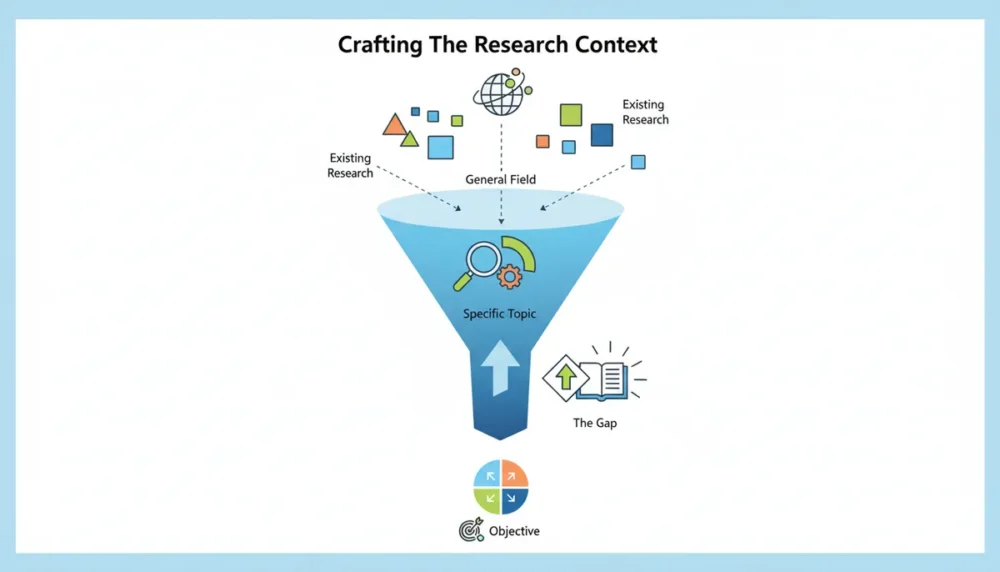
According to a manuscript writing review published on PubMed, effective introductions follow a four-paragraph funnel structure. This moves from general background context down to the specific research question or hypothesis your study addresses.

Why the Introduction Matters So Much
Journal reviewers and editors are busy professionals. They often form strong initial impressions based on the introduction alone. A poorly framed introduction raises immediate doubts about the quality of the entire manuscript.
Here is what editors look for when assessing an introduction:
- Is the research question clearly defined?
- Is there a genuine gap in the existing literature?
- Is the study’s significance well-articulated?
- Is the scope appropriate and focused?
- Is the writing concise, accurate, and well-organized?
When these elements are missing or poorly presented, editors may desk-reject the manuscript before sending it out for peer review. This is one of the most common reasons manuscripts are rejected early — not because the science is flawed, but because the introduction fails to make a convincing case. Read more about this in our article on why scientific manuscripts are rejected by journals.

The Core Components of a Strong Introduction
A well-written research paper introduction consistently includes the following elements. Each plays a distinct role in building a persuasive case for your study.
1. Background and Context
Begin by establishing the broader topic. Give readers enough context to understand why the subject is important. This is not the place for exhaustive historical detail. Keep it focused and relevant to your specific study area.
2. Literature Review Summary
Briefly summarize what previous research has shown. Highlight the key findings that are most relevant to your study. This demonstrates your command of the field and sets the stage for identifying the gap. For additional guidance, see our resource on how to write a literature review for a research paper.
3. The Research Gap
This is arguably the most critical element. You must clearly identify what is missing, unknown, or unresolved in the current literature. This gap is the reason your study exists. A vague or unconvincing gap statement is a common cause of rejection.
4. Rationale and Significance
Explain why filling this gap matters. What will your study contribute to the field? Why should anyone care about your findings? This section persuades editors and reviewers that your work is worth publishing.
5. Study Objective or Hypothesis
End the introduction with a clear statement of your study’s aim, research question, or hypothesis. This should directly address the gap you identified. It gives readers a precise understanding of what your paper sets out to achieve. Our guide on how to write a hypothesis for a research paper offers detailed help on framing this effectively.

Step-by-Step Structure for Writing Your Introduction
Following a clear sequence helps you build a logical and persuasive introduction. Here is a proven step-by-step approach used by experienced manuscript editors:
- Start broad: Open with the general topic and its importance to the field or to society.
- Narrow the focus: Move from the broad topic toward the specific area your study addresses.
- Summarize existing knowledge: Cite key studies that define the current state of research.
- Identify the gap: State clearly what is still unknown or underexplored.
- Justify your study: Explain why addressing this gap is scientifically or clinically significant.
- State your objective: End with a precise statement of your study’s aim or hypothesis.
This funnel-shaped approach is widely recommended by publishers including Elsevier, which advises authors to answer five key questions in their introduction: what is the problem, what existing solutions are available, which is the best current approach, what is its main limitation, and what does your study aim to achieve.
Common Mistakes in Research Paper Introductions
Even experienced researchers make errors that weaken their introductions. Understanding these pitfalls helps you avoid them before submission.
- Writing too broadly: An introduction that reads like a textbook chapter loses focus quickly and frustrates reviewers.
- Neglecting the gap: Failing to identify a clear research gap makes your study seem unnecessary.
- Including results or conclusions: The introduction should not preview your findings. Save those for the results and discussion sections.
- Citing outdated literature: Using old or superseded references signals that you are not current with the field.
- Being too vague: Imprecise language around your objective or hypothesis leaves reviewers confused about what you actually studied.
- Writing too much: A lengthy introduction dilutes impact. Most journals prefer concise, focused introductions.
For a deeper look at real examples of how introductions are framed successfully, see our collection of 13 research paper introduction examples that get published.
How Long Should a Research Paper Introduction Be?
There is no universal word count rule, but most journal introductions run between 250 and 600 words. The appropriate length depends on the complexity of the topic, the journal’s style guidelines, and the type of manuscript.
As a general guide, the introduction should be long enough to establish full context but short enough to maintain focus. If you find yourself exceeding one to two pages, the introduction is likely too broad or contains unnecessary detail.
Always check the target journal’s author guidelines before finalizing your introduction length. Some journals specify limits explicitly.
Introduction vs. Literature Review: Key Differences
Many early-career researchers confuse the introduction with a full literature review. They are related but distinct. The table below clarifies the key differences:
| Feature | Research Paper Introduction | Literature Review |
|---|---|---|
| Purpose | Establish context, identify gap, state objective | Comprehensively survey and analyze existing research |
| Length | Short (250–600 words typically) | Long (can span several pages or an entire paper) |
| Scope | Selectively cites most relevant studies | Covers the field broadly and systematically |
| Position in manuscript | Opening section of IMRAD structure | Can be a standalone paper or a section within a thesis |
| End goal | Lead logically to the study objective | Synthesize knowledge and identify future directions |
When Should You Write the Introduction?
Many experienced researchers recommend writing the introduction after completing the methods and results sections. This approach ensures that the final introduction accurately reflects the scope and findings of the actual study — not the study you initially planned.
Here is why this strategy works:
- Your results may narrow or shift the focus of the study.
- You can write a more precise objective statement once you know what you found.
- The introduction will align more tightly with the discussion section.
That said, writing an early draft of the introduction at the start of your project can serve as a useful planning tool. Just be prepared to revise it significantly before submission. Our guide on 11 essential steps to write a manuscript for publication walks you through the full writing sequence.
Tips for Non-Native English Authors
For researchers writing in English as a second language, the introduction presents additional challenges. Precise academic language is essential. Reviewers quickly notice grammatical errors, awkward phrasing, or unclear sentences — and these issues can undermine an otherwise strong manuscript.
Key areas to focus on include:
- Using precise verb tenses (present tense for established facts, past tense for prior studies)
- Avoiding overly long or complex sentence structures
- Using transition phrases to guide the reader logically through the funnel
- Ensuring that the research gap is stated clearly and unambiguously
- Checking that the objective statement is grammatically precise and specific
Professional language editing can make a substantial difference. Studies have shown that manuscripts with poor English are significantly more likely to be rejected, regardless of the quality of the underlying science. San Francisco Edit specializes in helping non-native English authors refine their manuscripts to meet the highest journal standards, with a 98% acceptance rate among edited papers.
How Professional Editing Strengthens Your Introduction
Even native English speakers benefit from professional manuscript editing before journal submission. An experienced scientific editor brings an objective perspective that authors often cannot provide for their own work.
Here is what expert editing adds to your research paper introduction:
- Identifies structural weaknesses and reorders content for maximum clarity
- Tightens language to eliminate wordiness and repetition
- Ensures the gap statement is compelling and logically positioned
- Verifies that the objective aligns with the study described in the methods
- Checks that citations are appropriately selected and accurately represented
San Francisco Edit provides scientific editing services delivered by native English-speaking PhD scientists. Our editors bring decades of combined experience working with authors from life sciences, medicine, engineering, social sciences, and beyond. Every introduction we edit is shaped to meet the standards that peer-reviewed journals expect.
You can also explore our full knowledge center for additional guidance on manuscript writing, structure, and submission strategy. For related guidance on crafting the opening sections of your manuscript, read our article on writing an introduction for publication and explore guidance from the Elsevier author resource center on structuring science papers editors take seriously.
For further academic writing standards guidance, the Scribbr step-by-step introduction guide offers a useful complement to professional editing services.
Conclusion
A well-crafted research paper introduction is not just an opening formality. It is a strategic argument for why your study deserves to be read, reviewed, and published. Every sentence should serve a purpose — from establishing context to identifying the gap to stating your objective with precision.
By following the funnel structure, avoiding common mistakes, and seeking professional editing support where needed, you give your manuscript the strongest possible foundation for publication success.
If you are ready to strengthen your manuscript from introduction to conclusion, submit your manuscript to San Francisco Edit and let our expert scientific editors help you achieve the clarity and precision that peer-reviewed journals demand.
FAQs
Q: What should be included in a research paper introduction?
A: A research paper introduction should include background context, a summary of relevant prior literature, a clearly defined research gap, the rationale for your study, and a precise statement of your objective or hypothesis. Each element should flow logically into the next, using a funnel structure that moves from broad context to the specific aim of your study.
Q: How long should a research paper introduction be?
A: Most research paper introductions run between 250 and 600 words, though this varies by journal and manuscript type. The introduction should be long enough to establish full context and justify your study, but concise enough to remain focused. Always check your target journal’s author guidelines for any specified length restrictions.
Q: Should the introduction be written before or after the results?
A: Many experienced researchers recommend drafting the introduction after completing the results section. This ensures the introduction accurately reflects the actual scope and findings of the study, rather than the original plan. An early draft can still be useful for planning purposes, but it should be thoroughly revised before journal submission.
Q: What is the difference between a research paper introduction and a literature review?
A: A research paper introduction selectively cites the most relevant prior studies to establish context, identify a gap, and lead to the study objective — typically in 250 to 600 words. A literature review is a comprehensive, systematic survey of an entire research field and can span several pages or form a standalone publication. The introduction is part of the IMRAD structure; the literature review is a broader academic exercise.
Q: How do editors evaluate a manuscript introduction?
A: Journal editors assess introductions for clarity of the research question, the strength of the research gap, the quality of supporting literature, the significance of the study, and the precision of the stated objective. Poor language, vague framing, or a missing gap statement can lead to desk rejection before the manuscript is sent out for peer review.