
Key Takeaways
-
The upside-down triangle structure (broad to specific) and CARS model are proven frameworks that systematically narrow from general context to research gap to study objectives, ensuring logical flow and reviewer engagement.
-
Peer reviewers often skim introductions to conclusions before full review, making your opening paragraphs critical to first impressions and publication success; a weak introduction risks rejection before results are considered.
-
Use discipline-specific opening techniques: statistical hooks for medicine, problem-definition for engineering, knowledge-gap statements for life sciences, and clinical relevance hooks for medical research to immediately establish study importance.
-
Every introduction must include four essential elements: a compelling hook, background context with citations, a specific research gap statement, and clear study objectives; missing any element triggers peer review flags.
-
Common introduction mistakes—vague research gaps, overly technical language, missing thesis statements, and poor logical flow—are systematically fixable through restructuring using the upside-down triangle model and precise tense usage (present for facts, past for prior studies).
-
Write your introduction last, after analyzing results and completing discussions, so you can define the research gap and objectives with precision and alignment to actual paper contributions.
Your introduction is the first thing peer reviewers read. If it fails to engage, your manuscript may be rejected before the results are even considered. A strong research paper introduction sets the stage for everything that follows. It establishes context, identifies a gap in existing knowledge, and tells the reader exactly why your work matters.
This guide presents 13 research paper introduction examples drawn from across scientific and medical disciplines. Each example illustrates a proven technique that manuscript editors use to strengthen introductions before journal submission. Whether you are writing your first paper or refining your tenth, these examples will help you craft an opening that earns reviewer approval.

Why Your Introduction Determines Publication Success
Readers commonly skim from the introduction directly to the conclusion before committing to a full review. This means your opening paragraphs shape the reviewer’s first impression. A well-edited introduction increases your manuscript’s clarity, credibility, and publication potential. According to publishing guidance from PMC (PubMed Central), the introduction serves three primary functions: establishing relevance, reviewing prior work, and stating objectives clearly.
For non-native English speakers especially, a polished introduction signals professionalism to reviewers. Services like language editing can help ensure that your opening section communicates precision and confidence, regardless of your native language.

The Upside-Down Triangle Structure
Every strong introduction follows a narrowing structure. It starts broad and ends specific. Think of it as an upside-down triangle. You begin with the wider topic, then focus on the specific problem, and finally state your research objectives.
Here are the three core levels of this structure:
- Broad context: Introduce the general field and its significance to the reader.
- Research gap: Identify what is unknown, understudied, or unresolved in current literature.
- Study objectives: State clearly what your paper aims to investigate or achieve.
This structure is consistent across disciplines, from medicine to engineering to social science. Learning to apply it correctly is one of the most valuable skills in academic writing. You can explore more about this in our guide on writing an introduction for publication.
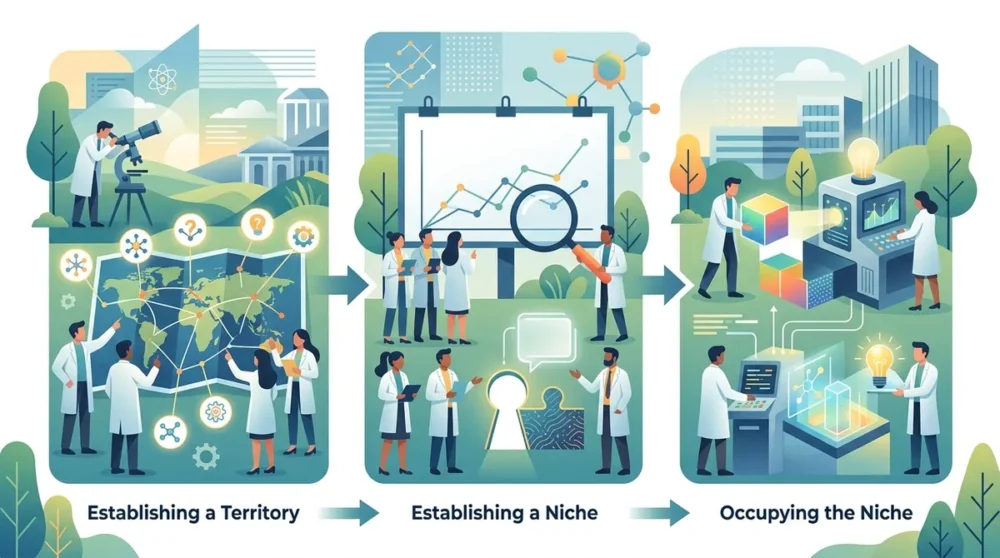
The CARS Model Explained
The CARS model (Create a Research Space) is a widely used framework for structuring introductions. It was developed by linguist John Swales and remains a standard reference for scientific writers. The model has three moves:
- Move 1 – Establishing a territory: Show the topic is important and relevant.
- Move 2 – Establishing a niche: Identify the gap or problem in existing research.
- Move 3 – Occupying the niche: Explain how your study fills the gap.
Editors at scientific editing services rely heavily on the CARS model when reviewing introductions. It provides a reliable checklist for ensuring every paragraph earns its place.

13 Research Paper Introduction Examples by Technique
1. The Statistical Hook (Medicine)
Opening with a striking statistic immediately establishes the scale of a problem. For example, a paper on vitamin D deficiency might begin: “Over 40% of adults worldwide are estimated to have insufficient vitamin D levels, yet the clinical consequences remain poorly defined.” This approach works well in medical and public health research where population-level data carries weight.
2. The Problem-Definition Opening (Engineering)
Engineering papers often open by defining a technical challenge. For example: “Current filtration systems for industrial wastewater fail to remove microplastics smaller than 5 microns, creating measurable risks to downstream water quality.” This immediately tells reviewers what problem the paper solves.
3. The Knowledge-Gap Statement (Life Sciences)
Explicitly naming what is not yet known is a powerful technique. For example: “While the role of BRCA1 in DNA repair is well established, the mechanisms governing its expression in non-breast tissue remain largely unexplored.” This type of introduction signals scientific rigor and intellectual honesty.
4. The Clinical Relevance Hook (Clinical Research)
Medical researchers can open by connecting their work to patient outcomes. For example: “Delayed diagnosis of sepsis remains one of the leading causes of preventable mortality in intensive care units globally.” This grounds the study in real-world urgency and resonates with journal editors focused on clinical impact.
5. The Contradictory Evidence Opening
Highlighting conflicting findings in existing literature is a compelling hook. For example: “Studies examining the association between sleep duration and metabolic syndrome have produced inconsistent results, suggesting that confounding variables may not have been adequately controlled.” This positions your study as the resolution to an ongoing debate.
6. The Technological Advancement Context
When your study builds on new technology, begin by contextualizing it. For example: “The recent availability of single-cell RNA sequencing has opened new avenues for investigating heterogeneity within tumor microenvironments that were previously inaccessible using bulk analysis methods.” This demonstrates that your work is timely and cutting-edge.
7. The Definitional Opening (Social Sciences)
Social science papers often benefit from defining a key term upfront. For example: “Burnout, defined by the World Health Organization as a syndrome resulting from chronic workplace stress, has increased significantly among healthcare workers since 2020.” Clarity in terminology builds reviewer trust from the first sentence.
8. The Epidemiological Context (Public Health)
Public health introductions work well when they establish disease burden. For example: “Type 2 diabetes affects approximately 537 million adults globally, placing enormous strain on healthcare systems in both high-income and low-income countries.” This scale-first approach is widely used in manuscripts targeting high-impact journals.
9. The Methodological Gap (Experimental Research)
If existing methods are flawed, say so clearly. For example: “Current protocols for measuring cortisol in saliva samples rely on immunoassay techniques that lack sensitivity at low concentrations, limiting the accuracy of stress assessments in non-clinical populations.” This type of opening is compelling when your study proposes a methodological improvement.
10. The Policy-Relevance Hook (Environmental Science)
Some studies matter because of their implications for policy. For example: “Despite international commitments to reduce carbon emissions, few studies have quantified the effectiveness of municipal-level interventions in achieving national climate targets.” This signals that your findings have practical and societal significance.
11. The Comparative Effectiveness Opening (Pharmacology)
In pharmacological research, comparing treatment outcomes is a reliable hook. For example: “Although metformin remains the first-line treatment for type 2 diabetes, emerging evidence suggests that newer GLP-1 receptor agonists may offer superior glycemic control with fewer gastrointestinal side effects.” This positions the study within an active clinical debate.
12. The Conceptual Framework Introduction (Basic Science)
For papers introducing a new theoretical model, begin with the existing paradigm. For example: “The central dogma of molecular biology has governed our understanding of gene expression for decades, yet recent discoveries in epigenetics challenge key assumptions about the directionality of biological information flow.” This type of opening is ideal for high-impact basic science journals.
13. The Global Burden Opening (Infectious Disease)
Infectious disease papers benefit from establishing global scale early. For example: “Antimicrobial resistance is projected to cause 10 million deaths annually by 2050, making the development of novel treatment strategies one of the most urgent priorities in global health.” This approach makes a strong case for the importance of your research from the very first sentence. Learn more about crafting powerful openings in our guide on how to write a great introduction to a scientific paper.
Key Elements Every Introduction Must Include
Regardless of which opening technique you use, every research paper introduction must contain the following elements:
- A hook: A statistic, question, or bold statement that captures attention.
- Background context: A brief review of what is already known, with key citations.
- A research gap: A clear statement of what remains unknown or unresolved.
- Study objectives: A direct statement of what the paper investigates.
- Paper structure (optional): A brief outline of the sections that follow.
Missing any of these elements is one of the most common reasons introductions are flagged during peer review. The knowledge center at San Francisco Edit provides additional resources on structuring each section of your manuscript for maximum impact.
Common Introduction Mistakes and How Editors Fix Them
| Common Mistake | Why It Hurts Your Paper | Editorial Fix |
|---|---|---|
| Vague or missing research gap | Reviewers cannot see the study’s contribution | Add a specific gap statement with citations |
| Overly technical language | Alienates non-specialist reviewers | Simplify terms; define key concepts early |
| No clear thesis or objective | Reviewers question the study’s purpose | End the introduction with a direct aim statement |
| Insufficient background | Context is missing for the research question | Add 2–3 sentences of relevant literature review |
| Poor logical flow | Reviewers lose track of the argument | Restructure using the upside-down triangle model |
| Wrong tense usage | Inconsistency confuses readers | Use simple present for established facts; past for prior studies |
Professional manuscript editors address each of these issues systematically. If your introduction has any of these weaknesses, working with an expert editor before submission can significantly improve your acceptance chances. You can read what authors say about the results of professional editing on our testimonials page.
When Should You Write the Introduction?
Many experienced researchers recommend writing the introduction last. Once your results are analyzed and your discussion is complete, you have a much clearer picture of what your study actually contributes. This makes it far easier to define the research gap and objectives with precision.
However, some authors prefer to write a rough draft introduction early to provide direction, then revise it after completing the manuscript. Either approach can work. What matters is that the final version aligns precisely with the content of the paper. Refer to our guide on 11 key steps to write a scientific paper in 2026 for a complete workflow.
Tense and Style Guidelines for Introductions
Using the correct tense is a small but important detail that editors frequently correct. Here are the standard conventions:
- Simple present tense: Use for established facts, theories, and general truths. (e.g., “Insulin regulates blood glucose levels.”)
- Past tense: Use when referring to specific prior studies. (e.g., “Smith et al. (2021) demonstrated that…”)
- Present perfect: Use when describing ongoing research trends. (e.g., “Recent studies have shown that…”)
Style should be formal, concise, and free of unnecessary hedging. Every sentence should serve the argument. Weak filler phrases dilute the impact of even the best research. For non-native English speakers, scientific editing for non-native English speakers can help you achieve the precision that high-impact journals require.
How San Francisco Edit Strengthens Your Introduction
San Francisco Edit is a specialist editing service that works with researchers globally across medicine, life sciences, engineering, and social sciences. Every manuscript is edited by native English-speaking PhD scientists who understand what journal reviewers expect. With a 98% publication success rate and over 325 combined years of staff experience, the team brings unmatched expertise to every introduction, abstract, and discussion section they review.
Whether you are submitting to a high-impact journal for the first time or revising after a rejection, working with a professional editor ensures your introduction is structured correctly, written clearly, and aligned with journal-specific standards. Visit the about page to learn more about the team and their approach. You can also find detailed answers to common questions on the FAQ page.
For a broader view of how your full manuscript should be structured, explore our resource on how to structure a research paper correctly. You can also access guidance on related sections, such as the abstract, methods, and discussion sections, all of which benefit from the same editorial rigor as the introduction.
Authoritative resources such as PubMed and PubMed Central (PMC) provide access to published examples across disciplines, which can serve as useful models when drafting your own introduction. Reviewing well-published papers in your target journal is one of the most effective preparation strategies available. Additionally, the Scribbr research paper introduction guide offers a useful supplementary reference for step-by-step structural advice.
Conclusion
A compelling research paper introduction is not a formality. It is a strategic tool that determines how reviewers perceive your work from the very first sentence. The 13 examples in this guide demonstrate that strong introductions share a common foundation: a clear hook, relevant background, a defined research gap, and precise objectives.
Applying these techniques, avoiding common mistakes, and following standard tense and style conventions will significantly improve your manuscript’s opening section. And when you want expert eyes on your introduction before submission, professional editing provides the precision and confidence that published authors rely on.
Ready to strengthen your manuscript from the introduction to the conclusion? Submit your manuscript to San Francisco Edit and let our team of expert editors help you get published.
FAQs
Q: What are the key components of a strong research paper introduction?
A: A strong research paper introduction includes four essential elements: a hook to capture attention, background context with supporting citations, a clearly stated research gap, and specific study objectives. Each element should flow logically into the next, following the upside-down triangle structure that narrows from broad context to precise aims.
Q: What is the CARS model and how does it apply to research paper introductions?
A: The CARS model (Create a Research Space) is a widely used framework for structuring scientific introductions. It involves three moves: establishing the territory by showing the topic’s importance, establishing a niche by identifying a gap in existing research, and occupying that niche by explaining how your study addresses it. Manuscript editors frequently use this model to evaluate and improve introduction structure.
Q: What tense should I use when writing a research paper introduction?
A: Use simple present tense for established facts and general scientific truths, past tense when referring to specific prior studies, and present perfect when describing ongoing research trends. Consistent, correct tense usage signals academic professionalism and is one of the most common areas corrected during professional manuscript editing.
Q: When is the best time to write the introduction of a research paper?
A: Many experienced researchers recommend writing the introduction after completing the results and discussion sections. By that stage, you have a clear understanding of your study’s actual contribution, making it much easier to define the research gap and objectives accurately. A rough draft written early can provide direction, but it should always be revised once the full manuscript is complete.
Q: How can a manuscript editor improve a weak research paper introduction?
A: A professional manuscript editor will assess the introduction for missing elements such as a clear research gap, logical flow, and a direct objective statement. Editors also correct tense inconsistencies, simplify overly technical language, and restructure the section to follow standard conventions like the upside-down triangle or CARS model. These targeted improvements significantly increase the likelihood of passing peer review.