Key Takeaways
-
Write the methods section in past tense describing what was actually done, ensuring it is detailed enough that another researcher could replicate your entire study from your description.
-
Organize your methods section with clear subheadings in this logical order: study design, participants, procedures, data collection, analysis approach, and ethical considerations to improve readability and reviewer navigation.
-
Ensure strict consistency between methods and results sections by confirming every variable and sample size mentioned in results is defined and justified in methods to avoid major revision requests.
-
Follow the appropriate reporting guideline for your study type (CONSORT for RCTs, PRISMA for systematic reviews, STROBE for observational studies, COREQ for qualitative research) to demonstrate rigor and meet journal requirements.
-
Include all essential components: study design, participant inclusion/exclusion criteria, materials and equipment, step-by-step procedures, data collection methods, statistical justification, and ethical approvals to prevent rejection.
-
Use precise technical language with clear definitions and avoid unnecessary narrative; include specific details on how data were collected, recorded, stored, and analyzed rather than justifying common methods.
The methods section of a research paper is one of the most important parts of any manuscript. Yet it is often one of the most poorly written. Reviewers and editors read this section carefully. They use it to judge whether your study was conducted properly and whether the results can be trusted. A weak methods section can lead to rejection — even if your findings are strong.
For authors preparing manuscripts for peer-reviewed journals, writing a clear and complete methods section is essential. This is true whether you are a graduate student submitting your first paper or an experienced researcher working on a complex clinical trial. Getting this section right can make a significant difference in your publication success rate.
This guide explains what the methods section should include, how to structure it effectively, and how professional editing can help you avoid the most common mistakes. You will also find guidance on reporting standards, tense usage, and how editors assess this critical section of your manuscript.

What Is the Methods Section of a Research Paper?
The methods section describes how a study was designed, conducted, and analyzed. It tells readers exactly what you did and why you did it that way. The goal is to give enough detail so that another researcher could replicate your study. Reproducibility is a cornerstone of scientific research, and the methods section is where reproducibility lives.
Editors and peer reviewers use the methods section to assess the validity and transparency of your work. They check that your study design was appropriate for your research question. They also verify that your analytical approach matches the data you collected. If the methods section is unclear or incomplete, reviewers may question the integrity of your entire paper.
For more guidance on the overall structure of your manuscript, see how to structure a research paper correctly or explore the 10 key sections every research paper must have in 2026.
What Should Be Included in the Methods Section?
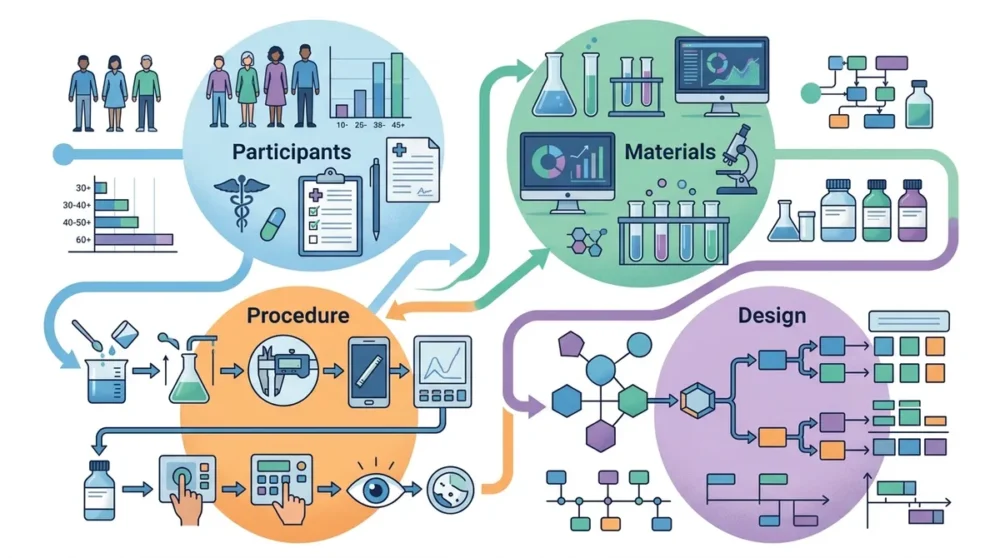
A strong methods section covers several core components. The exact content will vary depending on your research type, but most manuscripts should address the following areas:
- Study design: Describe the overall design, such as randomized controlled trial, cohort study, or qualitative interview study.
- Participants or subjects: Explain who or what was studied, including inclusion and exclusion criteria.
- Materials and equipment: List all tools, reagents, instruments, or software used.
- Procedures: Describe step-by-step what was done during the study.
- Data collection: Explain how data were gathered, recorded, and stored.
- Data analysis: Describe the statistical or analytical methods used to interpret the data.
- Ethical approvals: Include information on ethics committee approval and participant consent where applicable.
Each of these components should be written clearly and in enough detail for replication. At the same time, avoid unnecessary narrative or lengthy justification of common methods. Keep the writing direct and precise.
How Should the Methods Section Be Organized?
Organization is key to a readable methods section. Most journals recommend using subheadings to separate different components. This makes it easier for reviewers to locate specific information. It also signals to editors that you understand the expected structure of a scientific paper.
Here is a recommended order for organizing your methods section:
- Study design and setting — Establish context and scope first.
- Participants or samples — Define who or what was included and why.
- Procedures and interventions — Describe what was done in chronological order.
- Outcome measures and data collection — Explain what was measured and how.
- Statistical or analytical approach — Describe how data were analyzed.
- Ethical considerations — Note approvals and informed consent.
Following this logical sequence helps reviewers follow your methodology without confusion. It also makes the editing process more efficient, which is important when working with a professional editor under tight deadlines.

Methods vs. Materials and Methods: What Is the Difference?
Some journals use the heading “Methods” while others prefer “Materials and Methods.” The difference is mostly stylistic and journal-specific. In laboratory-based research, “Materials and Methods” is common because it emphasizes both the physical items used and the procedures followed. In clinical and social science research, “Methods” is often preferred.
Always follow the instructions for authors provided by your target journal. If the journal requires “Materials and Methods,” make sure your section includes a clear description of all reagents, instruments, or materials in addition to your procedural steps. Misalignment with journal style is one reason manuscripts are returned before peer review even begins.
Reporting Standards for the Methods Section
Many journals require authors to follow specific reporting guidelines. These standards help ensure that all essential information is included in the methods section. Using the correct checklist for your study type demonstrates rigor and professionalism to reviewers.
The table below summarizes the most widely used reporting guidelines:
| Reporting Guideline | Study Type | Checklist Items |
|---|---|---|
| CONSORT 2010 | Randomized controlled trials | 25 items + flow diagram |
| PRISMA 2020 | Systematic reviews and meta-analyses | 27 items |
| STROBE | Observational studies | 22 items |
| COREQ | Qualitative research (interviews, focus groups) | 32 items |
Reviewing PubMed for published papers in your field can also help you understand how other authors have structured their methods sections under the same reporting framework. Matching the conventions of top-tier journals in your discipline improves your chances of acceptance.
For additional strategies on writing your methodology clearly, visit writing a research methodology section: best practices for clarity and precision.
What Tense Should the Methods Section Use?
The methods section should be written in the past tense. You are describing what you did, and since the study is complete by the time you are writing the paper, past tense is appropriate. For example, write “Participants were recruited from three urban hospitals” rather than “Participants are recruited from three urban hospitals.”
Use passive voice selectively. Many journals in the sciences traditionally prefer passive constructions in the methods section, such as “Blood samples were collected at baseline.” However, some journals now encourage active voice for clarity. Always check your target journal’s style guide. A manuscript editor can help you apply the correct voice consistently throughout your paper.
Common Mistakes in the Methods Section
Even experienced researchers make mistakes in the methods section. Awareness of these common errors can help you avoid them during drafting and revision.
- Insufficient detail: Omitting key procedural steps that prevent replication.
- Inconsistency with results: Reporting different sample sizes or variables in the results section than in the methods.
- Unclear terminology: Using ambiguous or undefined technical terms without explanation.
- Missing statistical rationale: Failing to justify the choice of statistical tests.
- Ignoring reporting guidelines: Not following CONSORT, PRISMA, STROBE, or COREQ as required.
- Lack of ethical disclosure: Omitting ethics committee approval or participant consent information.
A survey of researchers found that around 70% had experienced difficulty with academic writing or manuscript preparation at least once. This highlights how widespread these challenges are — and why professional editing support is so valuable. For a detailed look at expert strategies, read 11 expert tips for writing a strong methods section.
How Does a Manuscript Editor Improve the Methods Section?
Professional manuscript editors bring a trained eye to the methods section. They go beyond correcting grammar. They assess whether the section is logically structured, internally consistent, and aligned with the rest of the paper. Their role is to strengthen the presentation of your science — not to change your findings.
Here is what a professional editor typically checks in the methods section:
- Completeness: Is every key component included? Are there gaps that a reviewer might question?
- Consistency: Do the sample sizes, variables, and procedures match what is reported in the results section?
- Clarity: Is the language precise and easy to follow? Are technical terms clearly defined?
- Compliance: Does the section conform to the target journal’s style and reporting standards?
- Conciseness: Is the section appropriately detailed without being repetitive or verbose?
These checks are especially important for non-native English speakers, who may find it difficult to express methodological nuance with precision. Studies consistently show that poor language quality contributes to manuscript rejection, particularly in high-impact journals. Scientific editing for non-native English speakers can make a significant difference in how your work is received by reviewers.
Aligning Methods With Results and Discussion
One of the most critical tasks for any editor reviewing a research manuscript is ensuring alignment between sections. The methods section must match the results section exactly. Every variable mentioned in the results must be defined in the methods. Every analytical technique applied in the results must be described in the methods.
Similarly, the discussion section should interpret findings within the context of the methods. If your methods have limitations, those should be acknowledged in the discussion. For guidance on writing a strong discussion, read 7 key steps to write a strong discussion section.
Misalignment between sections is one of the most common reasons peer reviewers request major revisions. A professional editor will flag these inconsistencies before the manuscript is submitted, saving you time and reducing the likelihood of rejection.
Why Professional Editing Matters for the Methods Section
San Francisco Edit specializes in editing scientific, medical, and general manuscripts for peer-reviewed publication. With more than 325 years of combined staff experience and a 98% acceptance rate for edited papers, the team brings deep expertise to every section of a manuscript — including the methods section.
Editing by San Francisco Edit is done entirely by human PhD scientists who understand your field. No AI tools are used. Every manuscript receives careful attention to clarity, consistency, completeness, and journal compliance. Whether you are preparing your first journal article or submitting to a top-tier publication, professional editing of your methods section can be the difference between acceptance and rejection.
For a broader look at how to write and structure your full manuscript, explore 11 essential steps to write a manuscript for publication. You can also visit the knowledge center for additional resources on writing for peer-reviewed journals.
Key Qualities of a Strong Methods Section
Before you submit, review your methods section against these quality markers:
- Written in past tense with consistent voice throughout.
- Organized with clear subheadings following journal instructions.
- Complete enough for another researcher to replicate the study.
- Consistent with all variables and sample sizes reported in the results.
- Compliant with the appropriate reporting guideline (CONSORT, PRISMA, STROBE, or COREQ).
- Free of vague or undefined terminology.
- Includes ethical approvals and consent information.
Checking your methods section against this list before submission is a simple but effective quality control step. If you are unsure whether your section meets these standards, a professional manuscript editor can provide an objective assessment. The scientific editing service at San Francisco Edit is designed precisely for this purpose.
Conclusion
The methods section of a research paper is far more than a procedural description. It is the backbone of your manuscript’s credibility. A clear, complete, and well-organized methods section reassures reviewers that your study was conducted rigorously and that your results can be trusted. Getting this section right significantly increases your chances of peer-review success.
Whether you need help with structure, language, consistency, or reporting compliance, professional editing makes a measurable difference. Take the next step toward publication success and submit your manuscript for expert editing today. For more writing resources, visit the guide to writing peer-reviewed methods sections from research design to publication success.
FAQs
Q: What should be included in the methods section of a research paper?
A: The methods section should include your study design, participant or subject details, materials and equipment, procedures, data collection approach, data analysis methods, and ethical approvals. Each component should be described in enough detail for another researcher to replicate your study.
Q: Should the methods section be written in past tense or present tense?
A: The methods section should be written in past tense because it describes work that has already been completed. For example, use ‘Participants were recruited’ rather than ‘Participants are recruited.’ Always check your target journal’s style guide for any specific requirements.
Q: What are the most common mistakes in the methods section?
A: Common mistakes include insufficient procedural detail, inconsistency between the methods and results sections, undefined terminology, missing statistical justification, and failure to follow required reporting guidelines such as CONSORT, PRISMA, or STROBE. A professional manuscript editor can identify and correct these issues before submission.
Q: Which reporting guidelines apply to the methods section?
A: The guideline you follow depends on your study type. Use CONSORT for randomized controlled trials, PRISMA for systematic reviews and meta-analyses, STROBE for observational studies, and COREQ for qualitative research involving interviews or focus groups. Always confirm which guideline your target journal requires.
Q: How can a manuscript editor improve the methods section?
A: A professional manuscript editor reviews the methods section for completeness, clarity, internal consistency, and compliance with journal style and reporting standards. They also ensure that the methods align with the results and discussion sections, reducing the likelihood of reviewer queries or rejection.