
Key Takeaways
-
Poor English language quality and unclear terminology are among the most common reasons environmental science manuscripts are rejected; professional editing addressing these issues before submission significantly improves publication chances.
-
Environmental science manuscript editors must possess advanced subject knowledge (master’s/PhD level), native English proficiency, and familiarity with journal-specific requirements and regulatory language to effectively refine technical papers.
-
A systematic editing process including scientific language refinement, structural review (IMRAD format), terminology consistency checks, and abstract optimization ensures manuscripts meet high publication standards before peer review.
-
Non-native English authors should seek professional editing to meet the high language standards expected by peer-reviewed environmental journals, as many journals explicitly recommend pre-submission editing for international researchers.
-
Weak Methods sections, disorganized structure, inadequate Discussion sections, and failure to address journal scope are avoidable rejection factors that skilled manuscript editors can systematically identify and fix before submission.
-
Preparing your manuscript thoroughly before professional editing—including completing all sections, confirming target journal requirements, and finalizing data—allows editors to focus on language and structure rather than incomplete content.
Environmental science research addresses some of the most urgent challenges facing our planet. From monitoring climate change to studying soil contamination, the work being done in this field is critical. But excellent research alone is not enough to secure publication. Your manuscript must also be clearly written, precisely structured, and fully aligned with journal requirements.
For many environmental scientists — especially those writing in English as a second language — manuscript preparation is one of the biggest barriers to publication. A single poorly worded sentence in your Methods section or an inconsistent term in your Results can trigger rejection before your data even gets reviewed. That is where professional scientific editing makes a measurable difference.
This guide explains exactly what environmental science manuscript editing involves, why it matters, and how to choose the right support for your next submission.
What Is Environmental Science Manuscript Editing?
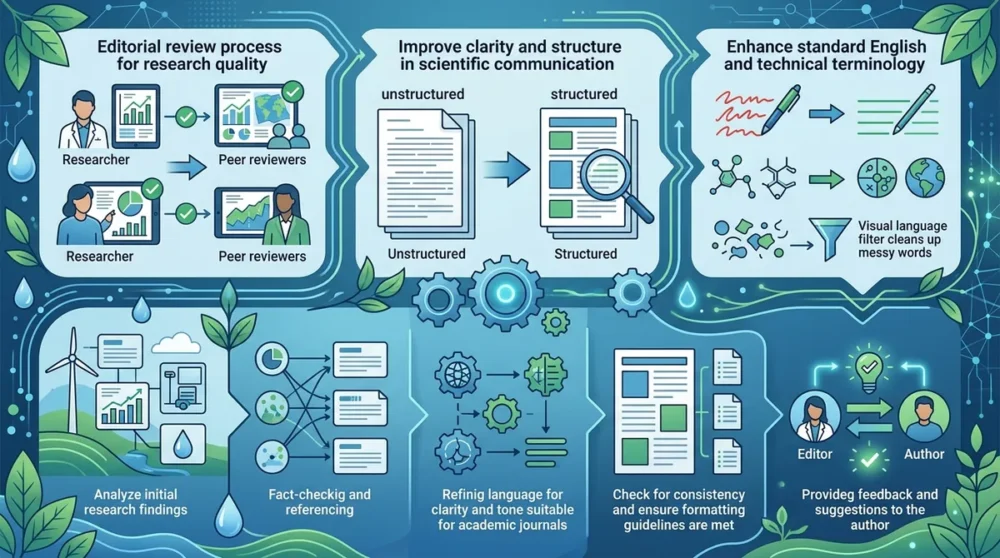
Environmental science manuscript editing is a specialized form of academic editing. It focuses on technical papers in fields such as ecology, hydrology, atmospheric science, soil science, oceanography, and environmental chemistry. Editors in this niche do much more than check grammar. They refine scientific language, improve logical flow, and ensure your paper meets the specific standards of your target journal.
Unlike general proofreading, environmental science editing requires subject-matter knowledge. An editor must understand discipline-specific terminology, regulatory language, and the structural conventions of peer-reviewed environmental journals. This is a niche skill set that combines scientific literacy with expert-level English writing ability.
Journals such as those indexed on PubMed often expect manuscripts to meet high language standards before peer review. Many journals explicitly recommend professional language editing for non-native English authors prior to submission.
Why Environmental Science Papers Get Rejected
Manuscript rejection is frustrating — especially when your data is strong. But the reasons for rejection are often avoidable. Understanding common failure points can help you submit with greater confidence.
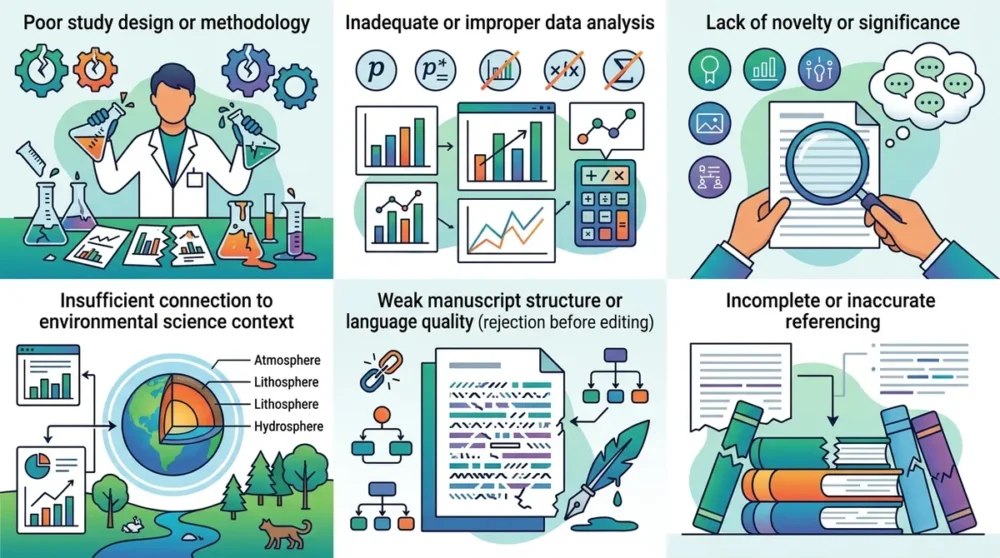
Here are the most common reasons environmental science manuscripts are rejected:
- Unclear or inconsistent terminology — Using different terms for the same concept confuses reviewers and undermines your credibility.
- Weak Methods section — Reviewers cannot assess reproducibility if your methods are vaguely described. See our guide on writing a strong Methods section for practical strategies.
- Poor English language quality — Grammatical errors and awkward phrasing distract reviewers from your findings.
- Disorganized structure — A paper that does not follow the expected IMRAD format (Introduction, Methods, Results, and Discussion) signals a lack of preparation.
- Inadequate discussion of results — Reviewers want to understand the significance of your findings. A weak Discussion section reduces your chances of acceptance.
- Failure to address journal scope — Submitting to the wrong journal or failing to tailor your abstract and introduction to the journal’s focus is a common and costly mistake.
The good news is that all of these issues can be addressed before submission. A skilled manuscript editor identifies these problems and helps you fix them systematically. You can also review why scientific manuscripts are rejected by journals for a deeper breakdown of common pitfalls.
Key Skills Every Environmental Science Editor Must Have
Not all editors are equipped to handle environmental science manuscripts. This is a highly technical field, and the quality of editing depends heavily on the editor’s background and expertise.
Here are the core competencies to look for in an environmental science manuscript editor:
- Advanced subject knowledge — Many professional roles in this niche prefer editors with a master’s degree, PhD, or equivalent experience in a relevant environmental discipline.
- Native or near-native English proficiency — Language precision is essential for producing publication-ready manuscripts.
- Familiarity with journal submission requirements — Different journals have different word limits, reference styles, and structural expectations.
- Experience with regulatory and policy language — Applied environmental science papers often reference environmental laws, compliance standards, and policy frameworks.
- Understanding of statistical reporting — Results sections in environmental science frequently include complex datasets, modeling outputs, and statistical analyses that must be described accurately.
At San Francisco Edit, all editing is performed by native English-speaking PhD scientists. The team brings more than 325 years of combined experience in writing, editing, and proofreading academic manuscripts across a wide range of scientific disciplines.
Types of Environmental Science Manuscripts Editors Handle
Environmental science encompasses a broad range of document types. A professional editing service must be equipped to handle all of them. Below is a summary of the most common manuscript types in this field.
| Manuscript Type | Description | Common Challenges |
|---|---|---|
| Original Research Article | Reports new empirical findings from field or lab studies | Methods clarity, statistical reporting, discussion depth |
| Review Article | Synthesizes existing literature on an environmental topic | Logical flow, citation consistency, scope definition |
| Systematic Review | Follows a structured protocol to evaluate a body of evidence | PRISMA compliance, objective language, reproducibility |
| Policy Brief | Communicates research findings to policymakers | Accessible language, clear recommendations, conciseness |
| Methods Paper | Introduces a new research methodology or instrument | Technical precision, validation reporting, reproducibility |
| Conference Paper | Preliminary findings presented at academic conferences | Word limits, abstract quality, audience alignment |
Understanding which type of paper you are writing helps your editor tailor their approach. For guidance on structuring your manuscript correctly, see this resource on how to structure a research paper correctly.
The Environmental Science Manuscript Editing Process
A professional editing process for environmental science manuscripts follows a clear, structured workflow. Here is how it typically unfolds:
- Submission and scope assessment — The author submits the manuscript along with the target journal name and any relevant instructions. The editor reviews the scope and identifies key areas for improvement.
- Scientific language editing — The editor refines sentences for clarity, corrects grammatical errors, improves word choice, and eliminates ambiguity throughout the manuscript.
- Structural review — The editor checks that the manuscript follows the expected structure, including a well-developed Introduction, Materials and Methods, Results, and Discussion (IMRAD format).
- Terminology and consistency check — Scientific terms, species names, chemical nomenclature, and measurement units are verified for accuracy and consistency throughout the text.
- Abstract and title optimization — The abstract and title are refined to improve discoverability and ensure they accurately represent the study. See our guidance on writing an abstract that gets your paper published.
- Reference formatting — Citations are checked against the target journal’s reference style. Note that San Francisco Edit does not include references in the word count for pricing.
- Delivery with tracked changes — The edited manuscript is returned in Microsoft Word with all changes tracked and explanatory comments provided for key revisions.
This systematic approach ensures that every section of your manuscript is polished and publication-ready. You can learn more about the full manuscript preparation process by reading 11 essential steps to write a manuscript for publication.
Environmental Science Editing for Non-Native English Authors
Many of the world’s leading environmental researchers do not speak English as their first language. This creates a significant communication challenge when submitting to English-language journals. Reviewers and editors at top-tier journals expect manuscripts to meet a high standard of written English — and papers that fall short are often rejected on language grounds alone.
Professional language editing services bridge this gap. They ensure that your scientific ideas are expressed with the precision and fluency that peer-reviewed journals require. This is especially important in environmental science, where regulatory terms, data interpretations, and technical descriptions must be written with absolute clarity.
The Frontiers in Environmental Science journal, indexed in Scopus and Web of Science (SCIE), is one example of a leading outlet that handles a wide range of article types — from Original Research to Policy Briefs. Meeting the language standards of journals like these requires expert editing support.
San Francisco Edit works with authors globally, offering expert editing by PhD scientists who specialize in scientific communication. The service has a 98% publication success rate — a reflection of how much professional editing improves the quality and competitiveness of submitted manuscripts. Read what authors have said on the testimonials page.
How to Prepare Your Manuscript Before Editing
To get the most value from professional editing, it helps to prepare your manuscript thoroughly before submission. Here are practical steps you can take:
- Complete all sections of the manuscript, including figures, tables, and references, before sending for editing.
- Confirm your target journal and include the journal’s author guidelines with your submission.
- Ensure all data and statistical outputs are finalized — editors refine language, not data.
- Use consistent terminology throughout the draft, even if it is not yet polished.
- Note any specific sections you feel need the most attention, such as the Discussion or Methods.
A well-prepared manuscript allows the editor to focus on language and structure rather than incomplete content. For specific guidance on the Discussion section, which is often the weakest part of environmental science papers, see 7 key steps to write a strong Discussion section.
Comparing Editing Service Features for Environmental Science Authors
| Feature | What to Look For | San Francisco Edit Standard |
|---|---|---|
| Editor qualifications | PhD-level subject expertise | Native English-speaking PhD scientists |
| Turnaround time | Standard and rush options | 6–8 days standard; 3–4 days rush |
| Deliverable format | Tracked changes with comments | Microsoft Word with full explanations |
| Confidentiality | Strict data security and document destruction policy | Documents destroyed if quote not accepted |
| Human editing | No AI-generated edits | 100% human editing — no AI |
| Publication success rate | Demonstrated track record | 98% of edited papers accepted and published |
Choosing the right editing service is a significant decision. The features above represent the minimum standards you should expect when entrusting your environmental science manuscript to a professional editor. Learn more about what you can expect from a scientific editor before making your choice.
Additional Resources for Environmental Science Authors
Strong manuscript preparation goes beyond language editing. Environmental science authors benefit from a solid understanding of every component of the scientific paper. Here are resources to support your writing at each stage:
- For structuring your paper: 10 key sections every research paper must have in 2026
- For writing your introduction: how to write a research paper introduction that gets published
- For reporting results: how to write a results section that gets published
- For journal submission: how to get a research paper published in 2026
- For writing your cover letter: 5 key steps to write a journal submission cover letter
You can also explore the full knowledge center at San Francisco Edit for additional writing and editing guidance tailored to scientific authors. The PubMed Central open-access archive is another valuable resource for reviewing published environmental science papers and understanding journal standards.
Conclusion
Environmental science research deserves to be read, cited, and applied. But it can only achieve that impact if it reaches publication. Professional manuscript editing is one of the most effective investments you can make in the success of your work.
Whether you are a graduate student submitting your first paper, a non-native English speaker navigating a complex journal system, or an established researcher looking to increase your publication rate, expert editing transforms the quality and competitiveness of your manuscript.
San Francisco Edit has helped environmental scientists and researchers across every discipline get their work published. With PhD-level editors, a 98% publication success rate, and a proven commitment to quality, it is the trusted choice for authors who take their research seriously. The U.S. Environmental Protection Agency’s research division provides useful context for the types of scientific standards and regulatory frameworks that environmental manuscripts often reference — a reminder of why precise language matters so much in this field.
Ready to take the next step? Submit your manuscript for professional editing and give your environmental science research the best possible chance of publication.
FAQs
Q: What does environmental science mean in the context of manuscript editing?
A: In manuscript editing, environmental science refers to the specialized editing of scholarly and technical papers in fields such as ecology, hydrology, atmospheric science, soil science, oceanography, and environmental chemistry. Editors in this niche combine subject-matter expertise with advanced English language skills to help authors produce publication-ready manuscripts.
Q: Do environmental science journals require professional language editing before submission?
A: Many peer-reviewed environmental science journals explicitly recommend professional language editing for non-native English authors before submission. Poor language quality is one of the most common reasons manuscripts are rejected, and pre-submission editing significantly improves a paper’s chances of acceptance.
Q: What qualifications should an environmental science manuscript editor have?
A: A qualified environmental science manuscript editor should hold an advanced degree — ideally a master’s or PhD — in a relevant scientific discipline. They must also be a native or highly proficient English speaker with experience in the structural and language standards of peer-reviewed environmental journals.
Q: What types of environmental science manuscripts can a professional editor handle?
A: Professional editors can handle a wide range of environmental science manuscript types, including original research articles, review articles, systematic reviews, policy briefs, methods papers, and conference papers. Each document type has distinct structural requirements and language conventions that a skilled editor will address.
Q: How is environmental science manuscript editing different from general proofreading?
A: General proofreading focuses primarily on spelling and grammar errors, while environmental science manuscript editing involves a deeper review of scientific language, terminology consistency, structural integrity, journal alignment, and technical precision. It requires editors who understand the subject matter and can evaluate the manuscript from both a scientific and a linguistic perspective.