Key Takeaways
- PhD-level editors with subject-matter expertise are essential for manuscript editing, as general proofreading misses scientific depth and accuracy needed for peer-reviewed journal acceptance.
- Professional editing directly addresses leading rejection reasons including unclear language, poorly structured abstracts, inconsistent terminology, and weak introductions that undermine publication chances.
- Top manuscript editing services should offer human editing (not AI), transparent turnaround times of 6-8 days standard or 3-4 days rush, and detailed feedback explaining each edit.
- Verify editor credentials, check publication acceptance rates (reputable services report 90%+ success), and review sample edits or client testimonials before selecting an editing service.
- Professional editing is particularly valuable for non-native English speakers and early-career researchers, as publication costs far exceed editing fees but significantly advances research careers and funding prospects.
- The best services handle diverse document types beyond journal articles, including grant proposals, theses, dissertations, and business documents, ensuring consistency across professional communications.
Publishing a manuscript in a peer-reviewed journal is one of the most competitive challenges in academic and medical research. Even groundbreaking research can face rejection if the writing lacks clarity, precision, or proper structure. That is why choosing the best editing services is a critical decision for any researcher, clinician, or academic author. Professional manuscript editing can be the difference between acceptance and rejection — and in science, that difference matters enormously.
This guide breaks down exactly what makes a manuscript editing service truly excellent, what features to look for, and why investing in professional editing is one of the smartest decisions you can make for your research career. Whether you are a non-native English speaker preparing your first paper, a seasoned academic managing multiple submissions, or a clinician translating study findings into publishable form, this article is written for you.

What Makes an Editing Service the Best Choice for Manuscripts
Not all editing services are created equal. General proofreading platforms may catch spelling errors, but they often lack the scientific depth required to improve a research manuscript. The best editing services for academic and scientific manuscripts combine linguistic precision with subject matter expertise. Here is what separates truly excellent services from the rest.
Key Qualities of Top Manuscript Editing Services
- Editors with advanced scientific credentials — PhD-level editors who understand your research field are essential for meaningful feedback.
- Native English proficiency — Language clarity is non-negotiable for peer-reviewed journal submission.
- Human editing, not AI — Automated tools miss nuance, context, and scientific accuracy that only a human expert can catch.
- Subject-matter breadth — The best services cover life sciences, medicine, engineering, social sciences, and humanities.
- Transparent turnaround times — Researchers work on deadlines. Reliable delivery windows are essential.
- Strict confidentiality protocols — Your unpublished research must remain secure and protected at all times.
- Detailed editorial feedback — Not just corrections, but explanations that help you grow as a writer and researcher.
When evaluating manuscript editing providers, these criteria should guide your decision. A service that meets all of them offers genuine value to the scientific community.

Why Professional Editing Improves Publication Rates
Published research consistently shows that poor English and careless manuscript preparation are among the leading reasons editors and reviewers reject submissions. This is especially true for non-native English-speaking authors, who make up a significant portion of the global research community. Even excellent science can be undermined by unclear writing. Journals indexed on PubMed and other major databases maintain rigorous standards, and manuscripts that do not meet them rarely advance past the initial review stage.
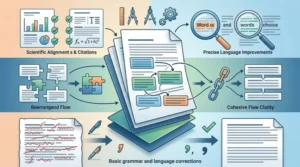
Professional editing addresses these barriers directly. A skilled editor restructures unclear arguments, tightens abstract language, improves sentence flow, and ensures that methods and results sections are both accurate and readable. The outcome is a manuscript that reviewers can engage with confidently — and that editors are more likely to send forward for peer review.
Common Reasons Manuscripts Are Rejected Without Editing Support
- Unclear or grammatically flawed language that obscures the research findings
- Poorly structured abstracts that fail to communicate the study’s value
- Inconsistent terminology or technical language that confuses reviewers
- Weak introductions that do not establish context within current literature
- Discussion sections that overstate or fail to connect conclusions to data
Each of these issues is correctable with the right professional support. Choosing the best editing services early in your manuscript preparation process can prevent these problems before they cost you a submission cycle.

Types of Documents the Best Services Edit
Top-tier manuscript editing services handle more than just journal articles. Researchers and academics need support across a wide range of document types throughout their careers. The knowledge center at San Francisco Edit, for example, provides resources covering many of these document types, reflecting the breadth of expertise available.
Scientific and Academic Documents
- Journal articles and research papers
- Grant applications and research proposals
- Theses and dissertations
- Book chapters and conference proceedings
- Posters, presentations, and protocols
- Curriculum vitae and safety guidelines
Business and Professional Documents
- White papers and annual reports
- Marketing materials and brochures
- Websites, newsletters, and business plans
- Training materials and manuals
If you need scientific editing, language editing, or business editing, the best services offer all three under one roof. This saves time and ensures consistency across your professional communications.

Comparing Features of the Best Manuscript Editing Services
To help researchers make an informed decision, the table below outlines the core features that distinguish high-quality manuscript editing services from standard proofreading options.
| Feature | Basic Proofreading | Professional Manuscript Editing |
|---|---|---|
| Editor Qualifications | General language skills | PhD-level subject experts |
| Scope of Editing | Grammar and spelling only | Structure, clarity, logic, and language |
| Scientific Understanding | Minimal | Deep field-specific knowledge |
| Feedback and Explanations | None or minimal | Detailed comments and suggestions |
| Turnaround Options | Variable | Standard (6–8 days) and Rush (3–4 days) |
| Confidentiality | Often unclear | Strict policy with document destruction option |
| Publication Success Rate | Not tracked | Up to 98% acceptance rate |
This comparison makes it clear why specialized manuscript editing is a far more valuable investment for researchers seeking publication in peer-reviewed journals.
How to Evaluate and Choose the Right Editing Service
With many options available globally, narrowing down the best editing services requires a methodical approach. Follow these steps to make a confident and well-informed decision.
- Verify editor credentials: Confirm that editors hold advanced degrees in relevant scientific or academic fields. This ensures they understand your research, not just your grammar.
- Check publication track record: Ask about acceptance rates. A reputable service will have data on how many edited manuscripts were successfully published.
- Review sample edits or testimonials: Real feedback from past clients reveals the quality and depth of the editing process. Read testimonials to hear directly from authors who have benefited from professional editing support.
- Understand the pricing model: Transparent, predictable pricing helps you budget effectively. Check pricing and payment details before committing.
- Assess communication and support: The best services offer clear communication, responsive support, and guidance throughout the editing process. Review the FAQ page to understand what to expect.
By following this process, you can select a service that genuinely meets your needs and supports your publication goals. You can also learn more by visiting the clients page to understand who benefits most from professional manuscript editing.
Why San Francisco Edit Stands Apart
San Francisco Edit is a globally operating specialist editing service with a proven record of helping authors succeed in peer-reviewed publication. The service is built on a foundation of deep scientific expertise, human-centered editing, and a commitment to author success that is hard to match.
Here is what sets San Francisco Edit apart from other providers:
- 98% publication success rate — Nearly all manuscripts edited by San Francisco Edit have been accepted and published.
- Over 325 combined years of experience — The editorial team brings unmatched depth of knowledge across scientific and academic disciplines.
- No AI editing — Every manuscript is reviewed and improved by a qualified human expert, ensuring nuance and accuracy.
- Extensive journal reviewer experience — The principals have worked with referees of top-tier journals and understand exactly what those reviewers expect.
- Global reach and collaborative history — The team has worked with international researchers and published collaborative work in leading English-language journals.
Researchers who want to understand more about the team’s background and approach can explore the about San Francisco Edit page for full details. The service covers a wide range of fields including life sciences, medicine, engineering, social sciences, and humanities — making it one of the most versatile and reliable options for academic authors worldwide.
Research published through institutions indexed in databases such as Google Scholar and other major academic repositories consistently highlights the importance of clear scientific writing. San Francisco Edit helps authors meet those standards with precision and professionalism. For additional context on writing standards in scientific publishing, the International Committee of Medical Journal Editors (ICMJE) provides widely respected guidelines that professional editors use as a benchmark.
What to Expect from the Editing Process
Understanding how the editing process works helps authors prepare their manuscripts more effectively. Here is a clear overview of what the best services deliver at each stage.
- Submission: You send your manuscript securely. At San Francisco Edit, you can submit your manuscript directly through a simple online form.
- Assignment: Your document is matched to an editor with relevant subject expertise in your field of research.
- Editing: The editor reviews and improves language, structure, clarity, and logical flow throughout the document.
- Feedback delivery: You receive a tracked-changes Word document with full explanations of all edits and suggestions for improvement.
- Follow-up support: Many services allow follow-up questions about the edits, helping authors understand and apply the improvements.
This structured process ensures that every author receives a manuscript that is polished, professional, and ready for journal submission. To stay updated on writing tips and resources, consider signing up through the newsletter for ongoing guidance tailored to scientific and academic authors.
Conclusion: Invest in the Best Editing Services for Your Research
Your research deserves to be read, cited, and published. The best editing services for scientific and medical manuscripts do more than fix grammar — they elevate your work to meet the rigorous standards of peer-reviewed journals. From expert editors with advanced degrees to transparent processes and a proven track record, the right editing partner makes a measurable difference in your publication outcomes.
San Francisco Edit has helped researchers around the world achieve a 98% publication success rate, backed by over 325 combined years of editorial expertise. If you are ready to give your manuscript the professional attention it deserves, take the first step today and submit your manuscript for expert editing. For any questions about the process or pricing, do not hesitate to contact the San Francisco Edit team directly.
FAQs
Q: What should I look for in the best editing services for scientific manuscripts?
A: The best editing services for scientific manuscripts should employ PhD-level editors with expertise in your research field, offer transparent turnaround times, and provide detailed feedback explaining every change made. Confidentiality, a strong publication track record, and human editing — rather than AI — are also critical factors to evaluate.
Q: How does professional manuscript editing improve journal acceptance rates?
A: Professional editing improves clarity, logical structure, and language precision — all of which are evaluated during peer review. Studies consistently show that manuscripts with poor English or unclear writing are frequently rejected before even reaching the review stage, regardless of the quality of the underlying research.
Q: Is professional editing worth the cost for early-career researchers?
A: Yes, professional editing is a highly valuable investment for early-career researchers. A single accepted publication can significantly advance a research career, attract funding, and increase academic visibility. The cost of editing is minimal compared to the long-term professional benefits of successful journal publication.
Q: Can non-native English speakers benefit from manuscript editing services?
A: Absolutely. Non-native English-speaking authors represent one of the groups that benefit most from professional manuscript editing. Skilled editors ensure that the language meets the standards expected by peer-reviewed journals, removing linguistic barriers that might otherwise lead to rejection despite strong scientific content.
Q: How long does it take to get a manuscript professionally edited?
A: Turnaround times vary by service and manuscript length. Leading providers like San Francisco Edit offer standard editing within 6–8 days and rush editing in 3–4 days, allowing researchers to meet journal submission deadlines without compromising on editing quality.