Key Takeaways
-
Poor editing is one of the most common reasons for manuscript rejection; journals evaluate how clearly science is communicated, not just its quality, making structural clarity and language precision essential before submission.
-
Start with structural review before line editing: evaluate overall organization, logical flow, and section purpose before fixing grammar, as structural problems cannot be solved through copyediting alone.
-
State your central argument clearly in the first paragraph—reviewers should understand your paper's purpose immediately, as burying the main hypothesis risks losing readers and reviewers early.
-
Verify citation accuracy, alignment with journal-specific formatting standards, and ethical compliance (IRB approval, funding disclosures, conflicts of interest) before submission to prevent desk rejection.
-
Professional human editors with subject expertise catch issues AI tools miss, particularly for technical scientific language and nuanced disciplinary conventions that automated systems cannot replicate.
-
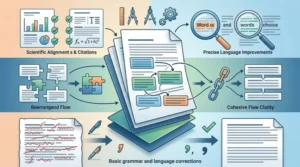
Professional editing services typically include structural review, language/grammar correction, reference checking, journal formatting, plagiarism screening, and ethical compliance review—addressing the most common rejection triggers.
Getting a research paper published in a peer-reviewed journal is competitive. Acceptance rates at major conferences and journals often hover between 20–25%. That means most manuscripts are rejected — and poor editing is one of the most common reasons. Whether you are a PhD candidate preparing your first submission or a seasoned clinician writing up a clinical trial, professional research paper editing can be the difference between acceptance and rejection.
This guide outlines 13 essential tips for editing research manuscripts effectively. From structural clarity to journal-specific formatting, each point addresses a real challenge that authors face. You will also learn what professional editing services offer, what to look for when choosing one, and how services like scientific editing can significantly improve your publication chances.

Why Research Paper Editing Matters
Journals do not just evaluate the quality of your science. They evaluate how clearly that science is communicated. Reviewers routinely flag papers for unclear writing, poor structure, and formatting errors — even when the underlying research is sound. A thorough editing process addresses all of these issues before submission.
For non-native English speakers, this challenge is even greater. Linguistic precision is essential for conveying complex ideas without ambiguity. According to published studies cited by editing professionals, poor English and careless preparation are among the leading contributors to manuscript rejection.

13 Essential Research Paper Editing Tips
1. Start With Structural Review Before Line Editing
Before fixing grammar or word choice, evaluate the overall structure. Does each section serve its purpose? Does the paper flow logically from introduction to conclusion? Structural problems cannot be solved with copyediting alone.
- Confirm your abstract accurately reflects the full paper
- Ensure the introduction sets up the research question clearly
- Check that the methods section is reproducible and complete
- Verify results are presented objectively without interpretation
- Confirm the discussion contextualizes findings within existing literature
2. Clarify Your Central Argument Early
Reviewers should understand your paper’s purpose within the first paragraph. If your main argument or hypothesis is buried in the third page, you risk losing the reader immediately. State your objective clearly and early.
3. Eliminate Redundant Language
Academic writing often suffers from wordiness. Phrases like “it is important to note that” or “in order to” add length without adding meaning. Trim these wherever possible to improve clarity and readability.
4. Improve Logical Flow Between Sections
Each paragraph and section should transition smoothly into the next. Abrupt shifts confuse reviewers and disrupt the narrative. Use clear transitional sentences to guide the reader through your argument.
5. Align Your Abstract With Journal Requirements
Many journals have strict word limits and structural requirements for abstracts. Some require structured abstracts with subheadings like Background, Methods, Results, and Conclusion. Others require a single paragraph. Check the target journal’s author guidelines carefully before submitting.
6. Verify Citation Accuracy and Formatting
Incorrect citations are a common reason for desk rejection. Editors who provide scientific editing services routinely check reference lists for accuracy, completeness, and correct formatting against journal style guides. Do not rely on automated tools alone for this step.
- Confirm all in-text citations appear in the reference list
- Check author names, publication years, volume numbers, and page ranges
- Format references according to the target journal’s preferred citation style
- Remove duplicate or outdated references
7. Check Figures, Tables, and Legends
Visual elements must be clearly labeled, properly formatted, and directly relevant to the text. Professional editors check that figure legends are self-explanatory and that tables do not repeat data already presented in the text. Research indexed on PubMed consistently shows that clear visual presentation improves comprehension and reviewer confidence.
8. Apply Journal-Specific Formatting Standards
Every journal has specific requirements for fonts, margins, line spacing, headings, and manuscript length. Submitting a paper that ignores these requirements signals to editors that the author has not read the guidelines carefully. This can lead to immediate rejection without review.
9. Conduct a Language and Grammar Review
Grammar errors, inconsistent tense use, and awkward phrasing undermine your credibility as an author. A professional language editing review catches issues that automated tools miss. Human editors with subject-area expertise understand context in ways that AI tools cannot replicate.
For non-native English speakers in particular, this step is critical. AI-powered tools can support readability enhancement, but they are not a substitute for expert human review — especially for technical scientific language.
10. Review Statistical Reporting
Statistical errors are a significant cause of peer review failure. Ensure that all statistical tests are correctly named, results include confidence intervals or p-values where appropriate, and that your statistical methods match what you reported in your methods section.
11. Check Ethical Compliance and Disclosures
Most journals require declarations of competing interests, ethical approval statements, and data availability statements. Missing or incomplete disclosures can trigger editorial rejection or post-publication corrections. Review the journal’s ethical requirements before submitting.
- Include IRB or ethics committee approval numbers
- Disclose all funding sources
- Declare any conflicts of interest clearly
- State whether data is available and how to access it
12. Run a Final Plagiarism and Compliance Check
Originality checks are now standard practice. Many professional editing services use AI-driven screening tools to detect potential plagiarism and flag passages that may require paraphrasing or citation. Submitting clean, original work protects your reputation and speeds up the review process. You can explore this and other preparation steps in the knowledge center at San Francisco Edit.
13. Get Expert Human Editing Before Submission
After completing all self-editing steps, a professional editor provides an objective, expert review that you simply cannot replicate yourself. Native English-speaking editors with scientific expertise catch issues that authors — no matter how skilled — tend to overlook after working closely with a manuscript.
San Francisco Edit employs PhD-level native English speakers who specialize in scientific, medical, and general manuscripts. With a 98% acceptance rate among edited papers and over 325 years of combined staff experience, the results speak for themselves. Read what authors have shared in the testimonials section to see the impact of professional editing firsthand.

What Professional Research Paper Editing Includes
Understanding what a professional editing service delivers helps you make an informed choice. The table below summarizes what a complete editing package typically covers.
| Editing Component | What It Covers | Why It Matters |
|---|---|---|
| Structural Review | Logical flow, section organization, argument clarity | Ensures the manuscript communicates clearly |
| Language and Grammar | Sentence clarity, grammar, tense consistency | Improves readability for reviewers |
| Reference Checking | Citation accuracy, formatting, completeness | Prevents desk rejection for formatting errors |
| Journal Formatting | Font, margins, headings, figures, tables | Meets journal submission requirements |
| Plagiarism Screening | Originality check against published literature | Protects authors and speeds up review |
| Ethical Compliance Review | Disclosures, data statements, approval citations | Meets journal ethical standards |

Developmental Editing vs. Copyediting: What Is the Difference?
These two types of editing serve different purposes, and understanding the distinction helps you choose the right level of support.
Developmental editing focuses on the big picture:
- Manuscript structure and logical organization
- Argument strength and coherence
- Clarity of the research narrative
- Completeness of methods and results
Copyediting focuses on the details:
- Grammar, punctuation, and spelling
- Sentence-level clarity and word choice
- Consistent terminology and style
- Reference list formatting
Many manuscripts require both. A paper with a strong structure but weak language still faces rejection. Equally, a beautifully written paper with a flawed argument will not pass peer review. Professional services like San Francisco Edit provide both levels of review in a single integrated process.
How Much Does Research Paper Editing Cost?
Pricing varies by service level, manuscript length, and turnaround time. San Francisco Edit charges US$33.00 per 250 words for editing and proofreading — references are not included in the word count. This price includes a Microsoft Word document showing all tracked changes, detailed explanations of edits, and suggested additions where appropriate. Visit the Pricing and Payment page for full details.
| Turnaround Option | Estimated Timeframe | Best For |
|---|---|---|
| Standard Editing | 6–8 business days | Manuscripts with standard submission deadlines |
| Rush Editing | 3–4 business days | Urgent conference or journal deadlines |
Choosing the Right Editing Service
Not all editing services offer the same quality. When evaluating options, look for these key factors:
- Human editors with subject expertise — AI tools are supplementary, not sufficient for complex scientific manuscripts
- Native English-speaking editors — Linguistic precision requires native fluency, especially for nuanced scientific writing
- Transparent pricing — Clear rates with no hidden fees make budgeting straightforward
- Proven publication success — A high acceptance rate among edited manuscripts is the strongest indicator of service quality
- Subject-area coverage — Look for services that cover your specific field, from life sciences and medicine to engineering and social sciences
- Confidentiality — Your unpublished research must be protected throughout the editing process
San Francisco Edit meets all of these criteria. The editing team includes PhD scientists with experience publishing in top-tier, peer-reviewed journals. You can learn more about the team’s background on the about page, or review the types of services offered including language editing and full scientific editing for journal-ready manuscripts. The service operates globally and accepts manuscripts from researchers worldwide.
Researchers submitting to databases like PubMed-indexed journals face some of the highest editorial standards in the world. Working with a specialist editing service ensures your manuscript meets those standards before it reaches the desk of a journal editor. You can also browse related guidance articles and writing resources in the knowledge center.
Getting Started With Professional Editing
The editing process at San Francisco Edit is straightforward. Authors submit their manuscripts, receive a quote, and work with an assigned expert editor who specializes in their field. Completed manuscripts are returned with all tracked changes visible, along with clear explanations of every revision. For authors who want to connect before submitting, the contact page provides direct access to the team. You can also review frequently asked questions before getting started.
Professional research paper editing is not a luxury reserved for struggling writers. It is a strategic step that every serious researcher should take before submitting to a competitive journal. The investment in expert editing pays dividends in the form of higher acceptance rates, stronger reviewer feedback, and greater research visibility.
If you are ready to improve your manuscript and increase your chances of publication, submit your manuscript today and let San Francisco Edit’s expert team help you put your best work forward.
FAQs
Q: What is the difference between copyediting and developmental editing for research papers?
A: Developmental editing addresses the big-picture elements of a manuscript — structure, argument clarity, logical flow, and completeness. Copyediting focuses on sentence-level corrections such as grammar, punctuation, word choice, and reference formatting. Most manuscripts benefit from both levels of review before journal submission.
Q: How much does professional research paper editing cost?
A: Pricing depends on manuscript length, service level, and turnaround time. San Francisco Edit charges US$33.00 per 250 words, which includes tracked changes in Microsoft Word and detailed editorial explanations. References are not included in the word count calculation.
Q: How long does the research paper editing process typically take?
A: Standard editing at San Francisco Edit takes approximately 6–8 business days. Rush projects can be completed in 3–4 business days. Turnaround time may vary depending on manuscript length and complexity.
Q: Can AI tools replace professional human editors for research papers?
A: AI tools can assist with readability screening and plagiarism detection, but they cannot replace human expertise for scientific manuscripts. Professional editors with subject-area knowledge understand research context, disciplinary conventions, and reviewer expectations in ways that automated tools do not.
Q: What are the most common issues found during research paper editing?
A: The most common issues include unclear or buried research objectives, grammatical errors, inconsistent terminology, poorly formatted references, missing ethical disclosures, and manuscript structures that do not align with the target journal’s requirements. Professional editing addresses all of these before submission.