Key Takeaways
-
Research papers in manuscript editing are unpublished academic documents presenting original findings in IMRAD format (Introduction, Methods, Results, Discussion) designed for peer-reviewed journal submission with rigorous standards.
-
Professional editing significantly improves publication acceptance rates by ensuring clarity, removing grammatical errors, and aligning manuscripts with journal scope—98% of professionally edited manuscripts are accepted according to San Francisco Edit data.
-
Non-native English speakers require specialized language editing to correct grammar, syntax, and vocabulary while maintaining scientific voice, as language errors can distort findings and trigger rejection despite sound science.
-
Self-editing before professional help strengthens manuscripts by identifying unclear sections, checking consistency, reading aloud for awkward phrasing, and ensuring abstracts accurately reflect final content.
-
Common rejection reasons include poor English clarity, unsupported conclusions, insufficient methods detail, misleading abstracts, inconsistent references, and failure to address target journal requirements—most preventable with proper editing.
-
High-quality editing services should provide subject-matter experts, tracked changes in Word, written explanations for edits, confidentiality, transparent pricing, and clear turnaround times (typically 6-8 days standard, 3-4 days rush).
Publishing a research paper is one of the most important milestones in an academic career. Yet many researchers struggle before they even start writing — because they lack a clear understanding of what a research paper truly is. In the context of manuscript editing, a research paper definition goes beyond a simple school assignment. It is a formal, unpublished academic document that presents original findings, follows a structured format, and must meet the rigorous standards of peer-reviewed journals. Understanding this definition is the first step toward producing a manuscript that editors and reviewers will take seriously. Whether you are a PhD candidate submitting your first article, a clinician translating research into print, or a non-native English speaker navigating the complex world of academic publishing, this guide will walk you through what a research paper is, what it requires, and how professional editing transforms a draft into a publication-ready manuscript.

What Is a Research Paper in the Context of Manuscript Editing
A research paper, in the manuscript editing context, is an unpublished document that reports original scientific or academic findings. It is designed to contribute new knowledge to a specific field. Unlike a textbook chapter or a review article, a research paper is built around data collected through a defined methodology.
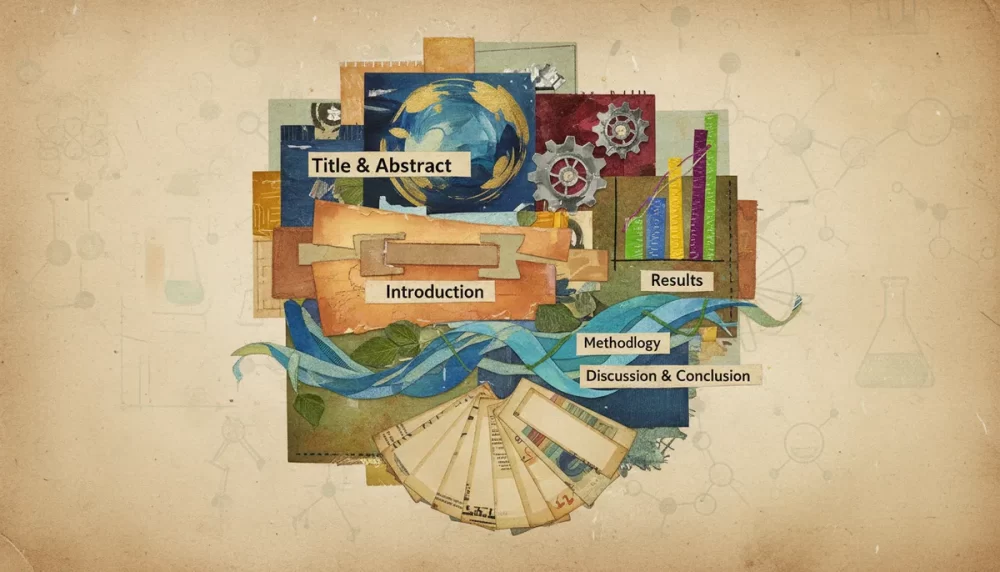
A research paper typically follows the IMRAD structure — Introduction, Methods, Results, and Discussion. This format is widely recognized by journals indexed in PubMed and other scientific databases. Journals expect manuscripts to follow this structure precisely, and deviating from it is a common reason for rejection.
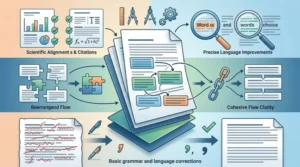
Before submission, the manuscript must be refined through multiple editing rounds. This is where professional scientific editing plays a critical role. Editing ensures the paper communicates its findings clearly, logically, and in correct academic English.
Key Components Every Research Paper Must Include
Understanding the structure of a research paper is essential for any author preparing a manuscript. A well-organized paper makes it easier for peer reviewers to evaluate scientific merit — rather than getting distracted by unclear writing.
Here are the essential components of a research paper:
- Title: Concise, descriptive, and keyword-rich to aid discoverability
- Abstract: A brief summary of the study’s objectives, methods, results, and conclusions
- Introduction: Background context, research gap, and study objectives
- Methods: A reproducible description of how the study was conducted
- Results: Clear presentation of findings, often supported by tables and figures
- Discussion: Interpretation of results, limitations, and implications
- References: Properly formatted citations following journal-specific style guides
Each section requires a different type of editing attention. Content editing focuses on logical flow and argument development, while copy editing targets grammar, spelling, and word choice.

The Difference Between Types of Research Paper Editing
Many authors confuse the different stages of manuscript editing. Understanding each stage helps you know what kind of support your manuscript needs at any given point.
| Type of Editing | Focus Area | Best Used When |
|---|---|---|
| Content Editing | Logical flow, argument structure, organization | After the first complete draft |
| Copy Editing | Grammar, spelling, punctuation, word choice | Once content is finalized |
| Language Editing | Clarity, tone, academic English precision | For non-native English authors |
| Proofreading | Final error check before submission | As the last step before submitting |
Professional editors evaluate novelty, relevance, and reader interest while matching objectives with conclusions. They also flag unsupported speculations — a common issue that peer reviewers penalize. Language editing is especially valuable for international researchers whose English fluency affects how reviewers perceive their scientific contributions.

Why Research Paper Editing Matters for Publication Success
Academic journals receive thousands of manuscript submissions every year. Clarity and editing quality directly influence editorial rejection rates, according to data from publishers like Springer Nature. A poorly written manuscript — even if it contains solid science — can be rejected before it ever reaches peer review.
Professional editing improves readability, allowing reviewers to focus on the scientific merit of your work rather than its language errors. This matters enormously in high-impact journals where competition is fierce.
Here is why professional editing increases your chances of acceptance:
- Editors align your manuscript with the target journal’s scope and style guidelines
- They improve sentence clarity so reviewers can follow your reasoning easily
- They eliminate grammatical and punctuation errors that signal a lack of care
- They ensure your abstract accurately reflects the paper’s content
- They verify that your conclusions are supported by your results
At San Francisco Edit, 98 percent of edited manuscripts are accepted and published. The team consists of native English-speaking PhD scientists with more than 325 combined years of editing experience. Every manuscript is edited by a human expert — no AI tools are used.
How to Self-Edit a Research Paper Before Professional Help
Before you submit your manuscript to a professional editing service, self-editing can strengthen your draft significantly. This reduces the number of revisions needed and helps your editor focus on deeper improvements.
Follow these steps to self-edit your research paper effectively:
- Start with the big picture. Read your entire draft without making changes. Identify sections that feel unclear or underdeveloped.
- Print the manuscript. Reading on paper helps you notice errors that your eye skips on screen.
- Highlight problem areas. Mark sections where your argument is weak, evidence is missing, or transitions are abrupt.
- Check for consistency. Verify that your terminology, abbreviations, and formatting are consistent throughout.
- Read aloud. This technique reveals awkward sentence structures and unnatural phrasing that silent reading misses.
- Review your abstract last. After revising, rewrite the abstract to ensure it accurately reflects the final version of your paper.
Once you have completed self-editing, your manuscript is better prepared for professional review. You can explore resources on improving your writing through the knowledge center at San Francisco Edit.
Common Mistakes That Lead to Research Paper Rejection
Understanding the research paper definition also means knowing what makes a manuscript fall short. Many rejections are preventable with the right editing support.
Common reasons manuscripts are rejected include:
- Poor English language quality that obscures the scientific message
- Conclusions that go beyond what the data actually supports
- Insufficient detail in the methods section to allow reproducibility
- Unclear or misleading abstracts that misrepresent the study
- Incorrect or inconsistent reference formatting
- Failure to address the specific aims of the target journal
Professional editing services use subject-matter experts to refine research mechanisms, methods, and conclusions so that they align precisely with journal guidelines. According to research cited in PMC, careless preparation and poor English are among the leading contributors to manuscript rejection — an avoidable outcome with proper editing support.
Special Considerations for Non-Native English Authors
For researchers whose primary language is not English, the challenges of preparing a research paper extend beyond science. The precision required in academic English is demanding, and even small language errors can distort the meaning of your findings.
Non-native English authors benefit most from:
- Language editing that corrects grammar, syntax, and vocabulary at a sentence level
- Restructuring of complex sentences that are technically correct but difficult to read
- Tone adjustments to match the formal register expected in academic journals
- Review of discipline-specific terminology to ensure accuracy
San Francisco Edit operates globally and has extensive experience helping international researchers — including scientists and clinicians from Asia, Europe, South America, and beyond — prepare manuscripts that meet the highest publication standards. The team understands the nuances of academic English and provides detailed explanations for every change made to your text.
If you are ready to prepare your manuscript for submission, you can submit your manuscript directly to begin the editing process.
What to Expect from a Professional Research Paper Editing Service
Choosing the right editing service is a critical decision. Not all editing services are equal, and the quality of editing directly affects your publication outcome.
Here is what a high-quality research paper editing service should provide:
- Editing by subject-matter experts who understand your field
- A tracked-changes document in Microsoft Word showing all edits clearly
- Written explanations for major edits and suggested additions
- Strict confidentiality and secure handling of your unpublished work
- Transparent pricing and clear turnaround times
San Francisco Edit offers standard turnaround of 6–8 days and rush service in 3–4 days, at US$33.00 per 250 words. References are not counted in the word total. You can review full details on the Pricing and Payment page or explore frequently asked questions through the FAQ section.
For researchers who want to verify quality before committing, reading feedback from past clients is always informative. You can read what authors around the world say on the testimonials page.
Conclusion
A research paper, properly defined in the manuscript editing context, is far more than a written document. It is an unpublished scientific manuscript that must meet the high standards of peer-reviewed publication. From structure and clarity to language precision and journal compliance, every element of a research paper requires careful attention. Professional editing transforms a rough draft into a polished, submission-ready manuscript — and significantly improves your chances of acceptance.
Whether you are submitting your first journal article or managing a team of researchers, expert editing support is an investment in your scientific reputation. Submit your manuscript to San Francisco Edit today and work with a team of PhD scientists who understand both your research and the publication process.
FAQs
Q: What is the definition of a research paper in manuscript editing?
A: In manuscript editing, a research paper is an unpublished academic document that presents original findings following a formal structure such as IMRAD — Introduction, Methods, Results, and Discussion. It is intended for submission to a peer-reviewed journal and must meet strict standards for language, organization, and scientific rigor. Professional editing prepares this document for successful publication.
Q: What is the difference between revising and editing a research paper?
A: Revising focuses on the content itself — reorganizing arguments, strengthening evidence, and improving overall structure. Editing, by contrast, refines the language, grammar, punctuation, and clarity of the manuscript after the content is finalized. Both steps are essential, but professional editing is the final stage that ensures the paper meets journal submission standards.
Q: Why do non-native English speakers need research paper editing?
A: Non-native English speakers often have strong scientific content but face challenges with the precision and formal tone required in academic journals. Language errors can distort the meaning of findings and lead to rejection, even when the science is sound. Professional language editing corrects grammar, syntax, and vocabulary while preserving the author’s scientific voice.
Q: What types of editing services are available for research papers?
A: Research papers typically require four types of editing: content editing for logical flow and argument structure, copy editing for grammar and punctuation, language editing for academic English precision, and proofreading as a final error check before submission. Each stage serves a specific purpose and contributes to a polished, publication-ready manuscript.
Q: What role does proofreading play in manuscript preparation?
A: Proofreading is the final step in manuscript preparation. It eliminates minor errors such as spelling mistakes, punctuation inconsistencies, and formatting issues that may have been missed during earlier editing rounds. A thorough proofread ensures the manuscript presents a professional, error-free appearance when it reaches the journal editor.