Key Takeaways
-
Poor language, unclear structure, and formatting errors are major causes of desk rejection before peer review—these are entirely preventable through careful editing and adherence to journal guidelines.
-
Select your target journal early and follow its author guidelines precisely, as ignoring specific requirements for structure, citation format, word limits, and ethical statements is one of the fastest ways to earn immediate rejection.
-
Complete a full draft before editing, then revise systematically section-by-section using a structured checklist, as skipping steps or polishing early sections prematurely often creates problems later in the process.
-
Professional language editing significantly improves publication chances by removing ambiguous phrasing, grammatical errors, and awkward sentence structure—particularly valuable for non-native English speakers submitting to English-language journals.
-
After journal acceptance, carefully review page proofs for typographical errors, verify references and figure resolution, and confirm author details, as errors at this stage will appear permanently in the published paper.
-
Common publication delays result from rushing submission before the manuscript is ready, submitting to the wrong journal scope, neglecting the abstract quality, and overlooking ethical declarations—all preventable with thorough pre-submission preparation.
Every researcher dreams of seeing their work in print. But getting from a draft manuscript to a published paper is rarely straightforward. The path involves careful writing, thorough revision, strategic journal selection, and precise formatting. Many strong studies are rejected not because the science is flawed, but because the manuscript was not ready. Poor language, unclear structure, or formatting errors can stop a paper before peer reviewers even evaluate the research itself.
This guide walks you through the key steps to prepare your manuscript for publication. Whether you are a PhD candidate writing your first paper, a clinician translating clinical findings into a journal article, or an established academic managing a research team, these practical steps will help you move from draft to published paper with confidence.
What Is the Difference Between a Manuscript and a Published Paper
These two terms are often confused, but they refer to different stages of the same process. A manuscript is the document you write, revise, and submit to a journal. A published paper is what that manuscript becomes after it has passed editorial screening, survived peer review, been accepted by the journal, and appeared in print or online.
Understanding this distinction matters. It helps you set realistic expectations and focus your preparation. The manuscript you submit is not a finished product. It is an argument for why your work deserves to become a published paper. Your goal is to make that argument as strong as possible before submission.
If you want a deeper understanding of how to structure that argument, the 11 essential steps to write a manuscript for publication provide a clear and actionable framework.
Why Manuscripts Get Rejected Before Peer Review
Many submissions never reach peer reviewers. Journals reject a large proportion of manuscripts at the editorial screening stage. The reasons are often avoidable. According to Taylor & Francis, poor-quality English and incorrect presentation are among the most common grounds for rejection.
Common reasons for early rejection include:
- Unclear or poorly written English that makes the science hard to follow
- Failure to match the journal’s scope or aims
- Incorrect formatting, citation style, or structure
- An abstract that does not clearly summarize the study
- Missing ethical approval statements or author declarations
- Figures and tables that do not meet the journal’s technical standards
Each of these issues is preventable. A well-edited manuscript addresses all of them before submission. If you want to understand the full range of problems that lead to rejection, the resource on reasons why scientific manuscripts are rejected by journals is worth reviewing carefully.

Step-by-Step: How to Prepare Your Manuscript for a Published Paper
Follow these steps in order. Each builds on the previous one. Skipping steps often creates problems later in the process.
Step 1: Complete Your Draft Before You Edit
Do not try to edit while you write. Finish a complete draft first, including all sections. This gives you a full picture of the manuscript before you start refining it. Many writers waste time polishing early sections before realizing the argument changes in the discussion.
Step 2: Choose the Right Journal Early
Select your target journal before you finalize your manuscript. Every journal has specific requirements for structure, length, citation format, and reporting standards. Writing to those requirements from the start saves significant revision time. Use resources like PubMed to search journals that publish work in your specific research area.
For practical advice on making this decision, the article on 10 tips for choosing the right journal for your scientific paper provides useful guidance on scope, impact factor, and audience fit.
Step 3: Follow the Target Journal’s Author Guidelines
Download the journal’s author guidelines and check every requirement. These guidelines specify word limits, section order, reference format, figure resolution, and ethical statement requirements. Ignoring them is one of the fastest ways to earn a desk rejection.
Step 4: Revise Each Section Systematically
Work through the manuscript section by section. Each part has a specific job to do. Use this checklist to guide your revision:
- Title: Is it specific, informative, and keyword-rich? See guidance on how to write a research paper title that gets noticed.
- Abstract: Does it summarize the objective, methods, results, and conclusions clearly? Check the advice on how to write an abstract that gets your paper published.
- Introduction: Does it establish the research gap and state your objective clearly?
- Methods: Is the methodology described in enough detail to be reproduced? Review 11 expert tips for writing a strong methods section.
- Results: Are findings presented clearly and objectively, without interpretation?
- Discussion: Do you interpret your results in the context of existing literature? See 7 key steps to write a strong discussion section.
- References: Are all citations formatted correctly and complete?
Step 5: Edit for Language, Clarity, and Flow
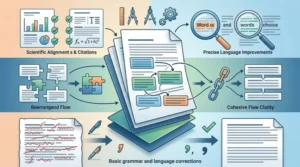
Once the structure and content are sound, focus on language quality. This step is critical for non-native English speakers and for anyone submitting to an English-language journal. Ambiguous phrasing, grammatical errors, and awkward sentence structure can obscure excellent science.
This is where professional scientific editing makes a measurable difference. A qualified editor improves readability, corrects terminology, and ensures consistency in style without altering your research findings. For authors whose primary language is not English, language editing services are particularly valuable for bridging the gap between strong science and polished written expression.
Step 6: Check Figures, Tables, and Legends
Figures and tables communicate your data visually. They must be accurate, clearly labeled, and properly formatted to journal specifications. Figure legends should be self-explanatory. A reader should be able to understand a figure without reading the full paper. For detailed guidance, see the resource on how to write a figure legend that strengthens your manuscript.
Step 7: Proofread the Final Version
Proofreading is not the same as editing. Editing addresses structure, clarity, and language quality. Proofreading catches remaining surface errors: typos, punctuation mistakes, inconsistent spacing, and formatting issues. Both steps are essential before submission. For a structured approach, the 9 proofreading steps that get manuscripts published offer a reliable checklist.
What Professional Editing Does for Your Manuscript
Many researchers underestimate how much a professional edit improves their manuscript. Editing does not change your findings. It makes your findings easier to understand, evaluate, and accept. Here is what a professional editing service typically addresses:
| Editing Area | What Gets Improved | Impact on Publication |
|---|---|---|
| Grammar and syntax | Sentence structure, verb agreement, tense consistency | Reduces language-related rejection risk |
| Clarity and concision | Removes redundant phrases, simplifies complex sentences | Improves readability for editors and reviewers |
| Scientific terminology | Ensures correct and consistent use of field-specific terms | Signals expertise and credibility |
| Journal formatting | Aligns structure, headings, and references with journal requirements | Prevents desk rejection for non-compliance |
| Abstract quality | Tightens summary to meet word limits and content requirements | Increases chances of passing editorial screening |
| Figure and table legends | Improves accuracy and self-sufficiency of visual element descriptions | Reduces reviewer requests for clarification |
San Francisco Edit offers expert manuscript editing by native English-speaking PhD scientists. With a reported 98% acceptance rate for edited manuscripts and over 325 combined years of staff experience, the service is trusted by researchers worldwide. Editing is done entirely by humans, with no AI involvement, ensuring precision and contextual understanding that automated tools cannot replicate.
Do Editing Services Guarantee Publication
This is one of the most common questions from authors considering professional editing. The honest answer is no. No editing service can guarantee that a journal will accept your manuscript. Final acceptance depends on peer reviewers and the editorial board, not on language quality alone.
What editing does guarantee is that your manuscript is presented in the clearest, most professional form possible. It removes avoidable barriers to acceptance. The science still needs to be sound, original, and relevant to the journal’s readership. But a well-edited manuscript gives that science its best possible chance of being evaluated fairly on its merits.
For a broader view of what the publication process involves, the guide on how to get a research paper published in 2026 is a practical and current resource.
Post-Acceptance: Editing After Your Paper Is Accepted
The editing process does not always end at submission. Once a journal accepts your manuscript, the production phase begins. This stage often requires additional attention to detail. Authors may need to:
- Review and approve page proofs for typographical errors
- Verify that all references are complete and correctly formatted
- Check that figures appear correctly at the required resolution
- Confirm that author names, affiliations, and contact details are accurate
- Respond to any final queries from the production team
Errors missed at this stage can appear in the published paper permanently. Corrections after publication are possible but cumbersome. Taking time to review proofs carefully protects the integrity of your work.
You can find further reading on navigating the journal submission process at PubMed Central, which also serves as a valuable archive of published biomedical and life sciences research.
Common Mistakes That Delay Publication
Even experienced researchers make these errors. Recognizing them early saves time and frustration.
- Submitting before the manuscript is ready. Rushing to submit leads to avoidable rejections. Take time to revise thoroughly.
- Ignoring journal scope. Submitting to the wrong journal wastes months. Read recent issues of your target journal before submitting.
- Neglecting the abstract. Many editors form their first impression from the abstract alone. A weak abstract can lead to rejection without further reading.
- Inconsistent citation formatting. References must follow the journal’s exact style. Mixed formats signal careless preparation.
- Overlooking ethical declarations. Missing statements on ethics approval, conflicts of interest, or data availability will trigger immediate queries or rejection.
Addressing these mistakes before submission significantly reduces delays. The manuscript formatting guide for authors is a helpful reference for ensuring compliance with journal requirements.
Special Considerations for Non-Native English Speakers
Researchers who write in English as a second language face an additional challenge. Journals evaluate science and language simultaneously. A study with important findings can still be rejected if reviewers struggle to follow the writing.
Professional language editing addresses this directly. It improves sentence clarity, corrects idiomatic errors, and ensures the manuscript reads as naturally and fluently as work written by a native English speaker. This levels the playing field for international researchers and gives their work a fair hearing. For more on this, the resource on scientific editing for non-native English speakers explains how targeted editing enhances publication chances.
Researchers can also explore the broader landscape of English editing services that transform academic writing in 2026 to understand what to look for when choosing a provider. For additional guidance, the U.S. National Library of Medicine offers extensive resources on medical writing and publication standards.
A Final Checklist Before You Submit
Use this checklist as your final quality check before submitting your manuscript:
- All sections are complete and in the correct order
- The manuscript meets the journal’s word and page limits
- The abstract matches the journal’s required format and word count
- All figures and tables are properly labeled and meet resolution requirements
- References are complete, accurate, and formatted correctly
- Ethical approval and author declarations are included
- The manuscript has been professionally edited for language and clarity
- A cover letter is prepared that explains the significance of the work
For cover letter guidance, see the resource on 5 key steps to write a journal submission cover letter. A strong cover letter complements a well-edited manuscript and gives editors the context they need to evaluate your work favorably.
Conclusion
Moving from manuscript to published paper requires deliberate preparation at every stage. Strong science is the foundation, but clear language, correct formatting, and professional editing are what carry that science to publication. Each step in this guide reduces the risk of avoidable rejection and brings your manuscript closer to the standard that journals expect.
Whether you are preparing your first submission or your fiftieth, the investment in professional editing pays dividends in acceptance rates, reviewer responses, and the long-term visibility of your research. Take the time to get it right before you submit.
Ready to give your manuscript the professional attention it deserves? Submit your manuscript to San Francisco Edit and work with expert PhD-qualified editors who understand what journals expect and how to help your research succeed.
FAQs
Q: What is the difference between a manuscript and a published paper?
A: A manuscript is the document an author writes and submits to a journal for consideration. A published paper is what that manuscript becomes after it has passed peer review, been accepted by the journal, and appeared in print or online. The two terms describe different stages of the same research communication process.
Q: Does professional manuscript editing guarantee that a paper will be published?
A: No editing service can guarantee publication. Final acceptance depends on the journal’s editorial team and peer reviewers, who evaluate the scientific merit and relevance of the work. However, professional editing removes avoidable language and formatting barriers, giving your manuscript its best possible chance of being evaluated fairly.
Q: What should be checked in a manuscript before it is submitted to a journal?
A: Before submission, authors should verify that all sections are complete, the abstract meets the journal’s word count and format requirements, references are accurate and correctly formatted, figures meet technical standards, and all ethical declarations are included. The manuscript should also be professionally edited for language clarity and adherence to the journal’s author guidelines.
Q: Why do journals reject manuscripts for language or formatting issues?
A: Journals receive far more submissions than they can publish, so editors often desk-reject manuscripts that are difficult to read or do not meet presentation standards. Poor English makes it hard for reviewers to evaluate the science accurately. Formatting errors signal that an author has not read the journal’s guidelines carefully, which can reduce editorial confidence in the submission.
Q: Can a paper be edited after it has been accepted by a journal?
A: Yes, post-acceptance editing is an important stage. Once a manuscript is accepted, authors are typically asked to review page proofs before the paper is formally published. At this stage, it is essential to check for typographical errors, confirm reference accuracy, and verify that figures and author details are correct. Errors found at this point are far easier to correct than errors in a published paper.