Key Takeaways
- A research paper abstract is a concise, standalone summary that provides a comprehensive overview of a study in 150-300 words.
- Abstracts serve as critical gateways for researchers to quickly assess the relevance and significance of a research paper.
- An effective abstract contains four essential components: background/purpose, methods, key results, and conclusions.
- Abstracts vary in type (structured, unstructured, descriptive, informative) and should be tailored to specific journal guidelines and disciplines.
- Write the abstract last, after completing the full manuscript, to ensure accuracy and consistency of information.
- Use past tense, third-person voice, and direct language, avoiding unnecessary jargon, qualifiers, and excessive technical complexity.
- Strategic keyword placement and precise language can optimize abstract discoverability and increase publication chances.
Writing a research paper abstract is one of the most important yet often challenging tasks for academic researchers. This brief but comprehensive summary serves as a gateway to your entire study, helping readers quickly determine whether your research is relevant to their interests. A well-crafted abstract can significantly increase your paper’s visibility and chances of publication in peer-reviewed journals. Whether you are a graduate student preparing your first manuscript or an established researcher refining your work, understanding the key elements of an effective abstract is essential for success in academic publishing.
An abstract provides a standalone summary of your research paper, typically ranging from 150 to 300 words. It must be concise yet complete, offering readers enough information to understand your study’s purpose, methodology, findings, and conclusions without reading the entire manuscript. For non-native English speakers and early-career scientists, mastering this skill becomes even more critical, as journal editors often make initial acceptance decisions based on abstract quality alone.

What Is a Research Paper Abstract
A research paper abstract is a self-contained, concise summary that appears at the beginning of your manuscript, immediately following the title and author information. This single paragraph encapsulates the entire scope of your study, presenting your research objectives, methods, key results, and main conclusions in a logical sequence. The abstract functions as an independent piece of writing that readers can understand without consulting the full paper.
Unlike an introduction that gradually leads readers into your topic, an abstract delivers all essential information upfront. According to PubMed, abstracts enable researchers to quickly scan thousands of papers and identify those most relevant to their work. Medical professionals and university faculty particularly rely on abstracts when conducting literature reviews or staying current with developments in their fields. The abstract appears in database searches, conference proceedings, and journal tables of contents, making it the most widely read part of your research paper.
Most journals require abstracts to follow specific formatting guidelines, including word count limits and structural requirements. These guidelines vary by discipline and publication, but the core purpose remains consistent: to provide readers with a clear, accurate representation of your research in the shortest possible format.

Standard Length and Word Count Requirements
The typical abstract length ranges between 150 and 300 words, though specific requirements depend on journal guidelines and paper type. This word count constraint forces authors to be extremely selective about which information to include, eliminating unnecessary details while preserving essential content. Some journals accept abstracts as short as 75 words for brief communications, while others allow up to 500 words for comprehensive research articles.
Understanding these length parameters helps you plan your abstract structure effectively:
- Descriptive abstracts: 75-150 words, providing a brief overview without detailed results
- Informative abstracts: 200-250 words, including full methodology and specific findings
- Structured abstracts: 250-300 words, organized with labeled sections
- Extended abstracts: Up to 500 words for complex studies or conference submissions
The word count typically excludes the title but includes all other text. References are not cited in abstracts, and abbreviations should be minimized or defined on first use. Many journals use automated systems to check abstract length, rejecting submissions that exceed the specified limit. Always consult your target journal’s author guidelines before writing to ensure compliance with specific requirements.

Essential Components of an Effective Abstract
Every strong research paper abstract contains four fundamental components that guide readers through your study systematically. These elements appear in a specific order, creating a logical flow that mirrors the structure of your full manuscript. Understanding and implementing these components correctly is crucial for both novice and experienced researchers seeking publication success.
Background and Purpose
The opening sentences establish context by briefly explaining the research problem and stating your study’s objective. This section answers why the research was conducted and what gap in knowledge it addresses. In one or two sentences, you should capture the significance of your topic without extensive background information. For example, rather than reviewing all previous literature, simply state the current problem and your specific research question.
Academic researchers should focus on presenting a clear rationale that immediately engages readers. Medical professionals writing for clinical journals might emphasize patient impact or treatment implications. The background should lead naturally into your study purpose, creating a seamless transition to your methodology.
Methods and Approach
This section describes how you conducted your research, including study design, sample size, data collection methods, and analytical techniques. Be specific enough that readers understand your approach but concise enough to preserve word count for results. Use past tense and active voice when possible, stating what you did rather than what was done.
For experimental studies, mention key variables, control measures, and statistical methods. For theoretical papers, describe your analytical framework or model. Qualitative researchers should specify their methodological approach and data sources. This section typically occupies about one-quarter to one-third of your abstract length.
Key Results and Findings
The results section presents your main findings with specific data points, statistical significance, and measurable outcomes. This is often the most important part of your abstract, as readers want to know what you discovered. Include actual numbers, percentages, or statistical values rather than vague statements like “significant differences were found.”
Prioritize your most important findings, as space limitations prevent comprehensive results reporting. Focus on outcomes that directly address your research question and support your conclusions. Non-native English authors should pay particular attention to verb tense here, consistently using past tense to describe completed research findings.
Conclusions and Implications
The final sentences interpret your results and explain their significance. State what your findings mean for the field, how they advance knowledge, or what practical applications they suggest. Avoid overstating conclusions or making claims beyond what your data support. Instead, present balanced interpretations that acknowledge limitations while highlighting contributions.
Strong conclusions often include recommendations for future research or practical applications. Early-career scientists should ensure their conclusions align logically with reported results without introducing new information not mentioned earlier in the abstract.
Types of Research Paper Abstracts
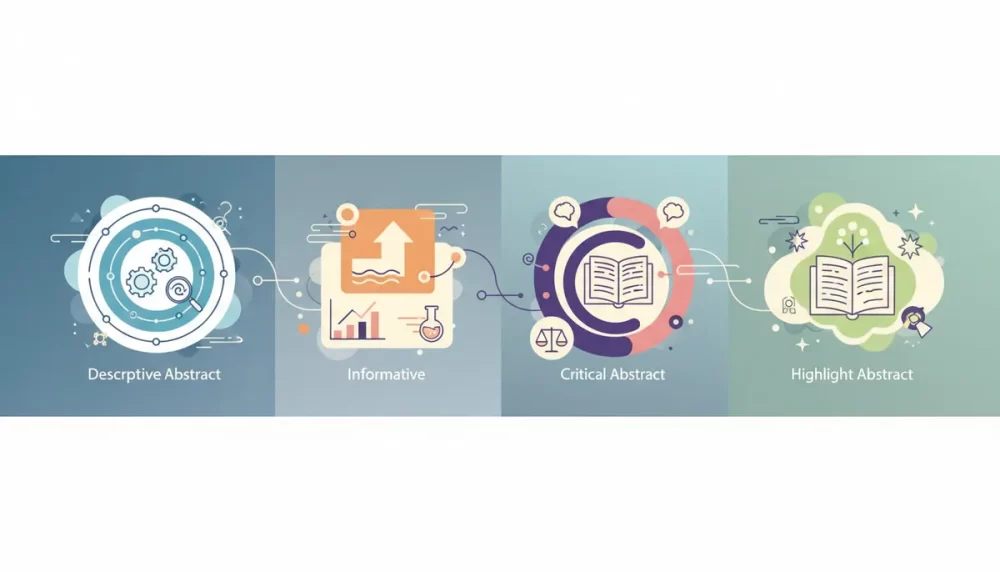
Different academic disciplines and journals prefer specific abstract formats. Understanding these variations helps you tailor your abstract to meet target publication requirements. The four main types each serve distinct purposes and follow unique organizational principles.
Structured Abstracts
Structured abstracts organize content under explicit subheadings such as Background, Methods, Results, and Conclusions. Medical and health sciences journals commonly require this format because it enhances clarity and allows readers to quickly locate specific information. Each section receives a label, making the abstract highly scannable and systematic.
This format typically runs 250-300 words and follows a rigid structure. Headings may vary by discipline (Objective, Design, Setting, Participants, Interventions, Main Outcome Measures, Results, Conclusions), but the principle remains consistent. Scientific editing services can help ensure your structured abstract meets journal-specific requirements while maintaining clarity and coherence.
Unstructured Abstracts
Unstructured abstracts present the same essential information in a single paragraph without labeled sections. Humanities and social sciences journals often prefer this format, which allows for more narrative flexibility and smoother transitions between ideas. Despite the lack of explicit headings, the content still follows a logical progression from background through conclusions.
Writers must skillfully integrate all four essential components into flowing prose, making transitions particularly important. This format requires strong organizational skills to maintain clarity without structural signposts. The typical length remains 150-250 words, with emphasis on concise, direct language.
Descriptive Abstracts
Descriptive abstracts provide a brief overview of research topics and methods without presenting specific results or conclusions. These shorter summaries, typically 75-150 words, function more like extended titles or tables of contents. They tell readers what the paper addresses but not what it found.
This format appears primarily in review articles, theoretical papers, or humanities research where specific numerical results are not central. Descriptive abstracts use present tense more frequently than other types and focus on scope rather than outcomes. They are less common in scientific publications, where informative abstracts predominate.
Informative Abstracts
Informative abstracts present complete summaries including specific results and definitive conclusions. This most common format in scientific research provides readers with enough detail to understand the study’s contribution without consulting the full text. At around 200-250 words, informative abstracts deliver maximum information density while maintaining readability.
These abstracts emphasize quantitative findings and use precise language to convey specific outcomes. They represent the gold standard for empirical research publications and satisfy the needs of researchers conducting systematic reviews or meta-analyses. University faculty members appreciate this format because it allows efficient literature screening.
Writing Process and Best Practices
Creating an effective abstract requires careful planning and revision. Following a systematic approach helps ensure your abstract accurately represents your research while meeting all technical requirements. Most experts recommend writing the abstract last, after completing the full manuscript, though preparing a preliminary version earlier can help maintain focus during the writing process.
When to Write Your Abstract
Write your abstract after finishing the complete research paper, not before. This timing ensures accuracy and consistency between the abstract and full manuscript. With the entire study completed, you can objectively identify the most important elements to highlight and accurately summarize your actual findings rather than anticipated results.
Some researchers draft a preliminary abstract early to clarify their research focus and maintain direction during manuscript preparation. However, always revise this draft thoroughly after completing the paper to reflect final results and refined conclusions. The final abstract should be one of the last elements you write before submission.
Language and Style Guidelines
Use past tense to describe completed research actions and findings (“We analyzed,” “The results showed”). Present tense may appear in background statements describing established facts (“DNA contains genetic information”). Third person voice creates professional distance and objectivity, though some journals now accept first person for increased clarity and directness.
Keep language simple, direct, and specific. Avoid:
- Vague qualifiers like “very,” “quite,” or “fairly”
- Unnecessary phrases such as “This study examined” (implied by context)
- Acronyms and abbreviations unless standard in your field
- Citations, references, or footnotes
- Mathematical equations or complex formulas
- Tables, figures, or graphical elements
Each sentence should convey maximum information using minimum words. Non-native English speakers often benefit from language editing services to refine clarity, grammar, and style while preserving technical accuracy.
Common Mistakes to Avoid
Several frequent errors undermine abstract effectiveness. Being aware of these pitfalls helps you avoid them:
- Including information not present in the full manuscript
- Using overly technical jargon that limits accessibility
- Presenting vague results without specific data
- Exceeding word count limits
- Failing to state clear conclusions
- Introducing new data or interpretations
- Using passive voice excessively
- Neglecting to proofread carefully
Inconsistencies between your abstract and full paper raise red flags for journal editors and peer reviewers. Ensure every statement in your abstract accurately reflects content in the manuscript. Preliminary or inconclusive findings should be acknowledged as such, maintaining honesty and avoiding misleading readers.
Optimizing Your Abstract for Publication Success
Beyond meeting basic requirements, strategic optimization increases your abstract’s impact and your paper’s publication chances. Journal editors often make initial screening decisions based solely on title and abstract quality, making this section critical for advancing through the review process. Academic researchers must balance technical accuracy with accessibility, creating abstracts that appeal to both specialist reviewers and broader audiences.
Keyword Selection and Placement
Strategically incorporate relevant keywords throughout your abstract to improve discoverability in database searches. Most journals require authors to list 3-6 keywords separately, but naturally including these terms in your abstract text enhances search engine optimization and helps researchers find your work. Choose specific, established terms from your field’s controlled vocabulary when possible.
Place keywords in your abstract’s first and last sentences for maximum impact. However, avoid forced repetition or awkward phrasing just to include keywords. The abstract must read naturally while containing terms researchers might use when searching for papers on your topic. Early-career scientists should consult senior colleagues or examine recently published papers in their target journal to identify appropriate terminology.
Clarity and Precision
Every word in your abstract must earn its place. Replace long phrases with shorter alternatives (“use” instead of “make use of”) and eliminate redundancy. Be specific rather than general: state actual sample sizes, effect sizes, and p-values instead of saying “many participants” or “significant results.”
Clear writing benefits all readers but particularly helps non-native English speakers understand your work. International scientific communication relies on accessible language that transcends language barriers. Medical professionals scanning hundreds of abstracts appreciate direct statements that communicate findings efficiently without requiring interpretation or inference.
Maintaining Objectivity
Present your research honestly and objectively, acknowledging limitations when appropriate. Avoid promotional language, exaggerated claims, or biased interpretations that overstate your findings’ significance. Journal editors and peer reviewers quickly identify abstracts that oversell results or ignore contradictory evidence.
If your study has preliminary findings or limited generalizability, state this clearly in your conclusions. Ethical research communication requires transparency about methodology constraints, sample limitations, or unexpected complications. This honesty enhances rather than diminishes your work’s credibility and demonstrates scientific integrity valued by the academic community.
Journal-Specific Requirements and Variations
Different journals and disciplines maintain unique abstract requirements that authors must follow precisely. Before writing, carefully review your target journal’s author guidelines, noting specific formatting, length, structure, and content requirements. Failure to comply with these specifications often results in automatic rejection before peer review begins.
Scientific journals typically prefer structured abstracts with explicit subheadings, while humanities journals often require unstructured narrative formats. Some publications mandate specific section titles or word limits for each section. Clinical trial registries may require additional elements like trial registration numbers or funding sources.
Many high-impact journals now require graphical abstracts or video abstracts alongside traditional text summaries. These visual supplements help communicate complex findings to broader audiences but require additional preparation time and technical skills. Check whether your target journal offers or requires these options when planning your submission timeline.
Understanding these variations prevents wasted effort revising abstracts for different journals. University faculty members managing multiple projects should maintain organized records of journal requirements to streamline the submission process across various manuscripts. Professional manuscript preparation services can help format abstracts correctly for specific journal requirements while ensuring content quality.
The Abstract’s Role in the Publication Process
Your abstract serves multiple critical functions throughout the publication journey and beyond. Understanding these roles helps you appreciate why investing time in abstract quality pays substantial dividends for your research career. The abstract acts as the primary marketing tool for your work, influencing decisions at every stage from initial submission through long-term citation impact.
Initial Screening and Desk Rejection
Journal editors receive far more submissions than they can publish, making initial screening essential. Many editors spend just minutes reviewing each new submission, focusing primarily on the title and abstract to determine whether the paper merits peer review. A poorly written or unfocused abstract often results in immediate desk rejection, ending the review process before it begins.
Your abstract must quickly demonstrate that your research addresses an important question, uses appropriate methods, produces significant findings, and fits the journal’s scope. Editors look for clear writing, logical organization, and substantive contributions to the field. Grammatical errors, vague results, or misalignment with journal focus trigger rejection, making abstract quality crucial for advancing to peer review.
Database Indexing and Discoverability
Once published, your abstract becomes the primary text indexed in academic databases, digital repositories, and search engines. Researchers searching for papers on your topic will find your work based largely on abstract content and keywords. A well-written abstract with appropriate terminology significantly increases your paper’s visibility and citation potential.
Databases like PubMed display only titles and abstracts in search results, making these elements crucial for attracting readers to your full text. Many researchers decide whether to download and read a paper based solely on abstract content. International scientists scanning hundreds of abstracts in their literature reviews rely on clear, informative summaries to identify relevant papers efficiently.
Conference Presentations and Professional Networking
Conference organizers typically select presentations based on submitted abstracts, making abstract quality essential for professional visibility. Strong abstracts increase your chances of acceptance for oral presentations, poster sessions, and symposium participation. These opportunities facilitate networking, collaboration development, and career advancement, particularly for early-career scientists building their professional reputations.
Many conferences publish abstract collections that remain permanently accessible online, creating additional citation opportunities and extending your research’s reach. Well-crafted conference abstracts can generate interest even before full manuscript publication, accelerating knowledge dissemination and establishing your expertise in emerging research areas.
Resources and Support for Abstract Writing
Numerous resources help researchers develop their abstract writing skills and refine specific drafts. Taking advantage of these tools and services can significantly improve your abstract quality and publication success rate. Both institutional resources and professional services offer valuable support at different career stages and skill levels.
University writing centers often provide workshops, templates, and individual consultations focused on scientific writing, including abstract preparation. Attend these sessions early in your research career to build foundational skills that will benefit all future publications. Many institutions also offer peer review groups where colleagues critique each other’s abstracts before journal submission, providing valuable feedback from knowledgeable readers.
Professional editing services specializing in academic manuscripts offer expert assistance for researchers at all levels. Native English-speaking editors with PhD-level scientific training can refine your abstract’s clarity, grammar, and style while ensuring technical accuracy. These services prove particularly valuable for non-native English authors who want to present their research with the linguistic precision required by top-tier journals.
Online tools like readability analyzers help assess whether your abstract uses appropriately simple language for broad accessibility. These programs calculate reading level scores and identify complex sentences or technical terms that might limit understanding. While not substitutes for human editing, such tools provide useful objective feedback during revision.
The knowledge center at San Francisco Edit offers comprehensive guidance on manuscript preparation, including detailed abstract writing instructions tailored to scientific, medical, and academic contexts. These resources help researchers understand journal requirements and develop effective writing strategies for successful publication.
Conclusion: Mastering the Art of Abstract Writing
Writing an effective research paper abstract requires balancing multiple competing demands: comprehensive content within strict word limits, technical accuracy with broad accessibility, and specific details with concise prose. This challenging task becomes easier with practice and attention to established principles. Understanding the essential components, structural variations, and strategic optimization techniques discussed in this guide will help you create abstracts that successfully represent your research and advance through the publication process.
Remember that your abstract serves as the gateway to your research, influencing editor decisions, reviewer assessments, reader engagement, and long-term citation impact. Investing time to craft a clear, accurate, and compelling abstract yields substantial returns throughout your paper’s publication journey and beyond. Whether you are a graduate student preparing your first submission or an established researcher refining your approach, continuous improvement in abstract writing skills enhances your overall scholarly communication effectiveness.
For researchers seeking to maximize their publication success, professional editing support can provide the linguistic precision and structural clarity that distinguish accepted manuscripts from rejected submissions. San Francisco Edit specializes in helping academic researchers, medical professionals, and non-native English speakers prepare high-quality manuscripts that meet rigorous journal standards. Our team of native English-speaking PhD scientists brings extensive publication experience and deep understanding of what editors and reviewers expect. Submit your manuscript today to discover how expert editing can transform your abstract and improve your chances of publication in peer-reviewed journals.
FAQs
Q: What is the ideal length for a research paper abstract?
A: Most research paper abstracts should be between 150 and 300 words, though specific requirements vary by journal and discipline. Descriptive abstracts may be as short as 75-150 words, while structured abstracts for medical journals typically run 250-300 words. Always consult your target journal’s author guidelines for exact word count requirements before writing.
Q: When should I write the abstract for my research paper?
A: Write your abstract after completing the full manuscript, not before. This ensures accuracy and consistency between the abstract and the complete paper. Once the entire study is finished, you can objectively identify the most important elements to highlight and accurately summarize your actual findings rather than anticipated results.
Q: What are the four essential components of a research abstract?
A: Every effective abstract contains four fundamental components: background and purpose (establishing context and research objectives), methods and approach (describing study design and techniques), key results and findings (presenting specific data and outcomes), and conclusions and implications (interpreting significance and applications). These elements appear in logical sequence, mirroring the structure of the full manuscript.
Q: What is the difference between structured and unstructured abstracts?
A: Structured abstracts organize content under explicit subheadings such as Background, Methods, Results, and Conclusions, making them highly scannable and systematic. Unstructured abstracts present the same information in a single flowing paragraph without labeled sections. Medical journals typically require structured formats, while humanities and social sciences often prefer unstructured narrative styles.
Q: How can professional editing improve my research paper abstract?
A: Professional editing services refine your abstract’s clarity, grammar, and style while ensuring technical accuracy and compliance with journal requirements. Expert editors help eliminate common errors, optimize keyword placement for discoverability, and ensure consistency with your full manuscript. This is particularly valuable for non-native English speakers who need linguistic precision required by peer-reviewed journals.