
Key Takeaways
- Clearly describe your research design, setting, and overall methodological approach to provide transparency and enable study replication.
- Detail participant selection criteria, sample sizes, and demographic characteristics with precision to establish research credibility.
- Use chronological order when explaining procedures, walking readers through each step logically and sequentially.
- Include specific information about data collection methods, measurement techniques, and quality control measures to demonstrate research rigor.
- Specify all statistical tests, analytical methods, and software used, explaining the rationale behind your chosen techniques.
- Document ethical approvals, informed consent procedures, and participant confidentiality protections to meet research standards.
- Use clear, discipline-specific subheadings and write in past tense with precise, unambiguous language to enhance methodological clarity.
The methods section of a research paper serves as the blueprint of your study. It explains exactly how you conducted your research, allowing other scientists to replicate your work and evaluate its validity. For researchers preparing manuscripts for peer-reviewed journals, understanding how to write this section properly is essential for publication success.
This critical component answers fundamental questions about your research process. It details what materials you used, how you collected data, and which analytical techniques you applied. Whether you’re a graduate student preparing your first manuscript or an established researcher refining your writing skills, mastering the methods section significantly improves your chances of journal acceptance.
In this comprehensive guide, we’ll explore everything you need to know about crafting an effective methods section. From structural requirements to common pitfalls, you’ll learn practical strategies to present your research methodology with clarity and precision.

Understanding the Purpose of the Methods Section
The methods section fulfills several critical functions in your research paper. First and foremost, it provides transparency about your research process. Readers and reviewers need to understand exactly what you did to generate your results. This transparency allows the scientific community to assess whether your approach was appropriate for answering your research question.
Replicability stands as another primary purpose. Other researchers should be able to follow your methods and repeat your study to verify findings. This reproducibility forms the foundation of scientific knowledge. Without detailed methods, your research cannot be properly validated by the broader scientific community.
The methods section also demonstrates the rigor and validity of your study. By thoroughly documenting your procedures, you show reviewers that you made thoughtful methodological choices. This justification helps establish credibility and increases confidence in your results. Professional scientific editing services can help ensure your methods section effectively communicates these essential elements.
Where Does the Methods Section Belong?
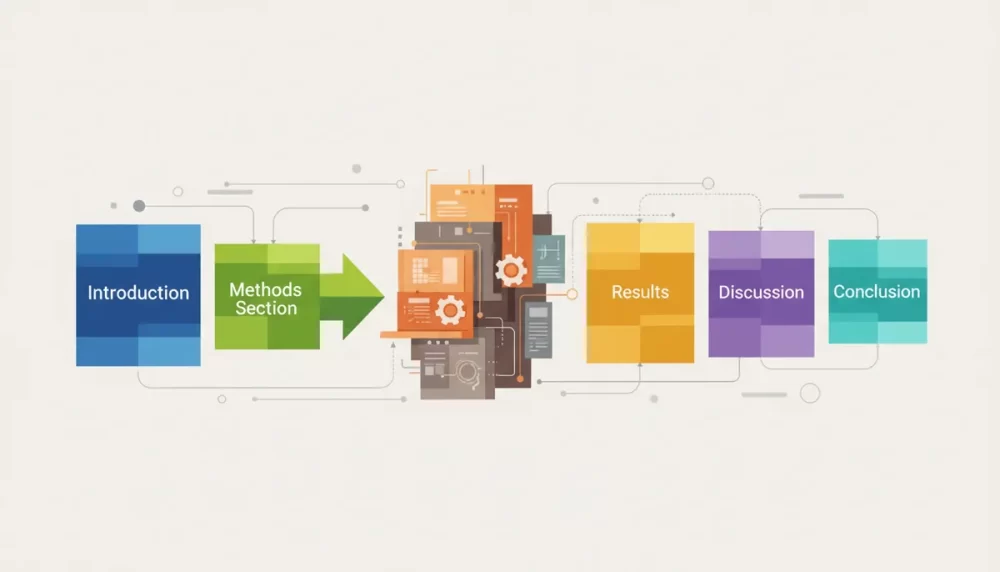
The methods section typically appears after the introduction in most research papers. In some cases, particularly in longer manuscripts, it may follow a literature review section. The placement makes logical sense because readers need to understand your research question and background before learning how you addressed it.
After the methods section comes the results section, where you present your findings. This sequential arrangement allows readers to evaluate your results in the context of how they were generated. Finally, the discussion section interprets these results and connects them back to your research question.
Different disciplines and journals may have specific preferences for section order. Always consult your target journal’s author guidelines before finalizing your manuscript structure. Some journals prefer combined results and discussion sections, while others maintain strict separation between methodological description and data presentation.

Essential Components of a Methods Section
A comprehensive methods section includes several key elements that work together to provide a complete picture of your research process. Understanding these components helps you organize information logically and ensures nothing important gets overlooked.
Study Design and Setting
Begin by clearly stating your overall research design. Was your study experimental, observational, qualitative, or quantitative? Specify whether you used a cross-sectional, longitudinal, randomized controlled trial, or another design. This overview helps readers quickly understand your methodological approach.
Describe the setting where your research took place. Include relevant details about location, timeframe, and environmental conditions that might affect your results. For clinical studies, mention the hospital or clinic name, department, and dates of data collection. Laboratory studies should describe the facility and specific conditions maintained during experiments.
Participants or Subjects
Detail your study population comprehensively. Explain how you selected participants or subjects, including specific inclusion and exclusion criteria. Provide demographic information such as age ranges, gender distribution, and other relevant characteristics that define your sample.
Report sample sizes and explain how you determined the appropriate number of participants. Include information about power analysis if applicable. Describe any randomization procedures used for assignment to experimental groups. For animal studies, specify species, strain, age, weight, and housing conditions.
Materials and Equipment
List all materials, equipment, and instruments used in your study. Include manufacturer names, model numbers, and locations for specialized equipment. This specificity allows other researchers to use identical or equivalent tools for replication studies.
For chemical reagents, provide exact formulations, concentrations, and catalog numbers. Describe any custom-built apparatus or modified equipment in detail. If you used standardized questionnaires or assessment tools, cite the original sources and mention whether you obtained permission for use.
Procedures and Protocols
Describe your research procedures in chronological order, walking readers through each step of your study. Explain what happened first, second, and so on, maintaining a logical flow that mirrors how the research actually unfolded. This sequential presentation makes your methods easier to follow and replicate.
Include specific details about timing, dosages, frequencies, and durations. If you followed established protocols, cite the original sources rather than describing every detail. For modified procedures, explain exactly what you changed and why. Provide enough information that a skilled researcher in your field could reproduce your work without consulting additional sources.
Data Collection Methods
Explain precisely how you gathered your data. For surveys, describe distribution methods, response rates, and any incentives offered. For observational studies, detail how observations were recorded and who made them. Laboratory experiments should specify measurement techniques, number of replicates, and timing of measurements.
Describe any quality control measures implemented during data collection. Mention calibration procedures for instruments, training of data collectors, or pilot testing of procedures. These details demonstrate rigor and help readers assess potential sources of measurement error.
Data Analysis Techniques
Specify all statistical tests and analytical methods you used. Name specific software programs, including version numbers. Describe how you prepared data for analysis, including any transformations, cleaning procedures, or handling of missing data.
Explain the rationale behind your analytical choices. Why did you select particular statistical tests? What assumptions did these tests require, and how did you verify them? For complex analyses, you may need to provide equations or cite methodological references. PubMed offers numerous articles on specialized analytical techniques.
Ethical Considerations
Document all ethical approvals obtained for your research. Include institutional review board (IRB) or ethics committee names and approval numbers. Describe informed consent procedures for human participants or animal care protocols.
Mention how you protected participant confidentiality and data security. If your study involved vulnerable populations, explain additional safeguards implemented. These ethical considerations are increasingly important to journal editors and reviewers evaluating manuscripts.

Structuring Your Methods Section Effectively
Organization significantly impacts how easily readers can follow your methodology. A well-structured methods section uses clear headings and logical progression to guide readers through your research process without confusion.
Using Subheadings for Clarity
Divide your methods section into clear subsections using descriptive subheadings. Common subheadings include:
- Study Design: Overview of your research approach and framework
- Participants/Subjects: Selection criteria and sample characteristics
- Materials: Equipment, instruments, and reagents used
- Procedures: Step-by-step description of what you did
- Data Collection: How you gathered information
- Data Analysis: Statistical and analytical methods applied
Some disciplines prefer discipline-specific subheadings. Psychological research might use “Design,” “Apparatus,” “Stimuli,” and “Procedure.” Adapt your subheadings to match conventions in your field while maintaining clarity for readers. Consulting knowledge resources about writing in your specific discipline can provide valuable guidance.
Maintaining Chronological Order
Present procedures in the order they occurred during your research. This chronological approach creates a natural narrative that readers can easily follow. Starting with preparation and ending with analysis mirrors the actual research timeline and helps readers understand how each step built upon previous ones.
Within each subsection, continue this chronological ordering. For example, when describing participant recruitment, explain screening first, then enrollment, then randomization. This consistent temporal organization reduces cognitive load for readers trying to understand your methodology.
Balancing Detail and Brevity
Include enough detail for replication without overwhelming readers with unnecessary information. Focus on aspects that could affect your results or that other researchers would need to reproduce your work. Omit trivial details that don’t contribute to understanding or replication.
For routine procedures, cite standard protocols rather than describing every step. Reserve detailed description for novel techniques, modifications to existing methods, or procedures central to your research question. Use appendices for extensive technical details like questionnaires, interview guides, or supplementary protocols.
Writing Style and Grammar Conventions
The methods section requires specific writing conventions that differ somewhat from other parts of your paper. Understanding these stylistic expectations helps you present your methodology professionally and clearly.
Tense and Voice
Write the methods section in past tense because you’re describing completed actions. Use phrases like “we measured,” “participants completed,” and “data were analyzed” rather than present or future tense constructions. This past tense indicates that you’re reporting what actually happened, not what might happen or what generally happens.
Both active and passive voice are acceptable in methods sections, though preferences vary by discipline. Active voice (“We conducted interviews”) tends to be clearer and more direct. Passive voice (“Interviews were conducted”) can help maintain focus on procedures rather than researchers. Choose the voice that best serves clarity and follows conventions in your field. Language editing services can help ensure your writing style meets disciplinary expectations.
Precision and Specificity
Use precise language that leaves no room for ambiguity. Instead of “high temperature,” specify “37°C.” Replace “small sample size” with the exact number. Avoid vague descriptors like “approximately,” “about,” or “around” when exact values are available.
Define all technical terms, abbreviations, and acronyms upon first use. Even if terms seem standard in your field, not all readers will have identical backgrounds. Clear definitions ensure everyone understands your methodology exactly as intended.
Conciseness Without Sacrificing Clarity
Aim for concise writing that communicates essential information efficiently. Eliminate redundancy, wordiness, and unnecessary qualifiers. Each sentence should add meaningful information about your methods.
However, never sacrifice clarity for brevity. If explaining something requires additional words, use them. A slightly longer, clearer description serves readers better than a confusing abbreviated version. The goal is efficient communication, not minimum word count.
Common Methods Section Formats by Discipline
Different academic fields have established conventions for methods sections. Understanding these discipline-specific expectations helps you format your section appropriately for your target journal.
Biomedical and Clinical Research
Biomedical papers typically follow a structured format with clear subsections. Common elements include:
- Study design and ethical approvals clearly stated upfront
- Detailed patient or subject selection criteria with sample size justification
- Specific intervention descriptions including dosages and administration routes
- Outcome measures defined with measurement timing
- Statistical analysis plan with predetermined significance levels
- Adherence to reporting guidelines like CONSORT for trials or STROBE for observational studies
Clinical research methods must demonstrate rigorous ethical oversight and patient protection measures. Reviewers scrutinize these sections carefully for methodological soundness and ethical compliance.
Social Sciences and Psychology
Social science methods sections emphasize participant characteristics and measures used. Key components include:
- Detailed demographic information about participants
- Recruitment methods and response rates
- Description of all measures, scales, and instruments with reliability information
- Procedure describing the exact participant experience
- Information about experimental manipulations or interventions
- Statistical approaches including tests for assumptions
Psychology papers often include subsections titled “Design,” “Participants,” “Materials,” and “Procedure” following APA style guidelines.
Laboratory Sciences
Laboratory-based research requires extensive technical detail about materials and procedures:
- Specific reagent formulations with catalog numbers
- Equipment specifications including manufacturers and models
- Detailed protocols for laboratory procedures
- Sample preparation methods
- Measurement techniques and instrument settings
- Quality control measures and calibration procedures
Laboratory methods must provide sufficient detail that researchers in other labs could replicate the work using equivalent materials and equipment.
Qualitative Research
Qualitative methods sections address different concerns than quantitative research:
- Researcher positioning and potential biases
- Philosophical or theoretical framework guiding the study
- Sampling strategy and rationale (purposive, theoretical, convenience)
- Data collection methods (interviews, focus groups, observations)
- Analysis approach (thematic, grounded theory, phenomenological)
- Trustworthiness measures (triangulation, member checking, audit trails)
Qualitative methods emphasize transparency about the research process and researcher reflexivity rather than standardized procedures for replication.
Following Journal and Style Guide Requirements
Each journal has specific requirements for methods sections that authors must follow carefully. Failing to adhere to these guidelines can result in immediate desk rejection before peer review even begins.
Consulting Author Guidelines
Read your target journal’s author guidelines thoroughly before writing your methods section. Look for specific requirements regarding:
- Section organization: Required or preferred subheading structure
- Word limits: Maximum length for methods or entire manuscript
- Reporting standards: Required checklists (CONSORT, STROBE, PRISMA)
- Citation format: How to cite methods and materials
- Supplementary material: Whether to include detailed protocols as supplements
Some journals provide specific templates or examples of well-written methods sections. Use these resources to understand editorial expectations. Frequently asked questions about journal submission can help clarify common points of confusion.
APA Style for Methods Sections
Many journals, particularly in social sciences and psychology, follow APA (American Psychological Association) style. Key APA requirements for methods sections include:
- Level 2 heading for “Method” or “Methods” (centered, bold)
- Level 3 subheadings for components like Participants, Materials, Procedure (left-aligned, bold)
- Past tense for describing completed actions
- Clear identification of all measures and materials
- Sufficient detail for replication
- Ethical compliance statement
APA style emphasizes clarity, precision, and systematic presentation of methodological information. The style guide provides detailed examples and formatting rules that authors should follow carefully.
Reporting Guidelines and Checklists
Many journals require adherence to reporting guidelines specific to study types. These standardized formats ensure complete reporting of essential methodological elements. Common reporting guidelines include:
| Study Type | Reporting Guideline | Key Focus |
|---|---|---|
| Randomized Controlled Trials | CONSORT | Trial design, randomization, blinding, outcomes |
| Observational Studies | STROBE | Study design, setting, participants, variables, analysis |
| Systematic Reviews | PRISMA | Search strategy, selection criteria, data extraction |
| Qualitative Research | COREQ | Research team, study design, analysis approach |
| Diagnostic Accuracy | STARD | Test methods, study population, reference standard |
Using appropriate reporting checklists strengthens your methods section and demonstrates adherence to community standards. Submit completed checklists along with your manuscript as required by journals.
Common Mistakes to Avoid
Even experienced researchers sometimes make errors in methods sections that weaken their manuscripts. Being aware of these common pitfalls helps you avoid them in your own writing.
Insufficient Detail for Replication
The most critical error is omitting information necessary for other researchers to reproduce your study. Reviewers and editors frequently reject manuscripts because methods sections lack adequate detail. Ask yourself: “Could someone replicate my study using only the information I’ve provided?”
Missing details commonly include specific reagent concentrations, exact timing of procedures, measurement settings, or statistical software versions. While space constraints may tempt you to abbreviate, insufficient detail undermines scientific rigor and reproducibility.
Including Results in the Methods Section
Methods sections should describe what you did, not what you found. Avoid statements like “We measured blood pressure, which was significantly elevated” or “Participants completed surveys, showing high satisfaction levels.” Save all findings, observations, and data for the results section.
Focus exclusively on procedures, materials, and analytical plans. The only exception is methodological validation data, such as reliability statistics for measures or success rates for technical procedures that other researchers need to evaluate your approach.
Vague or Ambiguous Language
Imprecise descriptions create uncertainty about what you actually did. Terms like “often,” “sometimes,” “several,” or “many” lack the specificity scientific writing requires. Replace vague language with exact information: instead of “participants were young adults,” state “participants aged 18-25 years.”
Similarly, avoid ambiguous references to procedures. Rather than “samples were processed using standard techniques,” specify exactly which technique you used and cite appropriate references if applicable.
Inconsistent Tense Usage
Mixing past and present tense creates confusion about whether you’re describing what you did or what generally happens. Maintain past tense throughout when describing your specific study procedures. Use present tense only when stating general facts or describing persistent conditions.
Poor Organization and Flow
Jumping between topics or presenting information in illogical order makes methods sections difficult to follow. Group related information together under clear subheadings. Present procedures chronologically. Ensure smooth transitions between subsections so readers can easily track your research process.
Neglecting Ethical Considerations
Failing to mention ethical approvals, informed consent, or animal care protocols raises red flags for reviewers. Always include statements about ethical oversight, even if your study involved minimal risk. Specify approval numbers and dates to demonstrate compliance with ethical standards.
Tips for Writing an Effective Methods Section
Beyond avoiding mistakes, you can employ several strategies to make your methods section particularly strong and reader-friendly.
Write for Your Audience
Consider who will read your paper. Specialists in your subfield need less background explanation than general readers. Journals with broad readership require more context and definition of specialized terms. Balance technical precision with accessibility based on your target audience.
Define terms that might be unfamiliar to some readers, even if they’re common in your specific subfield. This inclusive approach broadens your potential readership and impact.
Use Visual Aids When Appropriate
Flow charts, diagrams, or timelines can clarify complex procedures more effectively than text alone. A visual representation of your study design or participant flow helps readers quickly grasp your methodology. Consider whether your methods section would benefit from visual supplementation.
Tables work well for presenting multiple similar procedures, groups, or conditions in parallel. They organize information efficiently and allow easy comparison. However, don’t use tables for simple information that reads better as narrative text.
Be Consistent Across Your Manuscript
Ensure your methods section aligns perfectly with other manuscript sections. The methods you describe must match the results you report. Variables mentioned in methods should appear in results. Procedures outlined in methods should connect logically to objectives stated in the introduction.
Review your entire manuscript to catch any inconsistencies in terminology, sample sizes, or procedural descriptions. These discrepancies raise questions about research quality and attention to detail.
Cite Methodological Sources Appropriately
Reference original sources for established methods, validated instruments, and standard protocols. This citation practice gives credit to method developers and provides readers with additional resources for understanding techniques. It also demonstrates that you’ve built upon established, validated approaches.
For modified or novel methods, describe them fully without relying on citations. Explain exactly what makes your approach different from previously published work.
Have Others Review Your Methods
Ask colleagues to read your methods section and identify any unclear or missing information. Someone unfamiliar with your specific study provides valuable perspective on whether you’ve included sufficient detail. Their questions reveal gaps that need addressing before submission.
Professional editing services offer another valuable review layer. San Francisco Edit specializes in helping researchers strengthen their methods sections through expert scientific editing. Their editors have extensive experience with methodological writing across disciplines and can identify areas needing clarification or expansion.
Adapting Methods for Different Manuscript Types
While research articles require comprehensive methods sections, other manuscript types have different requirements. Understanding these variations helps you adjust your methods writing appropriately.
Original Research Articles
Full-length research articles demand the most detailed methods sections. Include comprehensive information about all aspects of your study, organized into clear subsections. Provide enough detail that knowledgeable researchers could replicate your work independently.
Original research articles allow more space for methodological detail than shorter formats. Use this space to thoroughly document your procedures, justify methodological choices, and address potential limitations of your approach.
Brief Communications and Letters
Shorter manuscript formats require condensed methods sections focusing on essential information only. Prioritize novel or unusual aspects of your methodology while citing standard procedures briefly. Emphasize what readers need to understand your findings rather than providing complete replication detail.
Many journals allow supplementary methods for brief communications. Use this option to provide comprehensive methodological detail without exceeding strict word limits in the main text.
Review Articles
Systematic reviews and meta-analyses require specialized methods sections describing:
- Search strategy: Databases searched, keywords used, date ranges
- Selection criteria: Inclusion and exclusion criteria for articles
- Data extraction: Information collected from each study
- Quality assessment: How you evaluated study quality or risk of bias
- Analysis approach: Statistical methods for combining or comparing studies
Narrative reviews typically have less structured methods sections or may combine methodology with other sections. Follow specific journal requirements for review article formats.
The Role of Supplementary Materials
Many journals now encourage or require supplementary materials that expand upon methods sections. Understanding how to use supplementary content effectively strengthens your manuscript while keeping the main text concise.
What to Include as Supplementary Methods
Supplementary methods sections should contain:
- Detailed technical protocols and recipes
- Complete questionnaires, surveys, or interview guides
- Extended mathematical derivations or statistical procedures
- Additional validation studies or pilot data
- Comprehensive lists of materials with catalog information
- Detailed equipment specifications and settings
These supplementary materials allow interested readers to access full methodological detail without overwhelming the main manuscript. They support replication while maintaining readability in the primary text.
Balancing Main and Supplementary Content
The main methods section should still be self-contained and complete enough to understand your study. Supplementary materials provide additional depth for readers seeking to replicate specific procedures or understand technical details. Don’t move essential information to supplements if it’s necessary for evaluating your study’s validity.
Reference supplementary materials clearly in the main text: “See Supplementary Methods for detailed protocol.” This cross-referencing helps readers know when additional information is available.
Revising and Refining Your Methods Section
First drafts of methods sections often need substantial revision. Plan time for multiple rounds of editing and refinement to produce a polished, publication-ready section.
Self-Editing Strategies
After writing your initial draft, set it aside for at least a day before revising. Fresh eyes help you identify unclear passages or missing information. Read through your methods section asking:
- Could someone replicate this study based on my description?
- Have I defined all specialized terms and abbreviations?
- Is information presented in logical order?
- Are all statements precise and specific?
- Have I maintained consistent tense and terminology?
- Does this section align with my results and introduction?
Read your methods section aloud. This technique reveals awkward phrasing, run-on sentences, or confusing constructions that you might miss when reading silently. If something sounds wrong, it likely needs revision.
Seeking Professional Editing Support
Professional scientific editors bring expertise that elevates methods sections from adequate to excellent. They identify missing information, unclear descriptions, and organizational issues that authors might overlook. Editors familiar with journal requirements ensure your methods section meets specific formatting and content standards.
San Francisco Edit specializes in editing scientific manuscripts for publication in peer-reviewed journals. Their editors have PhD-level training in scientific disciplines and extensive experience improving methods sections. They understand what journal reviewers expect and can strengthen your methodology description to meet those standards. With a 98 percent acceptance rate for edited manuscripts, San Francisco Edit has demonstrated success helping researchers achieve publication.
Non-native English speakers particularly benefit from professional editing. San Francisco Edit’s native English-speaking editors ensure clarity and precision in methodological writing, eliminating language barriers that might otherwise hinder publication success. Clear English significantly impacts acceptance rates, especially in top-tier journals where competition is intense.
Incorporating Reviewer Feedback
If reviewers request revisions to your methods section, address each comment thoroughly. Reviewers often identify genuine gaps or ambiguities that need correction. Add requested details, clarify confusing passages, and explain methodological choices more fully as needed.
In your response to reviewers, specify exactly where you made changes and how you addressed concerns. This transparency demonstrates responsiveness and helps editors evaluate whether revisions adequately address initial criticisms.
Methods Sections in the Broader Context of Publication Success
A strong methods section contributes to overall manuscript quality and publication success. Understanding how it fits within the complete publication process helps you prioritize this critical component.
Methods sections influence editorial decisions at multiple stages. Initial screening often includes assessment of methodological soundness. Papers with inadequate or problematic methods face immediate rejection. During peer review, reviewers scrutinize methods carefully to evaluate study validity and reliability.
Even after publication, your methods section continues to serve important functions. Other researchers cite your methods when building upon your work. They adapt your procedures for their own studies. A well-written methods section thus extends your research impact by facilitating subsequent investigations in your field.
Publication success depends on many factors beyond methods sections alone. However, methodological quality remains fundamental to acceptance in peer-reviewed journals. Investing time and effort in crafting an excellent methods section pays dividends throughout the publication process and beyond.
Researchers worldwide have discovered that professional editing support significantly improves their publication outcomes. San Francisco Edit provides comprehensive editing services tailored to scientific manuscripts across all disciplines. Their team understands the methodological standards required by leading journals and can help ensure your methods section meets those expectations.
Conclusion: Mastering the Methods Section for Publication Success
The methods section serves as the foundation of scientific credibility in your research paper. By providing transparent, detailed, and replicable procedures, you enable other scientists to evaluate, replicate, and build upon your work. This section demonstrates the rigor and validity of your research while facilitating the advancement of knowledge in your field.
Writing an effective methods section requires attention to detail, clear organization, and precise language. Focus on providing complete information necessary for replication while maintaining logical flow and readability. Follow journal guidelines, adhere to reporting standards, and address all essential components from study design through data analysis.
Remember that methods sections directly influence publication success. Reviewers carefully evaluate methodological soundness, and inadequate methods descriptions lead to rejection regardless of result quality. Investing time in crafting a strong methods section significantly improves your chances of acceptance in peer-reviewed journals.
Whether you’re preparing your first manuscript or refining your hundredth, continuous improvement in methods writing strengthens your research communication. Consider seeking feedback from colleagues and professional editors who can identify areas for enhancement. San Francisco Edit offers specialized scientific editing services designed to help researchers achieve publication success. With extensive experience across disciplines and a proven track record of successful publications, their team can help you strengthen your methods section and increase your manuscript’s impact.
Ready to improve your manuscript’s methods section? Submit your manuscript today to receive expert editing support that will enhance clarity, completeness, and adherence to journal standards. San Francisco Edit’s scientific editors bring decades of combined experience to help you achieve your publication goals.
FAQs
Q: What is the purpose of a methods section in a research paper?
A: The methods section serves three primary purposes: it provides transparency about your research process, enables other researchers to replicate your study to verify findings, and demonstrates the rigor and validity of your approach. By thoroughly documenting procedures, you establish credibility and allow the scientific community to properly evaluate and build upon your work.
Q: How detailed should a methods section be?
A: A methods section should include sufficient detail for a knowledgeable researcher in your field to replicate your study independently. This means specifying exact materials (with manufacturers and catalog numbers), precise measurements and timing, detailed procedures in chronological order, and complete information about data collection and analysis methods. However, cite standard protocols rather than describing every routine step.
Q: What tense should I use when writing a methods section?
A: Write your methods section in past tense because you are describing completed actions that occurred during your research. Use phrases like “we measured,” “participants completed,” and “data were analyzed.” The past tense indicates you are reporting what actually happened in your specific study rather than describing general procedures or future plans.
Q: What are common mistakes to avoid in a methods section?
A: The most critical mistakes include providing insufficient detail for replication, including results or findings in the methods section, using vague or ambiguous language instead of specific measurements, mixing verb tenses inconsistently, presenting information in illogical order, and neglecting to mention ethical approvals or informed consent procedures. Each of these errors can lead to manuscript rejection.
Q: Should I use active or passive voice in a methods section?
A: Both active voice (“we conducted interviews”) and passive voice (“interviews were conducted”) are acceptable in methods sections, though preferences vary by discipline. Active voice tends to be clearer and more direct, while passive voice can help maintain focus on procedures rather than researchers. Choose the voice that best serves clarity and follows standard conventions in your specific field.