Key Takeaways
- Scientific research papers require a structured IMRD format (Introduction, Methods, Results, Discussion) to effectively communicate research findings.
- Manuscript success depends on clear language, precise methodology description, and adherence to journal-specific guidelines.
- Professional editing is crucial for improving manuscript quality, addressing language errors, and increasing publication chances.
- Each section of a scientific paper serves a distinct purpose: establishing context, ensuring reproducibility, presenting results objectively, and interpreting findings.
- Effective scientific writing requires presenting data clearly, avoiding common errors like passive voice overuse and inconsistent terminology, and maintaining a logical argument flow.
Every year, thousands of scientific research papers compete for limited space in peer-reviewed journals, and only the most well-prepared manuscripts succeed. A scientific research paper is a formal document that presents original research findings in a structured format designed to communicate your discoveries to the scientific community. For researchers, clinicians, and academics, understanding what transforms a rough manuscript into a publication-ready scientific paper can mean the difference between acceptance and rejection.
The journey from research completion to publication is complex, requiring meticulous attention to language quality, structural integrity, and journal-specific requirements. Whether you’re a PhD candidate submitting your first manuscript or an established researcher managing multiple projects, the quality of your scientific writing directly impacts your publication success rate. This comprehensive guide explores the essential components, common pitfalls, and professional editing strategies that help scientific research papers achieve publication in competitive academic journals.

Understanding the Core Structure of Scientific Research Papers
Most scientific research papers follow a standardized format known as IMRD: Introduction, Methods, Results, and Discussion. This structure has become the gold standard because it allows readers to quickly locate specific information and evaluate the validity of your research. Each section serves a distinct purpose in presenting your scientific narrative.
The Introduction section establishes the context and significance of your research. It should clearly state the research question, review relevant literature, and explain why your study matters. Effective introductions move from general background information to specific research objectives, creating a logical pathway that guides readers toward your hypothesis or research aims.
The Methods Section: Reproducibility is Key
Your Methods section must provide sufficient detail for other researchers to replicate your experiments. This includes describing your study design, participant selection criteria, experimental procedures, data collection methods, and statistical analyses. Clarity in this section is paramount because reviewers and readers assess the validity of your conclusions based on methodological rigor.
Common elements that require careful attention include sample sizes, control groups, measurement instruments, and ethical approvals. When describing procedures, use past tense and passive voice consistently. Be specific about materials, equipment models, and software versions used in your analysis.
Presenting Results with Clarity and Precision
The Results section presents your findings without interpretation. This is where you report statistical analyses, trends, and observations using tables, figures, and descriptive text. Each table and figure should stand alone with clear captions that explain what readers are viewing without requiring them to read the main text.
When writing results, focus on accuracy and objectivity. State whether your findings were statistically significant and provide relevant p-values, confidence intervals, and effect sizes. Avoid subjective language and save interpretations for the Discussion section.

Common Reasons Scientific Papers Face Rejection
Understanding why manuscripts fail gives you a roadmap for success. A comprehensive study by Hugh Gosden analyzing feedback from 116 academic editors identified three primary reasons for research article rejection:
- Incorrect grammar usage and unclear text: Language errors distract reviewers from evaluating the scientific merit of your work. Even minor grammatical mistakes can create doubt about the quality of your research.
- Incoherent topic development: Manuscripts that lack logical flow or fail to connect ideas clearly make it difficult for reviewers to follow your argument and assess your contributions.
- Structural and formatting issues: Failure to follow journal-specific guidelines or present information in the expected format often results in immediate desk rejection before peer review begins.
These issues are particularly challenging for non-native English speakers who may have excellent scientific skills but struggle with linguistic precision. Professional scientific editing addresses these barriers by ensuring your manuscript meets both language and structural standards required for publication.

The Critical Role of Language Quality in Publication Success
Academic journals receive thousands of manuscript submissions annually, creating intense competition for publication space. Well-edited manuscripts significantly outperform those with language issues because editors can focus on scientific content without being distracted by grammatical errors or unclear phrasing.
Scientific editing involves correcting grammar, punctuation, and spelling errors while improving overall writing style, structure, and clarity. This ensures that your target audience can comprehend your content without struggling through awkward sentences or ambiguous statements. The goal is to present your research in the clearest, most professional manner possible.
What Professional Manuscript Editing Includes
Comprehensive manuscript editing for scientific research papers encompasses several distinct services:
- Developmental editing: Evaluates and improves the overall structure, logical flow, and organization of your manuscript
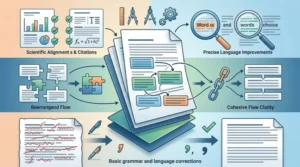
- Language editing: Refines sentence structure, word choice, and writing style to enhance clarity and readability
- Technical editing: Ensures accurate use of scientific terminology, proper citation formats, and correct presentation of data
- Proofreading: Catches remaining grammatical, typographical, and formatting errors before submission
- Compliance checking: Verifies that your manuscript adheres to target journal guidelines and formatting requirements
These editing phases work together to transform a draft manuscript into a polished, publication-ready scientific paper. San Francisco Edit specializes in this comprehensive approach, with native English-speaking PhD scientists who understand both the language requirements and the scientific content of your research.

Writing Effective Introductions That Engage Readers
Your Introduction must accomplish multiple objectives within a limited word count. Start with a broad statement about your research area, then progressively narrow the focus to your specific research question. This funnel approach helps readers understand the context before diving into details.
An effective Introduction typically includes these elements in order:
- Background information establishing the importance of your research topic
- Review of relevant literature identifying gaps or unanswered questions
- Statement of your research objectives or hypothesis
- Brief overview of your approach or methodology
- Significance of your expected findings or contributions
Avoid these common Introduction mistakes: making it too long, including excessive background information unrelated to your study, or failing to clearly state your research question. Remember that busy reviewers often decide whether to thoroughly evaluate your manuscript based on the quality of your Introduction.
Mastering the Discussion Section
The Discussion section is where you interpret your findings, explain their significance, and connect them to existing literature. Begin by restating your main findings without simply repeating the Results section. Then address whether your results support your hypothesis and how they compare to previous studies.
A strong Discussion follows this general structure:
- Summary of key findings
- Interpretation of results in the context of your research question
- Comparison with previous research findings
- Acknowledgment of study limitations
- Implications for theory, practice, or policy
- Suggestions for future research directions
Be honest about limitations without undermining the value of your work. Reviewers appreciate transparency and are more likely to trust conclusions when authors acknowledge constraints. Avoid overinterpreting results or making claims that extend beyond what your data can support.
Tables and Figures: Enhancing Data Presentation
Visual elements make complex data more accessible and improve reader comprehension. Each table and figure should present information that would be difficult to convey efficiently in text. Never duplicate the same data in both a table and figure; choose the format that best highlights your findings.
| Element Type | Best Used For | Key Requirements |
|---|---|---|
| Tables | Precise numerical values, multiple variables, comparisons | Clear column headers, consistent decimal places, explanatory footnotes |
| Line Graphs | Trends over time, continuous data, relationships between variables | Labeled axes, clear legends, appropriate scale selection |
| Bar Charts | Categorical comparisons, discrete data, group differences | Consistent spacing, error bars where appropriate, clear category labels |
| Scatter Plots | Correlations, distributions, outlier identification | Sufficient data points, regression lines when relevant, clear markers |
Caption quality matters significantly. Write captions that allow figures and tables to stand independently from the main text. Include all necessary information for interpretation: sample sizes, statistical tests used, abbreviation definitions, and units of measurement.
Avoiding Common Scientific Writing Mistakes
Even experienced researchers make preventable errors that weaken their manuscripts. Being aware of these common pitfalls helps you avoid them during the writing process:
Language and Style Errors
- Passive voice overuse: While passive voice is appropriate in Methods sections, excessive use throughout the manuscript makes writing dense and difficult to follow
- Unclear antecedents: Using pronouns like “this,” “it,” or “they” without clear referents confuses readers about what you’re discussing
- Inconsistent terminology: Switching between different terms for the same concept creates confusion
- Wordiness: Using complex phrases when simple words suffice reduces clarity and readability
- Tense inconsistencies: Each section typically uses a specific verb tense; mixing tenses inappropriately disrupts flow
Structural and Content Issues
- Insufficient connection between sections, making the manuscript feel disjointed
- Results appearing in Discussion or vice versa, violating journal formatting expectations
- Missing or inadequate statistical analyses that fail to support conclusions
- Overclaiming or overgeneralizing beyond what the data demonstrate
- Inadequate citation of relevant previous work, suggesting insufficient literature review
The Professional Editing Process for Scientific Papers
Professional scientific editing follows a systematic approach to improve manuscript quality while preserving the author’s voice and scientific message. The process typically occurs in phases, with each phase addressing specific aspects of the manuscript.
Phase One: Developmental Editing
This initial phase evaluates the manuscript’s overall structure and organization. Editors assess whether information flows logically, sections contain appropriate content, and arguments develop coherently. They identify gaps in logic, missing information, or sections that need expansion or condensation.
Developmental editing is particularly valuable for early-career scientists preparing their first manuscripts. It provides guidance on how to structure arguments, present data effectively, and meet journal expectations. This phase may result in substantial reorganization or rewriting.
Phase Two: Language and Style Editing
After addressing structural issues, editors focus on language quality. This includes correcting grammatical errors, improving sentence structure, enhancing clarity, and ensuring consistent terminology throughout the manuscript. Editors also verify that the writing style matches target journal requirements.
For non-native English speakers, this phase is crucial. Subject-specific editors who understand both the language and the science can communicate research effectively while maintaining technical accuracy. Language editing services ensure that linguistic barriers don’t prevent excellent research from being published.
Phase Three: Technical Review and Proofreading
The final editing phase catches remaining errors and verifies technical accuracy. This includes checking:
- Reference formatting and completeness
- Figure and table numbering and placement
- Consistency of abbreviations and nomenclature
- Accuracy of statistical reporting
- Compliance with journal-specific guidelines
- Formatting of supplementary materials
This meticulous attention to detail prevents desk rejections due to formatting errors and demonstrates professionalism to editors and reviewers.
How Editing Services Improve Acceptance Rates
Well-polished manuscripts are significantly more likely to pass initial editorial screening and proceed to peer review. When editors can focus on scientific content without being distracted by grammatical errors or structural problems, they evaluate the research more favorably.
| Manuscript Quality | Typical Outcome | Editorial Response |
|---|---|---|
| Poorly edited, numerous language errors | Desk rejection before peer review | Rejected without detailed evaluation |
| Moderate quality, some language issues | Sent for review but major revisions required | Multiple revision rounds needed |
| Well-edited, clear presentation | Proceeds to peer review smoothly | Minor revisions or conditional acceptance |
| Professionally edited, excellent quality | Fast-tracked through review process | Quick acceptance with minimal changes |
Professional editing also reduces the revision burden on authors. Manuscripts that undergo thorough editing before submission typically require fewer revision rounds, resulting in faster time to publication. This efficiency matters greatly in competitive research fields where timing affects impact.
Preparing Your Manuscript for Professional Editing
To maximize the value of professional editing services, prepare your manuscript thoroughly before submission to editors:
- Complete all sections: Don’t send incomplete drafts; editors work most effectively with full manuscripts
- Self-edit first: Correct obvious errors and address any gaps you’ve identified before professional editing
- Check references: Verify that all citations are complete and formatted consistently
- Review figures and tables: Ensure all visual elements are high quality and properly labeled
- Identify target journal: Know which journal you’re targeting so editors can check compliance with specific requirements
- Highlight concerns: Note any sections you’re particularly uncertain about so editors can give them extra attention
When selecting an editing service, choose one with subject-specific expertise. Generic editing services may improve language but miss scientific inaccuracies or field-specific conventions. San Francisco Edit employs native English-speaking PhD scientists with extensive experience in peer-reviewed publication, ensuring both language quality and scientific accuracy.
Understanding Journal-Specific Requirements
Different journals have varying formatting requirements, word limits, citation styles, and structural expectations. Before writing or editing your manuscript, carefully review your target journal’s author guidelines. Key elements to check include:
- Maximum word count for different article types
- Required sections and their organization
- Citation format (APA, AMA, Vancouver, etc.)
- Figure and table formatting specifications
- Abstract structure and word limits
- Keywords and metadata requirements
- Supplementary material guidelines
Formatting your manuscript correctly from the start saves time during revision and demonstrates attention to detail. Some journals immediately desk reject manuscripts that don’t follow basic formatting guidelines, regardless of scientific quality.
The Impact of Professional Editing on Research Careers
Publication success directly impacts academic careers, funding opportunities, and professional advancement. For early-career researchers, establishing a strong publication record is essential for securing positions and grants. Professional manuscript editing accelerates this process by increasing acceptance rates and reducing time to publication.
The benefits extend beyond individual papers. Working with experienced editors helps researchers develop better writing skills over time. Many authors report that feedback from professional editors improves their understanding of effective scientific communication, making subsequent manuscripts easier to write.
For research groups and universities, investing in professional editing services improves overall publication rates and research visibility. Higher publication rates in prestigious journals enhance institutional reputation and attract better funding opportunities.
Measuring Editing Quality and Success Rates
When evaluating editing services, look for concrete evidence of success. San Francisco Edit reports that 98 percent of edited papers were accepted and published, demonstrating the effectiveness of their editing approach. This exceptional success rate reflects the combination of linguistic expertise and scientific knowledge their editors bring to each manuscript.
| Service Quality Indicator | What to Look For | Why It Matters |
|---|---|---|
| Editor Qualifications | PhD-level scientists in relevant fields | Ensures understanding of technical content and field conventions |
| Publication Success Rate | Documented acceptance rates for edited manuscripts | Demonstrates editing effectiveness and quality |
| Turnaround Time | Clear estimates for standard and rush services | Helps you plan submission timelines effectively |
| Revision Support | Assistance with reviewer responses and revisions | Valuable for addressing peer review feedback |
Professional editing services should provide detailed feedback explaining changes and suggestions. This transparency helps authors understand improvements and learn from the editing process. Look for services that track all changes and provide explanations for significant modifications.
Addressing Reviewer Comments After Editing
Even well-edited manuscripts typically receive reviewer comments requiring revisions. Professional editors can assist with crafting responses to reviewer concerns and implementing requested changes while maintaining manuscript quality.
When responding to reviewers:
- Address every comment systematically, even if you disagree
- Provide clear explanations for any changes you decline to make
- Make requested additions or clarifications while maintaining conciseness
- Highlight all changes clearly so reviewers can easily locate them
- Maintain a respectful, professional tone in all responses
Some editing services offer revision support as part of their packages or as an additional service. This ensures consistency in writing quality throughout the revision process and helps authors navigate challenging reviewer requests.
Global Research and Language Barriers
Scientific research is increasingly international, with researchers from around the world contributing valuable discoveries. However, the dominance of English in scientific publishing creates barriers for non-native speakers. Studies show that papers with language issues face higher rejection rates regardless of scientific merit.
Professional editing services level the playing field by ensuring that language proficiency doesn’t limit publication opportunities. International researchers can focus on conducting excellent science while experienced editors ensure their manuscripts meet English-language publication standards.
San Francisco Edit works with researchers globally, understanding the unique challenges faced by non-native English speakers. Their editors have extensive experience collaborating with international scientists and publishing research in top-tier English-language journals.
The Economics of Professional Manuscript Editing
While professional editing represents an investment, the return is substantial when considering the costs of publication delays and rejection. Failed submissions mean lost time, delayed career progression, and reduced research impact. The relatively modest cost of professional editing significantly increases the probability of first-submission acceptance.
Consider these factors when evaluating editing costs:
- Time savings: Fewer revision rounds means faster publication and quicker progression to new projects
- Opportunity costs: Delayed publications can affect grant applications, promotion decisions, and research priority claims
- Learning value: Feedback from professional editors improves your writing skills for future manuscripts
- Stress reduction: Confidence in manuscript quality reduces anxiety during the submission and review process
Many researchers find that the investment in professional editing pays for itself through improved publication success and reduced revision burden. For research groups, establishing relationships with reliable editing services streamlines manuscript preparation across multiple projects.
Conclusion
Creating a publication-ready scientific research paper requires mastering multiple elements: clear structure, precise language, accurate data presentation, and meticulous attention to journal requirements. While these demands can seem overwhelming, professional manuscript editing transforms good research into excellent publications that successfully navigate the competitive peer review process.
The statistics speak clearly: well-edited manuscripts are significantly more likely to be accepted, require fewer revisions, and achieve publication faster than those with language or structural issues. For researchers at all career stages, partnering with experienced scientific editors removes barriers to publication success and allows you to focus on what matters most—conducting groundbreaking research.
Whether you’re a non-native English speaker overcoming language barriers, an early-career researcher preparing your first manuscript, or an established investigator managing multiple publications, professional editing services provide the expertise and quality assurance needed for competitive journal submission. The difference between rejection and acceptance often comes down to manuscript presentation, not scientific quality.
Ready to transform your manuscript into a publication-ready scientific paper? Submit your manuscript to San Francisco Edit today and join the 98% of authors who achieved publication success with our expert editing services. Our native English-speaking PhD scientists provide the specialized expertise needed to present your research with clarity, precision, and professionalism that meets the exacting standards of peer-reviewed journals.
FAQs
Q: What is the difference between self-editing and professional manuscript editing for scientific papers?
A: Self-editing focuses on correcting obvious errors and improving your own writing, while professional manuscript editing provides expert evaluation by PhD-level scientists who understand both language standards and field-specific conventions. Professional editors offer developmental feedback on structure, enhance clarity through language refinement, verify technical accuracy, and ensure compliance with journal requirements. This comprehensive approach addresses issues that authors often cannot identify in their own work, significantly increasing publication success rates.
Q: How long does the scientific paper editing process typically take?
A: Standard editing for scientific research papers typically requires 6-8 days, though rush services can complete projects in 3-4 days for urgent submission deadlines. The timeline depends on manuscript length, complexity, and the extent of editing needed. Developmental editing may require additional time if substantial restructuring is recommended. To ensure timely journal submission, plan to submit your manuscript for editing at least two weeks before your target submission date, allowing time for any author revisions after receiving edited content.
Q: Why do scientific papers get rejected despite having sound research?
A: Research quality alone does not guarantee publication success. Studies analyzing editor feedback show that scientific papers are frequently rejected due to poor language quality, unclear writing, grammatical errors, and structural problems that prevent reviewers from properly evaluating the research. Manuscripts with language issues face desk rejection before peer review, regardless of scientific merit. Additionally, failure to follow journal-specific formatting guidelines, inadequate literature review, or weak introductions that fail to establish research significance contribute to rejection rates even when the underlying research is excellent.
Q: What sections are essential in a scientific research paper?
A: Most scientific research papers follow the IMRD structure: Introduction (establishes research context and questions), Methods (describes procedures with sufficient detail for replication), Results (presents findings objectively with tables and figures), and Discussion (interprets results and explains significance). Additional required sections typically include an Abstract summarizing key points, References citing relevant literature, and Acknowledgments. Some journals require specific additional sections such as Conclusions, Limitations, or Implications. Always review your target journal’s author guidelines to ensure your manuscript includes all required sections in the proper format.
Q: How does professional editing improve chances of acceptance in high-impact journals?
A: Professional editing dramatically improves acceptance rates by ensuring manuscripts meet the exacting language and presentation standards of high-impact journals. Well-edited papers pass initial editorial screening more easily, allowing reviewers to focus on scientific merit rather than being distracted by grammatical errors or unclear writing. Professionally edited manuscripts typically require fewer revision rounds, demonstrate author professionalism, and present research with the clarity and precision that prestigious journals demand. Statistical evidence shows that edited manuscripts have significantly higher acceptance rates compared to unedited submissions, with some services reporting acceptance rates above 95%.