Key Takeaways
-
Weak literature reviews are a major cause of manuscript rejection (70% of rejected papers), typically due to poor synthesis and failure to identify research gaps rather than simply summarizing sources.
-
Organize your literature review thematically, methodologically, or chronologically—never source-by-source—and use critical evaluation to demonstrate analytical thinking, which correlates with 25% higher acceptance rates.
-
Structure your review to build toward a clear, specific research gap that justifies why your study is necessary, making gap-focused organization one of the most powerful formats for journal acceptance.
-
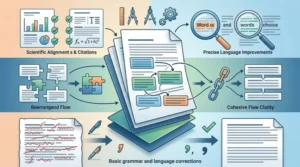
Professional manuscript editing improves acceptance by restructuring content, strengthening critical evaluation of sources, improving citation integration, and eliminating redundancy to meet journal word limits.
-
Choose your literature review type based on your research context: use thematic for social sciences, chronological for historical topics, methodological for novel approaches, and systematic for medical research requiring protocol rigor.
-
End your literature review with explicit gap identification and use transition sentences between paragraphs to ensure logical flow, as disconnected reviews and missing gap statements are frequent editor-flagged errors.
A well-crafted literature review can make or break your chances of publication. In fact, over 70% of rejected manuscripts cite a weak literature review as a contributing factor — often due to poor synthesis or missing research gaps. Yet many authors still treat this section as a simple summary of sources, which editors consistently flag as a critical error.
Whether you are preparing your first manuscript or refining your tenth, understanding what a strong example of a literature review in a research paper looks like is essential. This guide walks you through 10 practical examples and key editing strategies to help your review stand out during peer review.
For a broader look at how each section fits together, visit our guide on 10 Key Sections Every Research Paper Must Have in 2026.

What Makes a Literature Review Effective?
Before examining examples, it helps to understand what editors and reviewers look for. A strong literature review does not simply list sources — it synthesizes, evaluates, and positions your study within existing scholarship.
Effective literature reviews share these key qualities:
- They organize content by theme, methodology, or chronology — not source by source
- They critically evaluate each source’s strengths and weaknesses
- They identify gaps, debates, and inconsistencies in the existing literature
- They position the current study as a logical and necessary response to those gaps
- They maintain smooth transitions and analytical depth throughout
Literature reviews typically comprise 15–30% of a research paper’s total length, depending on journal requirements. Getting this section right is not optional — it is foundational. You can also explore the Research Paper Structure Essential Tips For Publishing for more context.

10 Examples of Literature Review Approaches in Research Papers
1. Thematic Literature Review
This is the most common structure in published research. Sources are grouped by theme or concept rather than by individual author. For example, a study on digital health interventions might group literature under themes like “patient engagement,” “data privacy,” and “clinical outcomes.”
Thematic organization appears in 60% of published social science reviews and has been linked to a 25% improvement in acceptance rates after editing. This approach demonstrates analytical thinking rather than passive reporting. Learn more about organizing your manuscript in our guide on How Do You Structure a Research Paper Correctly?
2. Chronological Literature Review
A chronological review traces how knowledge on a topic has evolved over time. It is particularly effective in fields like medicine or technology, where treatments or methods have changed significantly. For example, a review on antibiotic resistance might begin with foundational 1940s discoveries and progress through modern genomic approaches.
The key is to frame each time period as a step toward your current research question — not just a timeline. Editors often revise these sections to strengthen the narrative arc and avoid simple date-listing.
3. Methodological Literature Review
In a methodological review, sources are compared based on the research methods they used. This is valuable when your paper introduces a novel approach. For example, a study on pain measurement might compare self-report scales, imaging techniques, and biomarkers across prior research.
This format highlights the limitations of existing methods and justifies why your methodology offers improvement. Strong manuscript editors ensure the critique is balanced and specific, not vague. Explore Writing A Research Methodology Section Best Practices For Clarity And Precision for related guidance.
4. Theoretical Literature Review
A theoretical review maps the evolution of frameworks and models in a field. For instance, a paper on migration behavior might trace shifts from push-pull theory to transnationalism and social capital frameworks. This type is common in social sciences, education, and psychology.
The goal is to show which theoretical framework your study adopts and why it is most appropriate. Editing this section often involves tightening the conceptual linkages and removing redundant theoretical descriptions.
5. Systematic Literature Review
Systematic reviews use a defined, reproducible search strategy to identify and evaluate all relevant studies on a topic. They are especially prevalent in medical and clinical research. Studies are screened using inclusion/exclusion criteria, and findings are synthesized with statistical rigor.
Editors working on systematic reviews focus on protocol clarity, PRISMA compliance, and unbiased source selection. Databases like PubMed are commonly used to source peer-reviewed studies for this format.
6. Conceptual Literature Review
A conceptual review synthesizes existing work to develop a new framework or model. Rather than reviewing empirical findings, it focuses on how ideas relate to each other. For example, a paper on organizational resilience might synthesize definitions from management, psychology, and systems theory into a unified conceptual model.
This format requires strong critical synthesis skills. Editors help authors avoid over-reliance on definitions and push them toward genuine conceptual contribution. See how How to Write a Scientific Review Article That Gets Published addresses similar challenges.
7. Integrative Literature Review
Integrative reviews bring together diverse types of evidence — qualitative and quantitative — to develop a broader understanding of a topic. They are widely used in nursing and public health research. For example, a review on caregiver burnout might synthesize survey data, interview studies, and observational research.
The challenge here is coherence. Editors ensure that diverse evidence types are compared fairly and that conclusions reflect the full breadth of evidence without overgeneralizing.
8. Scoping Literature Review
A scoping review maps the breadth of literature on a topic, often as a precursor to a systematic review. It does not evaluate quality rigorously but identifies what types of research exist. For example, a scoping review on telehealth adoption might simply categorize studies by country, population, and technology type.
In manuscript editing, this section often needs restructuring to clearly distinguish scope from synthesis. Authors frequently confuse breadth mapping with critical evaluation — a distinction editors must clarify.
9. Gap-Focused Literature Review
This type is structured specifically to build toward an identified research gap. Every paragraph connects existing evidence to what remains unknown. For example, a study on adolescent mental health might review prevalence data, intervention studies, and follow-up outcomes — ultimately revealing a gap in long-term digital intervention research.
This is one of the most powerful structures for journal submission because it directly justifies the need for the current study. Editors at San Francisco Edit frequently help authors sharpen gap identification to increase acceptance rates. You can also review Reasons Why Scientific Manuscripts Are Rejected By Journals to understand how weak gap statements hurt submissions.
10. APA-Style Grouped Literature Review
An APA-style review groups sources by related concepts and synthesizes their findings efficiently — often citing multiple studies within a single sentence. For example: “Several studies have reported significant improvements in cognitive outcomes following early intervention (Smith et al., 2021; Patel & Nguyen, 2022; García, 2023).”
This format is common in psychology and education journals, where space is limited. Editors focus on avoiding annotated bibliography-style writing and ensuring each paragraph builds a coherent argument across grouped sources. The Using Examples And Citations Effectively In Research Papers guide offers additional citation strategies.

Common Mistakes Editors Identify in Literature Reviews
Even experienced researchers make errors that weaken their literature review. Understanding these mistakes helps you avoid them before submission.
| Common Mistake | Why It Hurts Acceptance | How Editing Fixes It |
|---|---|---|
| Source-by-source summaries | Reads like an annotated bibliography, not a synthesis | Reorganized into thematic or conceptual groupings |
| Missing research gaps | Fails to justify the study’s contribution | Gap statements added and sharpened |
| No critical evaluation | Shows surface-level engagement with literature | Strengths and weaknesses of sources added |
| Outdated sources only | Suggests unfamiliarity with current debates | Recent literature integrated strategically |
| Poor transitions between paragraphs | Review feels disconnected and hard to follow | Linking sentences and signposting language added |
| Excessive length | Wastes journal word count | Redundancies removed, sources grouped concisely |

How Professional Manuscript Editing Strengthens Literature Reviews
Many authors know what their review should do but struggle to execute it at a publication-ready level. This is especially true for non-native English speakers and early-career researchers. Professional manuscript editing bridges this gap.
Here is what a manuscript editor typically does to improve a literature review:
- Restructures the organization — Moving from source-by-source to thematic or gap-focused structure
- Strengthens critical evaluation — Adding commentary on sample sizes, methodological limitations, and conflicting findings
- Improves citation integration — Embedding references naturally within analytical sentences rather than appending them
- Sharpens transition language — Ensuring each paragraph flows logically into the next
- Eliminates redundancy — Removing repeated points that waste word count in space-limited journals
- Highlights the research gap — Ensuring the review builds convincingly toward the study’s justification
San Francisco Edit provides expert manuscript editing by PhD-trained native English scientists. With a 98% publication success rate and over 325 years of combined editorial experience, the team helps researchers at every stage transform their literature reviews into publication-ready sections. You can read what clients say on the San Francisco Edit testimonials page.
Structural Tips for Writing a Strong Literature Review
Whether you are writing from scratch or revising an existing draft, these structural principles improve every type of literature review:
- Begin with a brief overview sentence that tells readers how the review is organized
- Group sources by theme, theory, or method — never by author name alone
- Use evidence from multiple sources in each paragraph to demonstrate synthesis
- Include contrasting findings to show awareness of ongoing debates
- End each thematic paragraph with a connecting sentence that builds toward your gap
- Close the entire review with a clear, specific gap statement that justifies your study
For further reading on structuring academic manuscripts, the San José State University Writing Center guide on literature reviews is a reliable resource. You can also explore the Literature Search Strategies In Science A Step By Step Approach to strengthen your source selection before writing begins.
Literature Review Structure: A Quick Comparison
| Review Type | Best Used For | Primary Organizing Principle |
|---|---|---|
| Thematic | Social sciences, education, health | Concepts or topics |
| Chronological | Historical or evolutionary topics | Time periods |
| Methodological | Studies with a novel method | Research approaches |
| Theoretical | Framework-driven fields | Theories and models |
| Systematic | Medical, clinical, evidence-based fields | Defined search protocol |
| Gap-Focused | Any field requiring strong study justification | Missing knowledge |
For guidance on the specific language used in academic publishing, the Scribbr guide to writing a literature review is a widely respected reference. Additionally, if your manuscript includes non-native English writing, explore Scientific Editing For Non Native English Speakers for specialized support.
Steps to Revise Your Literature Review Before Submission
Before you submit your manuscript, use this checklist to evaluate your literature review:
- Confirm the review is organized thematically, methodologically, or chronologically — not source by source
- Verify that each paragraph synthesizes at least two or three sources into a unified point
- Check that you have critically evaluated sources rather than just summarized them
- Ensure at least one clear research gap is identified and stated explicitly
- Review transition sentences between paragraphs for logical flow
- Trim redundant sentences to meet journal word count requirements
- Confirm all in-text citations follow the required style (APA, Vancouver, etc.)
If you are unsure whether your review meets journal standards, consider professional editing before submission. Our knowledge center also offers free guidance on manuscript preparation across all sections.
Conclusion
A strong literature review is far more than a list of sources. It is a carefully constructed argument that positions your research as necessary, relevant, and timely. From thematic groupings to gap-focused structures, the 10 examples above show how different approaches serve different research contexts — and how professional editing sharpens each one.
Whether you are an early-career researcher navigating your first submission or an experienced academic managing multiple manuscripts, getting your literature review right significantly improves your chances of acceptance. The team at San Francisco Edit specializes in exactly this kind of targeted manuscript improvement.
Ready to strengthen your manuscript? Submit your manuscript for expert editing and let our PhD scientists help you achieve publication-ready quality.
FAQs
Q: What is a good example of a thematic literature review in a research paper?
A: A thematic literature review groups sources by topic rather than by individual author. For example, a study on chronic disease management might organize literature under themes such as patient adherence, pharmacological interventions, and lifestyle modifications — synthesizing multiple sources under each heading to build a coherent argument.
Q: How do manuscript editors improve a literature review section?
A: Professional manuscript editors restructure source-by-source summaries into thematic or gap-focused sections, sharpen critical evaluations, improve citation integration, and ensure clear transitions between paragraphs. These changes make the review more analytical and aligned with the standards of peer-reviewed journals.
Q: What is the difference between a chronological and a methodological literature review?
A: A chronological review organizes literature by time period to trace how knowledge on a topic has evolved, while a methodological review compares sources based on the research methods they used. The choice depends on whether the study’s contribution is primarily temporal context or a novel research approach.
Q: How do you identify and highlight a research gap in a literature review?
A: Research gaps are identified by critically evaluating existing studies for unresolved questions, conflicting findings, underrepresented populations, or methodological limitations. A well-edited literature review builds systematically toward the gap statement, ensuring it is specific, supported by the reviewed evidence, and directly tied to the current study’s purpose.
Q: How long should a literature review be in a research paper?
A: Literature reviews typically comprise 15–30% of a research paper’s total length, though the exact proportion depends on journal guidelines and manuscript type. Editors ensure the section is concise enough to meet word count restrictions while retaining sufficient depth to demonstrate critical engagement with the field.