Key Takeaways
-
Write your background section last, after completing Methods, Results, and Discussion, so you can accurately identify which prior studies are most relevant and how your findings connect to existing literature.
-
Explicitly state the research gap using direct language such as ‘No studies to date have examined…’ or ‘Current evidence does not address…’ since vague gap statements weaken your entire argument.
-
Build a logical narrative arc that flows from broad context to specific gap to your study’s rationale, reading as a coherent story rather than a disconnected list of citations.
-
Critically evaluate prior research by highlighting strengths and limitations rather than simply listing studies, demonstrating analytical thinking and building a persuasive case for your study.
-
Ensure your final sentences transition smoothly to your study’s objectives so readers feel your research logically follows from the background, transforming a good background into a great one.
-
Tailor your background to your target journal’s audience and scope, adjusting explanation levels and assuming appropriate reader knowledge to improve relevance and acceptance chances.
The background section of a research manuscript is one of the most critical components of the entire paper. It sets the stage for your study, contextualizes your findings, and convinces journal editors that your work matters. Yet many authors underestimate its importance — or struggle to get it right. A weak writing background can lead to desk rejection before reviewers ever read your methods or results.
Whether you are a PhD candidate submitting your first paper or an experienced clinician publishing clinical findings, this guide provides 13 actionable tips to strengthen your manuscript’s background section. Each tip reflects best practices used by professional manuscript editors to help authors improve their chances of acceptance in peer-reviewed journals.

What Is the Writing Background in a Research Manuscript?
In manuscript editing, “writing background” refers specifically to crafting the background portion of a research paper’s Introduction. This section provides context for the study, summarizes relevant prior research, identifies gaps in the literature, and justifies why the current study is necessary. It is embedded within the IMRaD structure (Introduction, Methods, Results, and Discussion) that governs most scientific and medical publications.
A well-edited background section does more than summarize literature. It builds a logical argument that leads readers — and journal editors — directly to your research question. For guidance on how the background fits within the larger manuscript, explore key elements every scientist should know about writing an introduction for publication.

Why a Strong Background Section Matters
Journal editors and peer reviewers form their first impressions from your Introduction. A compelling background signals expertise, rigor, and relevance. It demonstrates that you understand the field and have identified a genuine gap worth investigating.
Conversely, a vague or disorganized background raises red flags. According to PubMed-indexed research on manuscript rejection, poor preparation and unclear problem framing are among the top reasons papers are rejected before peer review. Your background section must work hard from the very first paragraph.

13 Expert Tips for Writing an Effective Background Section
1. Write the Background Last
Counterintuitively, the best time to write your background is after you have completed your Methods, Results, and Discussion sections. This approach allows you to incorporate all the insights gained during your research. You will know exactly which prior studies are most relevant and how your findings connect to existing literature.
2. Start with the Broad Context
Begin your background by placing your study within the wider field. Introduce the general topic before narrowing down to your specific research question. This funnel-shaped structure helps readers — including those unfamiliar with your niche — understand why your work is relevant.
For additional structure guidance, review how to structure a research paper correctly.
3. Identify and State the Research Gap Clearly
The most important function of the background section is identifying what is missing in the current literature. Be explicit about this gap. Use direct language such as “No studies to date have examined…” or “Current evidence does not address…” A vague gap statement weakens your entire argument.
4. Summarize Prior Research Critically
Do not simply list previous studies. Critically evaluate them. Highlight their strengths and limitations. Show how they collectively point toward the need for your research. This demonstrates analytical thinking and builds a persuasive case for your study’s contribution.
5. Define Key Terms and Concepts Early
If your study involves specialized terminology, interdisciplinary concepts, or theories that may be unfamiliar to your target audience, define them early in the background. This is especially important for non-native English-speaking authors and researchers writing across disciplines.
6. Maintain a Logical Narrative Arc
Your background should read as a coherent story, not a disconnected list of citations. Each paragraph should build on the previous one. The narrative should flow from broad context to specific gap to your study’s rationale. Professional editors frequently restructure backgrounds to establish this logical arc.
7. Tailor the Background to Your Target Journal
Different journals serve different audiences. A background written for a highly specialized journal can assume more reader knowledge than one aimed at a broader readership. Research your target journal’s scope and adjust your level of explanation accordingly. This targeted approach improves relevance and increases acceptance chances.
8. Avoid Excessive Length and Redundancy
A common mistake is making the background too long. Include only what is directly relevant to your study. Eliminate redundant statements and avoid restating the same point in multiple ways. Editors at services like San Francisco Edit frequently trim background sections to remove extraneous content that dilutes focus and reader engagement.
9. Use Current and Authoritative Citations
Your citations must be current, relevant, and from credible sources. Outdated references suggest a lack of engagement with the current literature. Aim to include recent landmark studies alongside foundational works. Databases such as PubMed and Google Scholar are essential tools for comprehensive literature searches.
10. Craft a Clear Problem Statement
Closely linked to your research gap is a clear problem statement. This is a concise articulation of the specific problem your study addresses. A strong problem statement focuses reader attention and signals scholarly rigor. For detailed guidance, explore how to define your research goals through a problem statement.
11. Connect the Background to Your Study’s Objectives
The final sentences of your background should transition smoothly into your study’s aims or objectives. The reader should feel that your research logically and inevitably follows from everything you have described. This connection transforms a good background into a great one.
12. Edit for Consistency and Factual Accuracy
Fact-check every claim in your background. Ensure that all statistics, dates, and study findings are accurately reported. Inconsistencies between the background and other manuscript sections confuse reviewers and damage credibility. A professional editor will cross-check these details thoroughly.
13. Seek Professional Structural Editing
Even experienced researchers benefit from structural editing of their background sections. A professional editor identifies gaps in logic, removes redundancy, improves flow, and ensures the section meets journal standards. This level of polish can be the difference between acceptance and rejection.

Common Mistakes to Avoid When Writing a Background Section
Understanding what not to do is just as important as knowing best practices. Here are the most frequent pitfalls authors encounter:
- Vague problem statements that fail to specify what is missing in the literature
- Over-reliance on secondary sources instead of primary research articles
- Lack of critical analysis — simply listing studies without evaluating them
- Ignoring the target audience by pitching the explanation at the wrong level
- Missing the connection between the literature review and the study’s rationale
- Failing to update citations to reflect the most current research
For a comprehensive look at what causes manuscripts to fail at the journal level, read about the most common reasons scientific manuscripts are rejected by journals.
How Editors Improve the Writing Background
Professional manuscript editors approach the background section in a structured, multi-stage process. Understanding this process helps authors prepare stronger first drafts.
| Editing Stage | Focus Area | Outcome |
|---|---|---|
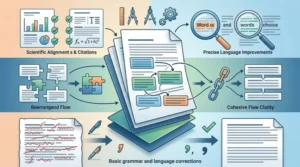
| Structural Edit | Narrative arc, logical flow, section organization | Coherent, persuasive argument |
| Content Edit | Gap identification, critical analysis, relevance of citations | Clear justification for the study |
| Line Edit | Redundancy, sentence clarity, consistency | Concise, precise language |
| Proofread | Grammar, spelling, factual accuracy | Error-free, credible text |
This systematic approach ensures the background section is not only well-written but also strategically positioned to influence editorial decisions. For more on what professional editing involves, visit the San Francisco Edit knowledge center.
Key Elements Every Background Section Must Include
A strong writing background consistently incorporates the following elements:
- Broad contextual framing — the wider field or problem area
- Summary of prior research — what is already known
- Identification of research gaps — what remains unanswered
- Justification of the study — why this research matters now
- Transition to study objectives — a bridge to the research question or hypothesis
These five elements create a complete, persuasive argument that supports everything that follows in the manuscript. Learn more about how to write the background of your scientific paper with detailed guidance tailored to researchers at every career stage.
Background Section vs. Literature Review: Key Differences
Authors sometimes confuse the background section with a full literature review. These are distinct in scope and purpose:
| Feature | Background Section | Literature Review |
|---|---|---|
| Location | Within the Introduction | Standalone section or chapter |
| Length | Concise (a few paragraphs) | Extensive (multiple pages) |
| Purpose | Justify the current study | Synthesize the field comprehensively |
| Depth of Analysis | Selective and focused | Broad and systematic |
| Common in | Journal articles | Theses, dissertations, review articles |
Understanding this distinction prevents authors from over-loading their introduction with unnecessary detail. For guidance on related introductory components, explore the differences between abstract vs introduction in research manuscripts.
Writing Background for Different Manuscript Types
The approach to writing background varies depending on the type of manuscript being prepared:
- Original research articles — focus on the literature gap and study justification
- Review articles — broader framing of the field’s development over time
- Case reports — brief contextual background explaining why the case is noteworthy
- Theses and dissertations — more extensive treatment of historical and theoretical context
- Grant applications — background emphasizes significance and innovation for funding bodies
Each manuscript type requires a tailored approach. For specific guidance on case reports, see guidelines for writing medical case reports.
How Non-Native English Authors Can Strengthen Their Background
For researchers whose primary language is not English, the background section presents unique challenges. Expressing nuanced critical analysis and logical argumentation in a second language requires both linguistic precision and academic fluency.
Here are practical steps non-native English authors can take:
- Write a complete draft in your native language first, then translate and refine
- Use published articles in your target journal as model examples of background writing
- Focus on clarity over complexity — simple, direct sentences are always preferred
- Work with a native English-speaking professional editor to refine your final draft
Professional language editing services play a crucial role in helping international researchers communicate their work with the precision required by top-tier journals. San Francisco Edit’s team of native English-speaking PhD scientists has decades of experience supporting non-native authors through this process.
The Role of Professional Editing in Strengthening Your Background
Even a well-researched background section benefits significantly from professional editing. Structural edits refine the narrative arc. Line edits improve clarity and remove redundancy. Fact-checking ensures accuracy. Together, these improvements elevate the entire manuscript’s quality and credibility.
San Francisco Edit provides expert scientific editing and language editing services that address every layer of the background section. With a 98% publication success rate among edited manuscripts and more than 325 combined years of editing experience across our staff, we understand exactly what journal editors and reviewers expect to see.
Read what authors say about their experience by visiting our testimonials page.
Conclusion
A well-crafted writing background is the foundation of a successful research manuscript. It provides context, builds your argument, identifies the research gap, and prepares reviewers to appreciate your study’s value. By following these 13 expert tips — and working with professional editors where needed — you give your manuscript the strongest possible foundation for publication.
Do not let a weak background section undermine years of rigorous research. Take the next step toward a polished, publication-ready manuscript by working with an expert editing team. Submit your manuscript today and let San Francisco Edit help you achieve the publication success your research deserves.
FAQs
Q: What is the background section in a research manuscript?
A: The background section is part of the Introduction in a research manuscript. It provides context for the study, summarizes relevant prior research, identifies gaps in the literature, and justifies why the current study is necessary. It is a critical component of the IMRaD structure used in most scientific and medical journals.
Q: When should I write the background section of my manuscript?
A: It is best to write the background section last, after completing your Methods, Results, and Discussion sections. This allows you to fully understand which prior studies are most relevant and how your findings connect to the existing literature, resulting in a more focused and accurate background.
Q: How long should the background section of a research paper be?
A: The background section should be concise and focused. For a standard journal article, it typically spans a few well-organized paragraphs within the Introduction. Include only information that is directly relevant to your research question and gap — avoid unnecessary detail that dilutes the section’s persuasive impact.
Q: How does professional editing improve a manuscript’s background section?
A: Professional editors improve the background section through structural edits that refine narrative flow, content edits that clarify the research gap, line edits that eliminate redundancy, and proofreading that ensures factual accuracy. These combined improvements create a stronger, more persuasive argument that positively influences journal editors and peer reviewers.
Q: What are the most common mistakes in writing a research background?
A: The most common mistakes include vague problem statements, over-reliance on secondary sources, failure to critically analyze prior studies, ignoring the target audience’s knowledge level, missing a clear connection between the literature and the study’s rationale, and using outdated citations. Professional manuscript editing helps identify and correct all of these issues.