Key Takeaways
-
Define your central message in one sentence answering: what you studied, what you found, and why it matters—if you cannot do this, your manuscript needs further focus.
-
A clear central message improves clarity, coherence, conciseness, impact, and readability, directly addressing the leading reason manuscripts are rejected: unclear writing.
-
Use structural editing to ensure your introduction, body, and conclusion align with the central message, removing sections that drift from the main argument.
-
Test clarity by asking colleagues unfamiliar with your work to summarize the paper’s point after reading the abstract and introduction—their answer reveals how clearly the central message comes through.
-
Remove tangential findings, overly detailed methodology, lengthy limitation discussions, and speculative statements that distract from your central message and weaken publication prospects.
-
Distinguish between your thesis statement (formal claim in introduction) and central message (broader takeaway reinforced throughout)—a strong thesis is the seed that grows into your central message.
Every great manuscript has one thing at its core: a clear central message. This is the single idea you want readers to take away. In manuscript editing, it acts as a compass. It guides every section, every paragraph, and every sentence toward one unified purpose.
Many authors struggle to define their central message clearly. Research may be strong, but if the core idea is buried under unnecessary detail, reviewers may reject the paper. A strong central message improves readability, coherence, and your chances of publication in a peer-reviewed journal.
This guide explains what the central message means in manuscript editing, why it matters, and how you can sharpen it at every level of your writing. Whether you are preparing your first manuscript or revising a complex research paper, understanding and strengthening your central message is one of the most important steps you can take.

What Is the Central Message in a Manuscript?
The central message is the main takeaway of your manuscript. It is the one idea that your entire paper supports. In academic writing, it may closely resemble your thesis statement or core argument. But it goes beyond just a claim. It tells readers why your work matters and what they should remember after reading it.
In manuscript editing, the central message is used as a benchmark. Editors evaluate every section of a paper against this core idea. If a section does not support or connect to the central message, it may need to be revised or removed. For more on determining a central message for a scientific article, this approach is the foundation of focused scientific writing.
Think of the central message as the answer to this question: “What is the one thing I want my reader to know?” If you cannot answer that in one sentence, your manuscript may need further focus.

Why the Central Message Matters for Publication
Journal reviewers read dozens of manuscripts. They look for papers that are clear, focused, and well-argued. A manuscript without a clear central message often feels disorganized. Reviewers may struggle to understand the paper’s purpose, which can lead to rejection.
A well-defined central message improves several aspects of your manuscript at once:
- Clarity: Readers understand the purpose of the paper from the start.
- Coherence: Every section connects logically to the main argument.
- Conciseness: Irrelevant content is easier to identify and remove.
- Impact: The paper’s contribution to the field is easier to recognize.
- Readability: The manuscript flows more naturally from start to finish.
According to research cited by editing professionals, poor English and unclear writing are among the leading reasons manuscripts are rejected by peer-reviewed journals. Strengthening your central message is one direct way to address this problem. You can explore more reasons for rejection in this resource on reasons why scientific manuscripts are rejected by journals.

How to Identify the Central Message of Your Manuscript
Before you can strengthen your central message, you need to identify it clearly. Use the following steps to find it in your existing manuscript.
- Read your abstract first. Your abstract should summarize the central message in a few sentences. If it does not, this is your first area to address.
- Look at your introduction’s final paragraph. Most well-structured introductions end with the purpose statement. This often reveals the intended central message.
- Check your conclusion. What does your conclusion say the paper has shown? This should match your central message exactly.
- Write one sentence. Summarize the entire manuscript in a single sentence. If you cannot do this easily, the central message may not yet be clear enough.
- Ask a colleague. Have someone unfamiliar with your work read the abstract and introduction. Ask them to summarize the paper’s point. Their answer reveals how clearly the central message comes through.
This exercise is commonly used by professional editors. At San Francisco Edit, editors work with authors to define and sharpen the central message before addressing sentence-level changes. This top-down approach ensures that structural revisions serve the paper’s core purpose.

How Manuscript Editing Strengthens the Central Message
Professional manuscript editing improves the central message at multiple levels. Each stage of the editing process targets a different layer of clarity and focus.
Structural Editing and the Central Message
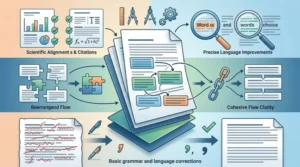
Structural editing looks at the big picture. It checks whether the introduction, body, and conclusion all align with the central message. Editors look for sections that drift away from the main argument. They also check whether the logical flow supports the paper’s core claim.
Common structural problems that obscure the central message include:
- Background sections that are too long and delay the main argument
- Results sections that present data without linking it back to the research question
- Discussion sections that introduce new topics not related to the central message
- Conclusions that summarize findings but fail to reinforce the main takeaway
If your discussion section needs improvement, review this guide on 7 key steps to write a strong discussion section. A well-written discussion always returns to the central message of the paper.
Line Editing and Clarity at the Sentence Level
Line editing refines how the central message is expressed at the sentence level. This includes improving word choice, sentence structure, transitions, and tone. Vague language weakens the central message. Strong, precise language makes it stand out.
Line editors look for and correct:
- Vague or ambiguous phrasing that confuses the main argument
- Redundant sentences that repeat ideas already stated
- Weak transitions that break the logical flow between paragraphs
- Passive constructions that hide the subject and reduce clarity
For researchers writing in English as a second language, this stage is especially important. Language editing by native English-speaking PhD scientists ensures that precision and tone support the central message throughout the manuscript.
Copyediting and Consistency
Copyediting ensures that terminology, style, and formatting are consistent. Inconsistent terminology can confuse readers and weaken the perceived focus of the paper. When the same concept is described with different terms in different sections, the central message becomes harder to follow.
A copyeditor checks that:
- Key terms are used consistently throughout
- The tone and voice remain appropriate for the journal audience
- Figures, tables, and headings align with the manuscript’s main argument
- Formatting meets the target journal’s requirements
The Central Message vs. the Thesis Statement
Many researchers ask about the difference between a central message and a thesis statement. They are related but not identical. Understanding the distinction helps you use both more effectively.
| Feature | Thesis Statement | Central Message |
|---|---|---|
| Definition | A formal claim or argument stated early in the paper | The key takeaway the reader should remember |
| Location | Usually in the introduction | Expressed throughout the entire manuscript |
| Function | Sets up the argument the paper will prove | Ties the entire paper together as a unified message |
| Tone | Often formal and declarative | Can be broader and more conceptual |
| Scope | Narrow and specific | Broader, connecting all sections of the paper |
In practice, a strong thesis statement is the seed of the central message. As you revise and edit, the central message grows to encompass the full scope of the paper’s contribution. Learning how to write a manuscript that gets published involves understanding both concepts and using them together.
Common Problems That Weaken the Central Message
Even experienced researchers make writing mistakes that obscure the central message. Below are the most common issues, along with editing strategies to address them.
- Trying to argue too many points at once. A manuscript with multiple competing arguments confuses readers. Focus on one central message and let all supporting points reinforce it.
- Including irrelevant background information. Long literature reviews that do not connect to the research question dilute the central message. Every reference should justify its presence.
- Burying the main finding. Some authors present their most important result deep in the paper. The central message should be stated clearly in the abstract, introduction, and conclusion.
- Using hedging language excessively. Phrases like “it might be possible that” and “there could be some suggestion” weaken the central message. State your conclusions with appropriate confidence.
- Failing to connect results to the research question. Every result should link back to the central question and the paper’s main argument. If a result does not do this, consider whether it belongs in the paper.
Professional scientific editing helps authors identify and resolve these problems systematically. A trained editor can spot issues that authors often miss simply because they are too close to their own work.
How to Test Whether Your Central Message Is Clear Enough
There is a simple test that professional editors use. Ask yourself: can I state the central message of my manuscript in one sentence? This sentence should answer three things:
- What did you study or investigate? Identify the subject of the research clearly.
- What did you find or argue? State the main result or claim in plain language.
- Why does it matter? Explain the significance of the finding for the field.
If your one-sentence summary is unclear, overly long, or covers multiple topics, the manuscript needs further focus. This test is one of the most effective revision strategies used in professional manuscript editing. Researchers preparing for their first submission can benefit from reading about 11 essential steps to write a manuscript for publication, which includes guidance on building a focused central argument from the start.
For additional guidance on how to structure your manuscript effectively, PubMed provides access to thousands of published research articles across scientific and medical disciplines. Reading well-published papers in your field is one of the best ways to understand how a clear central message is expressed in practice.
What Editors Remove to Protect the Central Message
A key part of manuscript editing is removing content that distracts from the central message. Many authors are reluctant to cut material they worked hard to produce. However, removing irrelevant content almost always improves the overall quality of the manuscript.
Editors commonly recommend removing or revising the following:
- Tangential findings that do not support the main argument
- Overly detailed methodology sections that shift focus away from the results
- Lengthy discussions of limitations that overwhelm the positive findings
- Repetitive sentences that restate the same point multiple times
- Speculative statements that are not supported by the data presented
The goal is a manuscript that is precise, focused, and publication-ready. You can learn more about this process by exploring the knowledge center at San Francisco Edit, which offers in-depth resources on all aspects of manuscript preparation and editing.
External research also supports the importance of focused scientific writing. The World Health Organization and other major research institutions emphasize that clear scientific communication is essential for advancing medical and public health knowledge. A manuscript with a clear central message contributes directly to that goal.
Getting Professional Help to Strengthen Your Central Message
Sometimes, authors need an outside perspective to see where the central message is unclear. This is where professional manuscript editing makes the greatest difference. An experienced editor brings objectivity and expertise that authors cannot provide for their own work.
San Francisco Edit offers professional editing and proofreading by native English-speaking PhD scientists. With a 98 percent publication success rate and more than 325 years of combined staff experience, the team is equipped to help authors at all stages of manuscript preparation. From identifying a weak central message to polishing the final draft, every aspect of the editing process is designed to improve publication outcomes.
Services are available for journal articles, grant applications, theses, dissertations, and more. Turnaround times are approximately 6 to 8 days for standard projects and 3 to 4 days for rush submissions. All editing is done by humans, not automated tools, ensuring that context, nuance, and argument are handled with care. You can read what authors have said about their experience on the testimonials page.
Academic institutions, including major research universities, also emphasize the importance of clear scientific writing. Resources from institutions such as the University of Wisconsin Writing Center confirm that focused, well-structured arguments are central to successful academic publication.
Conclusion
The central message is the foundation of every successful manuscript. Without it, even strong research can fail to communicate its value. With it, your paper becomes easier to read, easier to evaluate, and more likely to be published.
Identifying your central message early, testing it regularly, and aligning every section of your manuscript with it are the most effective steps you can take before submission. Professional editing reinforces this process by offering expert, objective review at every level of the manuscript.
If you are ready to refine your manuscript’s core argument and improve your chances of publication, take the next step today. Submit your manuscript for professional editing and work with a team that understands what it takes to get published in the world’s leading peer-reviewed journals.
FAQs
Q: What does central message mean in manuscript editing?
A: In manuscript editing, the central message is the single most important idea the author wants readers to take away from the paper. It serves as a benchmark against which every section, argument, and piece of evidence is evaluated to ensure alignment and focus.
Q: How do you identify the central message of a manuscript?
A: The most effective method is to summarize the entire manuscript in one clear sentence that answers what was studied, what was found, and why it matters. Editors also check the abstract, introduction, and conclusion for alignment, as these sections should all reflect the same central message.
Q: What is the difference between a central message and a thesis statement?
A: A thesis statement is a formal claim stated in the introduction, while the central message is the broader takeaway that is expressed and reinforced throughout the entire manuscript. The thesis sets up the argument; the central message unifies the whole paper around that argument.
Q: Can manuscript editing help strengthen the core argument of a paper?
A: Yes. Professional manuscript editing evaluates the structure, language, and consistency of the paper to ensure that the core argument is clear and well-supported at every level. Editors identify sections that weaken or contradict the central message and recommend targeted revisions.
Q: What should be removed if it distracts from the central message?
A: Content that should be removed includes tangential findings, overly detailed background information, speculative statements unsupported by data, and repetitive passages that do not add to the main argument. Removing this material makes the manuscript more focused and easier for reviewers to evaluate.