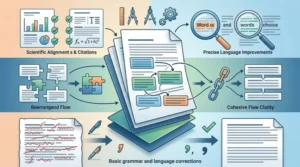
Key Takeaways
-
Write your abstract only after completing the full manuscript, extracting one key sentence from each major section (Introduction, Methods, Results, Discussion) to form the foundation of your summary.
-
Include all six core elements in every abstract: background/context, research gap, objective, methods, results/findings, and implications—missing any weakens the abstract significantly.
-
Follow your target journal's specific word count (typically 150–300 words) and format requirements (structured vs. unstructured); exceeding limits is a common reason manuscripts are desk-rejected without review.
-
Use specific, quantitative language and active voice instead of vague phrases like 'results were significant'; remove all citations, undefined abbreviations, and avoid repeating your title word-for-word.
-
Understand discipline-specific differences: STEM abstracts emphasize methods and quantitative data in labeled sections, while humanities abstracts flow as single narrative paragraphs focusing on thesis and argument.
-
Have a colleague or professional editor review your abstract before submission to catch errors, improve clarity, and ensure compliance with journal-specific guidelines and publication standards.
Your abstract is the first thing journal editors, reviewers, and readers see. It can determine whether your manuscript gets read or rejected. A weak abstract — even for a groundbreaking study — can cost you a publication opportunity. Yet many researchers, especially those early in their careers or writing in a second language, struggle to write clear, concise abstracts that meet journal standards. This guide walks you through exactly how to write an abstract with examples drawn from real manuscript scenarios, covering structure, word count, discipline-specific variations, and common mistakes to avoid. Whether you are submitting to a high-impact medical journal or a specialized STEM publication, mastering the abstract is an essential step toward successful publication.

What Is a Research Paper Abstract?
An abstract is a brief, standalone summary of your entire manuscript. It typically appears at the top of your paper, just below the title, and gives readers a complete picture of your research in 150–300 words. Unlike an introduction, the abstract does not lead the reader into the topic gradually. It delivers the key information upfront: what you studied, why it matters, how you did it, what you found, and what it means.
Most journals — including those indexed on PubMed — require structured or unstructured abstracts depending on the discipline. Structured abstracts use labeled sections (Background, Methods, Results, Conclusions). Unstructured abstracts flow as a single paragraph without subheadings. Either way, the core elements remain the same.

Core Elements Every Abstract Must Include
Regardless of discipline or journal format, a strong abstract consistently covers six key components. Missing any one of these weakens the abstract significantly.
- Background/Context: The broader problem your research addresses
- Research gap: What is missing or unknown in existing literature
- Objective/Contribution: What your study aims to do or demonstrate
- Methods: How you conducted the study (study design, sample, approach)
- Results/Findings: The key data or outcomes you discovered
- Implications/Conclusions: Why your findings matter and what they mean
These elements map directly to the sections of your manuscript. An abstract is, in essence, a condensed version of your entire paper — written after you have completed the full manuscript.

How to Write an Abstract: A Step-by-Step Process
Following a clear process helps you write a focused, publication-ready abstract. Use the steps below to build your abstract systematically.
- Complete the full manuscript first. Never write your abstract before the paper is finished. The abstract summarizes what exists, not what you plan to write.
- Highlight one key sentence from each section. Go through your Introduction, Methods, Results, and Discussion. Identify the single most important sentence in each. These become the foundation of your abstract.
- Write a rough draft in 6–7 sentences. Cover the big-picture problem, the literature gap, your study’s contribution, your methods, your main results, and the broader significance.
- Revise for word count and clarity. Trim to 150–300 words. Remove unnecessary qualifiers, passive constructions, and redundant phrases.
- Check against journal guidelines. Every journal specifies format and word limits. Some require structured headings; others do not. Adjust accordingly.
- Seek expert feedback. Have a colleague or professional editor review the abstract before submission to catch errors and improve flow.
Abstract Word Count and Format Guidelines
Word count requirements vary by journal and discipline. However, standard ranges are well established. Use the table below as a reference.
| Abstract Type | Typical Word Count | Common In |
|---|---|---|
| Unstructured (narrative) | 150–200 words | Humanities, social sciences |
| Structured (labeled sections) | 200–250 words | Medicine, clinical research |
| STEM/scientific | 150–300 words | Life sciences, engineering |
| Conference abstract | 250–500 words | All disciplines |
Always confirm word limits in the target journal’s author guidelines before submitting. Exceeding limits is a common reason manuscripts are returned without review. For additional writing guidance, visit the knowledge center at San Francisco Edit.
Abstract Examples by Discipline
Seeing a well-constructed abstract in your own field makes the structure easier to apply. The examples below illustrate how the same core components appear across different disciplines.
Example 1: Biomedical Science (Structured Abstract)
Background: Insulin resistance is a primary driver of type 2 diabetes, yet its molecular mechanisms in skeletal muscle remain incompletely understood.
Objective: This study investigated the role of mitochondrial dysfunction in impaired glucose uptake in human skeletal muscle cells.
Methods: Muscle biopsies were collected from 40 adults with obesity and 40 healthy controls. Mitochondrial function was assessed using high-resolution respirometry.
Results: Mitochondrial respiratory capacity was reduced by 34% in participants with obesity compared to controls (p < 0.01). Glucose transporter expression was significantly lower in the same group.
Conclusions: These findings suggest mitochondrial dysfunction directly contributes to reduced glucose uptake in skeletal muscle, offering a potential therapeutic target for type 2 diabetes.
Example 2: Humanities (Unstructured Abstract)
This paper examines how post-colonial literary theory shaped the reception of African novels in British academic journals between 1980 and 2010. Drawing on archival analysis of 200 published reviews, the study argues that Eurocentric critical frameworks consistently marginalized indigenous narrative traditions. The analysis reveals a pattern of what this paper terms “interpretive erasure,” in which Western academic discourse reduced complex oral traditions to simple binary oppositions. These findings contribute to ongoing debates about decolonizing the literary canon and have implications for journal editorial practices in the humanities.
Notice how both examples cover the same six elements — context, gap, objective, methods, findings, and implications — despite very different structures and disciplinary styles.
STEM vs. Humanities Abstracts: Key Differences
Discipline shapes not just word count but emphasis. Understanding the differences helps you meet reviewer expectations in your field.
| Feature | STEM Abstract | Humanities Abstract |
|---|---|---|
| Structure | Labeled sections (Background, Methods, Results, Conclusions) | Single narrative paragraph |
| Primary focus | Methods, data, statistical results | Thesis, argument, evidence |
| Language style | Precise, quantitative, objective | Interpretive, contextual, analytical |
| Citations | Rarely included | Occasionally referenced (sparingly) |
| Typical length | 200–250 words | 150–200 words |
Common Mistakes That Weaken Abstracts
Even experienced researchers make avoidable errors in their abstracts. Recognizing these pitfalls before you submit can protect your manuscript from unnecessary rejection.
- Including citations: Abstracts should be standalone. Citing sources introduces confusion and is against most journal policies.
- Vague language: Phrases like “results were significant” or “data showed improvement” are too general. Use specific numbers where possible.
- Repeating the title word-for-word: The abstract should add information, not simply restate the title.
- Exceeding the word limit: Journals may desk-reject manuscripts that violate formatting rules, including abstract length.
- Omitting the research gap: Failing to explain why your study was needed weakens the abstract’s persuasive power.
- Writing the abstract too early: Drafting it before completing the manuscript often results in inaccuracies that require extensive revision later.
How Professional Editing Strengthens Your Abstract
Even well-structured abstracts often need expert refinement before submission. A professional editor checks far more than spelling and grammar. They evaluate logical flow, precision of language, adherence to journal-specific guidelines, and the overall impact of your summary. For non-native English speakers in particular, language editing services can make the difference between a rejected and an accepted manuscript.
At San Francisco Edit, abstracts and full manuscripts are reviewed by native English-speaking PhD scientists with direct experience in peer-reviewed publication. With a 98% acceptance rate across edited manuscripts and over 325 years of combined staff experience, San Francisco Edit offers the level of expertise your research deserves. You can explore testimonials from researchers worldwide who have benefited from this specialized support.
If you are preparing a manuscript for submission, professional scientific editing ensures your abstract — and the entire manuscript — meets the highest standards for clarity and compliance. For guidance on the editing process and what to expect, visit the FAQ page.
Final Tips for Writing a Publication-Ready Abstract
Use this checklist before finalizing your abstract for submission. A well-prepared abstract signals professionalism and readiness to journal editors.
- Confirm word count matches the target journal’s requirements
- Ensure all six core elements are present and clearly stated
- Use active voice and specific, quantitative language wherever possible
- Remove all citations and undefined abbreviations
- Read the abstract aloud to check for awkward phrasing or missing transitions
- Have an expert editor review it before submission
Research published in academic writing resources from the University of Wisconsin-Madison consistently reinforces that clarity, concision, and completeness are the three pillars of an effective abstract. Each sentence must earn its place.
Remember: your abstract is your manuscript’s most visible asset. It appears in database searches, journal tables of contents, and citation managers. A strong, polished abstract increases discoverability and citation rates — outcomes that matter for any researcher’s career and impact. For researchers preparing manuscripts across all fields, access to structured editing services with transparent pricing makes professional support accessible at every stage of the publication process.
Conclusion
Writing an effective abstract requires understanding structure, discipline-specific conventions, and the specific requirements of your target journal. It is a skill that improves with practice and expert feedback. By following the step-by-step process outlined here and learning from real abstract examples, you can craft summaries that accurately represent your research and compel editors to read further.
If you are ready to take your manuscript — including your abstract — to the next level, submit your manuscript for professional editing and work with a team that understands what peer-reviewed journals expect. The right editing support can transform a good paper into a published one.
FAQs
Q: What are the key elements of a strong research paper abstract?
A: A strong abstract includes six core elements: background or context, the research gap, the study’s objective, the methods used, the key findings, and the implications or conclusions. Each element should be addressed concisely within the journal’s word limit, typically 150–300 words.
Q: Should abstracts include citations or references?
A: No. Abstracts are designed to be standalone summaries that do not rely on external sources. Including citations in an abstract is against most journal policies and can signal a lack of familiarity with submission standards.
Q: How do abstracts differ between STEM and humanities manuscripts?
A: STEM abstracts typically use a structured format with labeled sections such as Background, Methods, Results, and Conclusions, with an emphasis on quantitative data. Humanities abstracts are generally written as a single narrative paragraph, focusing on the thesis, interpretive argument, and theoretical contribution.
Q: What is the standard word count for a journal abstract?
A: Most journals require abstracts between 150 and 300 words. Structured abstracts in medical and clinical journals commonly specify 200–250 words, while conference abstracts may allow up to 500 words. Always verify the exact limit in the target journal’s author guidelines before submission.
Q: When should I write the abstract for my research manuscript?
A: The abstract should be written after the full manuscript is complete. Writing it last ensures accuracy, since the abstract summarizes findings and conclusions that can only be confirmed once all sections of the paper have been finalized and reviewed.