Key Takeaways
-
A literature review must critically synthesize and compare findings across studies rather than merely listing sources; it should evaluate evidence quality, highlight contradictions, and demonstrate analytical depth to meet peer reviewer standards.
-
Your literature review must establish a clear gap in existing knowledge and justify why your study was needed; without this rationale, reviewers commonly reject manuscripts early in the evaluation process.
-
Most cited sources should be from the past five to seven years, supplemented with foundational landmark studies; relying heavily on outdated literature signals to reviewers that you haven’t stayed current in your field.
-
Maintain tight scope and focus by aligning every source to your specific research question; grouping studies by theme rather than date and removing tangential references makes the argument more persuasive and easier to follow.
-
Prioritize primary peer-reviewed articles from trusted databases like PubMed, Scopus, and Web of Science; weak secondary sources and grey literature undermine manuscript credibility with editors and peer reviewers.
-
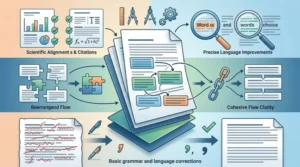
Professional editors assess six key qualities: relevance, completeness, critical analysis, logical flow, citation accuracy, and language clarity; addressing these criteria before submission significantly increases your chances of acceptance.
A strong manuscript lives or dies by the quality of its literature review. Whether you are preparing your first journal submission or revising a manuscript after peer review, understanding what is literature review in research is essential. The literature review is not just a list of papers you have read. It is a focused, critical synthesis of existing knowledge that shows editors and reviewers why your study matters.
For authors submitting to peer-reviewed journals, a weak literature review can lead to rejection — even when the research itself is solid. Editors and peer reviewers look closely at this section to assess whether the manuscript is grounded in relevant, current evidence. Getting it right is one of the most impactful steps you can take before submission. Here are six key things every researcher should know about the literature review in research manuscripts.

1. A Literature Review Is More Than a Summary
Many authors make the mistake of treating the literature review as a simple list of previous studies. In reality, it must do much more. A literature review should compare findings across studies, assess the strength of different research methods, and synthesize patterns in the existing evidence.
According to peer review guidance from Wiley’s reviewer guidelines, reviewers are instructed to check whether references adequately support the manuscript’s claims and whether any significant studies are missing. A descriptive list of sources does not meet this standard. Your literature review must demonstrate critical thinking and analytical depth.
This means you need to:
- Compare the methods and findings of key studies
- Highlight agreements and contradictions in the literature
- Evaluate the quality of evidence across sources
- Show how patterns in the literature support your research question
If your manuscript’s literature review reads like a series of one-sentence summaries, it likely needs revision before submission. You can learn more about strengthening this section by exploring resources in the knowledge center at San Francisco Edit.

2. It Establishes the Rationale for Your Study
One of the primary purposes of a literature review in a research manuscript is to justify why the study was needed. Peer reviewers and editors want to understand what gap in knowledge your research addresses. The literature review is where you make that argument clearly and persuasively.
A well-constructed literature review demonstrates that:
- The research question is grounded in existing knowledge
- A gap or unresolved question exists in the field
- The current study is designed to address that gap
- The work contributes something meaningful to the field
Without this rationale, reviewers may question whether the study was necessary at all. This is one of the most common reasons manuscripts are rejected early in the review process. To understand the full structure of a well-prepared submission, see our guide on 11 Essential Steps to Write a Manuscript for Publication.
3. Scope and Focus Are Essential
A common problem in manuscript literature reviews is that they are too broad. Authors sometimes try to cover everything ever written on a topic. This weakens the section by diluting its relevance and making it harder for readers to follow the argument.
A strong literature review has a clearly defined scope. It is guided by the manuscript’s specific research question. Every source included should be directly relevant to that question. Sources that are tangential or only loosely related should be removed or kept to a minimum.
To maintain focus, consider these steps:
- Write your research question at the top of your outline before drafting the review
- Evaluate each source by asking whether it directly informs your question
- Group related studies together by theme or methodology, not by date alone
- Keep the narrative tight and logically connected throughout
A focused literature review is easier to read, easier to assess, and far more persuasive to peer reviewers. For additional guidance on how to structure this section properly, visit our article on how to write a literature review for a research paper.
4. Source Quality Determines Review Credibility
Not all references carry equal weight. Editors and peer reviewers pay close attention to the types of sources cited in a literature review. Primary, peer-reviewed research published in reputable journals carries the most credibility. Weak secondary sources, textbooks, or non-peer-reviewed material can undermine the manuscript’s authority.
When selecting sources for your literature review, use trusted academic databases. PubMed is one of the most authoritative sources for biomedical and life sciences research. Other reliable databases include Web of Science, Scopus, and EBSCO.
Here is a quick guide to evaluating source quality:
| Source Type | Credibility Level | Recommended for Literature Review? |
|---|---|---|
| Primary peer-reviewed journal articles | High | Yes — strongly preferred |
| Systematic reviews and meta-analyses | High | Yes — excellent supporting evidence |
| Academic textbooks | Moderate | Use sparingly for background only |
| Conference abstracts | Low to Moderate | Only if peer-reviewed and relevant |
| Websites and grey literature | Low | Generally not recommended |
Ensuring your citations are reliable and traceable is a core part of preparing a manuscript that passes peer review. The scientific editing team at San Francisco Edit routinely checks references for accuracy, relevance, and retrieval during the editing process.
5. Currency of Sources Matters to Reviewers
Peer reviewers actively check whether the literature cited is up to date. A manuscript that relies heavily on studies from a decade ago — without acknowledging more recent findings — sends a signal that the authors have not stayed current in their field. This can result in requests for major revisions or outright rejection.
As a general rule, most of your cited literature should be from the past five to seven years. Older landmark studies are still appropriate to cite when they are foundational to the field. However, they should be supplemented with recent evidence.
To keep your literature current:
- Set up alerts in PubMed or Scopus for your research topic
- Search for new publications in the three to six months before submission
- Review reference lists of recent papers you have cited to find additional relevant sources
- Check whether any landmark studies have been updated, retracted, or superseded
Staying on top of the current literature also strengthens the discussion section of your manuscript. See our guide on how to write a discussion section for a research paper for practical advice on linking your findings to the existing evidence base.
6. Editors Look for These Specific Qualities in a Literature Review
Understanding what manuscript editors and peer reviewers actually assess in a literature review helps you write one that meets their expectations. The review process is rigorous. Knowing the criteria in advance gives you a clear target to aim for.
When professional manuscript editors evaluate a literature review, they typically check for the following:
- Relevance: Are all cited sources directly related to the research question?
- Completeness: Are any significant studies missing from the review?
- Critical analysis: Does the review compare and evaluate sources, or just list them?
- Logical flow: Does the narrative build a coherent argument toward the study’s rationale?
- Citation accuracy: Are all references correctly formatted and retrievable?
- Language clarity: Is the writing clear, precise, and free of ambiguity?
For non-native English authors, language clarity is often the biggest challenge. Imprecise phrasing can obscure the logic of even a well-constructed literature review. This is where professional language editing can make a significant difference to the overall quality of the manuscript.
How Literature Reviews Differ Between Original Research and Review Articles
It is worth noting that the role of the literature review differs slightly depending on the type of manuscript. In an original research article, the literature review typically appears in the introduction. Its purpose is to provide context and justify the study design. In a standalone review article, the literature review IS the primary content of the paper.
As Taylor & Francis notes in its author guidance, a review article does not present new experimental results. Instead, it synthesizes and evaluates existing research on a topic. This distinction matters when you are deciding how to structure your manuscript and how much space to devote to reviewing previous work.
For guidance on writing a standalone scientific review, see our resource on how to write a scientific review article that gets published. You can also explore 10 strong examples of literature review in a research paper for practical models to follow.
Common Mistakes Authors Make in Literature Reviews
Even experienced researchers make predictable errors in their literature reviews. Knowing these pitfalls in advance helps you avoid them and produce a stronger manuscript on your first draft.
The most frequent mistakes include:
- Including sources that are not directly relevant to the research question
- Describing each study in isolation rather than synthesizing across them
- Failing to identify or articulate a clear gap in the existing literature
- Over-relying on older studies while ignoring recent publications
- Using poorly formatted or inaccurate citations that reviewers cannot verify
- Writing in unclear or overly complex language that obscures the argument
Avoiding these errors improves your chances of clearing the initial editorial screening stage. For a complete checklist of what makes a manuscript ready for submission, explore our guide on how to get your research manuscript ready for a published paper.
How Professional Editing Strengthens Your Literature Review
Even when the research is strong and the sources are appropriate, the writing itself can undermine the literature review. Sentence structure, word choice, and logical transitions all affect how clearly the argument comes across. For authors who are not writing in their first language, these challenges are especially significant.
Professional manuscript editing addresses these issues directly. Editors trained in your subject area can identify missing references, flag logical gaps, improve sentence clarity, and ensure the overall argument flows from the literature to the study rationale. You can also explore resources on scientific editing for non-native English speakers to understand how targeted editing supports publication success.
Reviewing the reasons why scientific manuscripts are rejected by journals can also help you identify weaknesses in your literature review before submission. Additionally, resources on literature search strategies in science offer practical tools for building a more complete and credible evidence base. For those using citation databases, learning how to use the new PubMed efficiently can help you locate and verify sources quickly.
Conclusion
Understanding what is literature review in research is not an academic formality. It is a practical skill that directly influences whether your manuscript gets accepted or rejected. A strong literature review demonstrates that you know the field, have identified a genuine gap, and have designed your study to address it. It is critical, focused, current, and grounded in high-quality sources.
Whether you are a PhD candidate submitting for the first time, a medical professional preparing a clinical study, or an established faculty member managing multiple submissions, the quality of your literature review matters. San Francisco Edit’s team of PhD-trained editors works with authors across all scientific and medical disciplines to strengthen manuscripts for peer-reviewed publication — with a 98% acceptance rate across edited papers.
Ready to give your manuscript the best possible chance of acceptance? Submit your manuscript for professional editing and let our expert team help you build a literature review that meets the highest publication standards.
FAQs
Q: What is the purpose of a literature review in a research manuscript?
A: The literature review provides the context and rationale for your study. It demonstrates that you understand the existing body of knowledge, identifies a clear gap your research addresses, and shows peer reviewers that your manuscript contributes meaningfully to the field.
Q: How is a literature review different from a simple summary of sources?
A: A summary merely describes what each source says. A literature review goes further by comparing studies, evaluating the strength of evidence, identifying patterns and contradictions, and building a logical argument that supports the manuscript’s research question.
Q: What types of sources are best to use in a literature review?
A: Primary peer-reviewed journal articles and systematic reviews carry the highest credibility. Databases such as PubMed, Scopus, and Web of Science are reliable starting points. Grey literature, websites, and non-peer-reviewed sources should generally be avoided or used only sparingly.
Q: How recent should the sources in a literature review be?
A: Most cited sources should be from the past five to seven years. Foundational older studies are acceptable when they are landmark contributions to the field, but they should be supplemented with more recent evidence to show that the review is current.
Q: What do manuscript editors look for in a literature review?
A: Professional manuscript editors assess relevance, completeness, logical flow, critical analysis, citation accuracy, and language clarity. They also check whether the review clearly identifies a gap in the literature and whether the research question is well-supported by the cited evidence.